
Introducing the Press Ranger Blog
We're excited to announce the launch of the Press Ranger Blog. PR is changing fast and we want to make it move even faster. There are 10,000+ businesses using Press Ranger to manage PR campaig...
Discover how a modern financial public relations strategy can build credibility and drive growth. Learn to navigate the complexities and secure your success.


Picture this: you have to explain a major business decision—say, a merger or a disappointing quarter—to a room full of people. In one corner, you have a skeptical investor. In another, a journalist looking for a headline. And over there, a team of employees worried about their jobs.
Financial public relations (FPR) is the skill of navigating that exact situation. It’s the art of being the strategic translator between a company's complex financial life and the people who care about it. Think of it as the crucial bridge that builds trust, steers market expectations, and ultimately protects your company’s hard-earned value.
At its heart, financial PR is a specialized discipline focused on managing all communication between a company and the financial world. This goes way beyond just firing off a press release when quarterly earnings are due. It’s the long-term, deliberate work of building and protecting a reputation for credibility, transparency, and sound management with anyone who has a financial stake in your business.
A general PR pro is a master storyteller for the brand and its products. A financial PR specialist, on the other hand, is more of a financial diplomat. They're fluent in the nuanced language of investors, analysts, and the financial media, ensuring that intricate financial data is not just reported, but understood.
A solid financial PR strategy doesn't just present the numbers; it weaves a compelling story around them. This narrative gives the figures context, helps manage what the market expects next, and reinforces the company's vision for the future. Without that story, your financial performance is just data, left wide open to misinterpretation, which can easily lead to stock volatility and shaken investor confidence.
Effective financial storytelling achieves several key goals:
To put it simply, the table below outlines the core functions that financial PR teams handle day in and day out.
| Function | Objective | Key Audience |
|---|---|---|
| Investor Relations | Maintain trust and provide transparent updates on performance and strategy. | Current and potential shareholders, institutional investors. |
| Media Relations | Secure accurate and positive coverage of financial news and milestones. | Financial journalists, reporters, business editors, bloggers. |
| Transaction Comms | Manage the narrative around major events like M&A, IPOs, or funding rounds. | Investors, media, employees, regulators. |
| Crisis Management | Protect the company’s reputation during financial downturns or negative events. | All stakeholders (investors, media, employees, public). |
| Corporate Reporting | Craft clear and compelling annual/quarterly reports and shareholder letters. | Shareholders, analysts, regulators. |
These responsibilities show that financial PR is far more than just damage control; it's a proactive engine for building and protecting corporate value.
The need for this kind of specialized communication is only growing. The global public relations market, which counts financial PR as a major component, was valued at around $112.98 billion in 2023 and is expected to climb to $143.19 billion by 2029. What's driving this? A relentless demand for clear, data-backed communication that builds genuine trust, especially in a digital-first world. You can find more details in the latest PR industry statistics.
Key Takeaway: Financial PR isn't a defensive shield you only pull out during a crisis. It's a forward-looking strategy for creating value by shaping how the market views your company’s financial stability and future potential.
This kind of strategic communication is absolutely vital for navigating the modern financial landscape. It ensures everyone—from individual shareholders to major investment banks—gets a consistent, clear, and credible message. To see these principles in action, it's worth exploring relevant case studies in financial services.
Ultimately, financial public relations is all about protecting and growing one of a company’s most precious assets: its reputation.

The days when financial public relations was just a press release factory, cranking out whatever the legal or finance teams handed over, are long gone. Financial PR has earned its seat at the executive table, and for good reason. Smart CEOs and CFOs now see their financial communications experts not as messengers, but as essential strategic advisors.
This isn't just a minor tweak; it's a fundamental shift in how successful companies operate. Leaders now get that every big decision—whether it’s an acquisition, a pivot in product strategy, or a new funding round—sends ripples through the market. Trying to guess how investors will react is a recipe for disaster. Proactively shaping that reaction? That’s the art of world-class financial PR.
Think of your top financial PR pro as your in-house market whisperer. They bring a crucial, outside-in perspective that a leadership team, often buried in internal operations, can easily miss. Before the company pulls the trigger on a major move, the FPR advisor is there to pressure-test the story, predict the tough questions from skeptical journalists, and get a read on how investors might respond.
This guidance is absolutely critical during make-or-break moments. Imagine a merger is on the table. The financial PR expert is the one asking the vital questions:
Getting ahead of these questions means you control the narrative from the jump. It’s the difference between announcing a decision and letting the market’s assumptions define it for you—a scenario that almost always breeds confusion and volatility.
A recent report on C-suite dynamics highlights this trend. It found that 84% of communications leaders said their executive team sought their advice more often in 2025 than in prior years. For CEOs, the number one priority was using communications to drive sustainable growth and bolster brand value.
The data is clear: financial PR is no longer a support role. It's a core driver of business strategy and value at the highest level.
It wasn't long ago that most companies only called in the financial PR team when something went wrong—a missed earnings target, a regulatory headache, or a market slide. The job was purely defensive: stop the bleeding.
Today, the playbook has flipped entirely. The role is now about proactive, offensive strategy designed to build and protect the company's value for the long haul.
A forward-thinking company bakes financial PR right into its strategic planning. That means regular check-ins about the competitive landscape, shifts in investor sentiment, and new opportunities to tell a stronger corporate story. This continuous dialogue builds a deep reservoir of trust and goodwill with the market. For younger businesses, establishing this foundation early is non-negotiable, and our guide on public relations for startups offers a solid roadmap.
This approach transforms financial communication from a string of one-off announcements into a coherent, ongoing campaign. It empowers a company to not just report its numbers, but to shape the entire context in which those numbers are judged. By making financial PR a trusted member of the C-suite’s inner circle, a business moves from merely reacting to market cycles to actively influencing them.
A truly effective financial public relations strategy isn't about one single action. It's built on several coordinated pillars, all working together. Think of it like building a house—each pillar supports a different part of the load, but together they ensure the whole structure is stable. If one pillar cracks, the integrity of the entire building is at risk.
These core components are the bedrock of any successful FPR program. They turn abstract goals into real-world results. While each one targets a specific audience and objective, they all share a common purpose: to build trust and protect the company’s value.
Let's break down these essential pillars.
At its heart, investor relations (IR) is all about managing the direct line of communication between a company and its financial backers. This goes way beyond the legally required quarterly earnings reports and annual filings. It’s the continuous, transparent dialogue that builds genuine, long-term relationships with shareholders, analysts, and potential investors.
Strong IR is proactive, not reactive. It’s about giving clear context for financial performance, spelling out the long-term vision, and being available to answer the tough questions.
When investors feel informed and respected, they're far more likely to stick with you and trust your leadership, even when facing market headwinds. This pillar is the ultimate foundation of trust.
While investor relations speaks directly to the financial community, media relations shapes how the broader market sees your company. This pillar is all about building trusted relationships with financial journalists, editors, and influential commentators. The goal is to earn fair, accurate, and, ideally, positive coverage of your company's financial story.
This isn't about "spinning" the news. It's about giving reporters timely, accurate information and making your executives available as credible sources.
A financial journalist on a tight deadline values a PR professional who provides clear, concise facts and direct access to leadership. Earning this trust means your side of the story is more likely to be heard and accurately represented during critical moments.
Getting this right requires a deep understanding of what makes a story newsworthy to a financial audience. You have to frame company milestones—like a new product launch or a strategic pivot—in terms of their impact on revenue, market share, and long-term growth. To manage this outreach, many teams rely on specialized software. If you're looking to streamline your efforts, exploring different tools for public relations can be a huge help.
No matter how well a company is doing, crises are pretty much inevitable. A market downturn, a product recall, an unexpected executive departure, or a negative analyst report can strike at any moment. Crisis communications is the pillar designed to prepare for and manage these high-stakes events to protect the company's reputation and minimize financial damage.
A solid financial PR strategy has to reach a lot of different people across many platforms. Adopting a modern multi-channel marketing strategy can amplify your impact and keep your messaging consistent everywhere.
The infographic below shows the core stages of a well-structured crisis management plan.
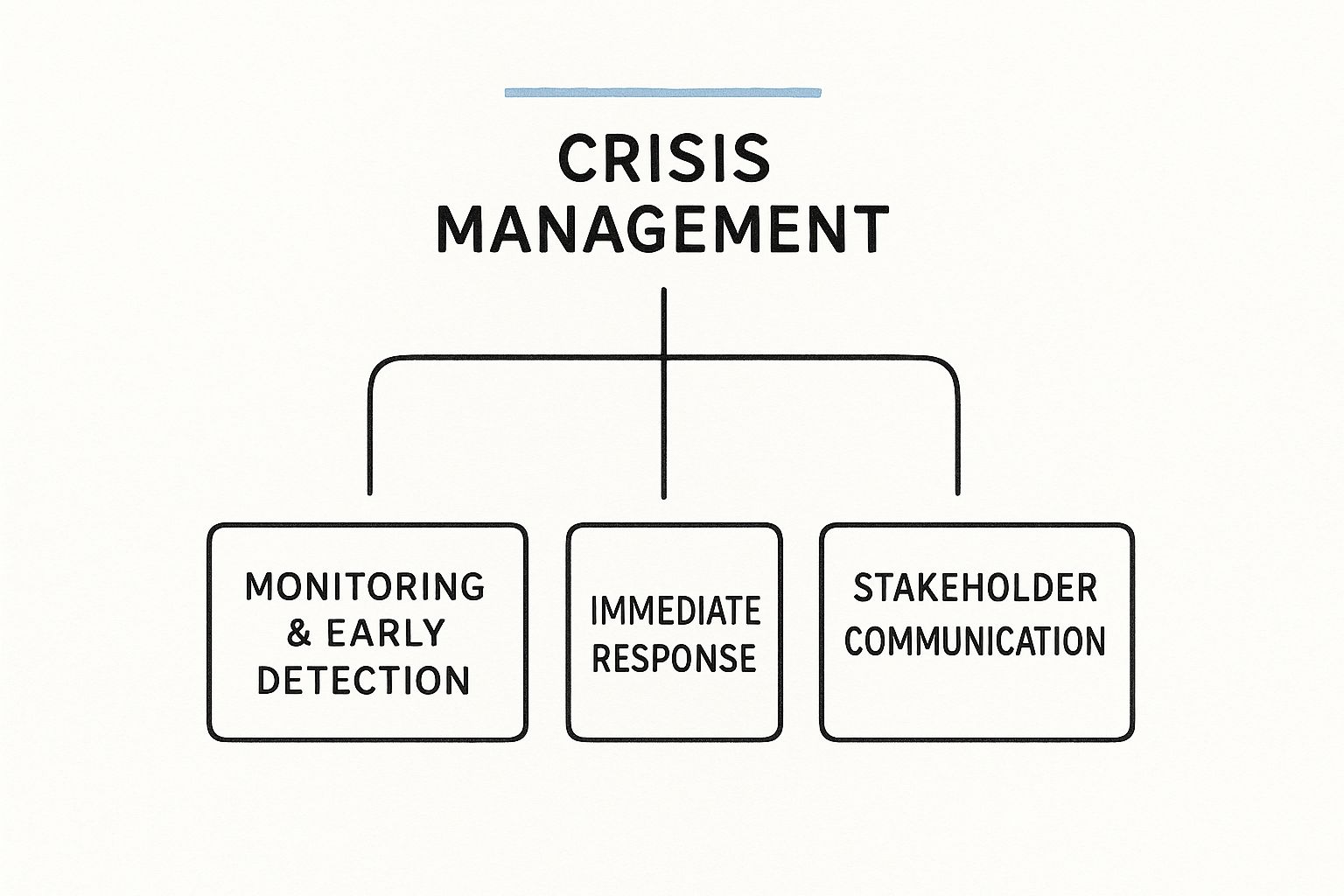
As the diagram shows, real crisis management begins long before a crisis actually hits. Monitoring and early detection are your first line of defense.
Finally, transaction communications focuses on handling the unique messaging needs of major corporate events. These are the make-or-break moments that can define a company's future.
Each of these transactions demands its own custom-built communication playbook. Mastering this pillar ensures that your most significant corporate milestones are seen as strategic successes, not desperate gambles.

Modern financial public relations is as much about data science as it is about communication. The sharpest minds in the field aren't just great storytellers anymore. They're a hybrid—part communicator, part technologist—armed with tools that give them a serious competitive edge.
Gut feelings about how the market might react are quickly being replaced by data-backed predictions. Technology is fundamentally changing how companies steer their financial narratives, shifting the entire practice from making reactive announcements to driving proactive, informed engagement. It offers a level of precision and foresight that was simply out of reach just a few years ago.
One of the biggest game-changers has been the rise of AI-powered platforms. These tools are constantly scanning the web, social media, and news outlets to deliver real-time sentiment analysis. Think of it as an early-warning system for your company’s reputation.
Instead of waiting for a negative story to hit the front page, you can spot sentiment shifting online and get ahead of concerns before they snowball. This allows financial PR teams to anticipate market reactions to news—good or bad—with far greater accuracy.
For instance, an AI tool might flag a growing number of negative conversations among influential financial bloggers about a company’s supply chain. This gives the FPR team a head start to prepare a response and brief executives before the narrative spirals out of control.
Key Takeaway: The ability to monitor and analyze sentiment in real time turns financial PR from a defensive function into a proactive one. It’s about managing the story before the story manages you.
Data analytics also gives you the power to tailor your message with surgical precision. After all, an institutional investor in Hong Kong cares about different metrics than a retail shareholder in New York. Data helps you understand these nuances and speak to each audience in a language that resonates.
Sophisticated data analytics and AI have completely reshaped how financial information is perceived, underpinning everything from media monitoring to creating personalized content for investor relations. This is especially true in major financial centers, where the ability to predict a campaign's outcome can directly impact investor confidence.
For broader market insights and a clearer view of what your competitors are doing, exploring the top free market research tools can give you a significant advantage in shaping your strategy.
The final piece of the puzzle is the shift to a digital-first mindset. Investor relations is no longer confined to stuffy boardrooms and glossy annual reports gathering dust on a shelf.
The new standard includes:
This approach acknowledges a simple reality: today’s investors and journalists are short on time and fluent in data. They expect information that is clear, concise, and immediately accessible on their screens. By embracing these tools and methods, financial PR pros can land better media coverage, build stronger investor confidence, and ultimately create more value for their companies.
Knowing the theory of financial public relations is one thing. Putting it into practice during a high-stakes corporate event is something else entirely. This is where a sharp strategy moves off the whiteboard and into the real world, showing its true worth when the pressure is on.
These moments—an IPO, a major merger, or a sudden crisis—are what define a company. They can make or break a reputation overnight. Let's walk through how a smart financial PR plan turns potential disasters into manageable challenges and major milestones into roaring successes.
Taking a company public is one of the most thrilling—and riskiest—journeys in the business world. During an Initial Public Offering (IPO), the financial PR team has two critical jobs: build genuine excitement about the company’s story and carefully navigate the legally required “quiet period.”
That quiet period is a tricky time. Regulations strictly limit what a company can say publicly to avoid artificially inflating the stock price before it lists. This creates a communication vacuum that a skilled PR team must fill without breaking the rules. The real work actually starts months before the IPO roadshow even begins.
The pre-IPO game plan involves:
A great IPO communication strategy isn't about drumming up short-term hype. It’s about building a credible, long-term investment case. The aim is to attract stable investors who are in it for the long haul, not just day traders looking for a quick profit. This sets the stage for a much more stable life as a public company.
Once the quiet period lifts, the PR team launches a coordinated media blitz to celebrate the listing. This reinforces the company’s vision for the future, making sure the first day of trading is just the start of a new chapter, not the end of the story.
When two companies merge, uncertainty becomes the biggest threat. Employees wonder about their jobs, customers worry about service changes, and investors from both sides question the move. The main job of financial PR during a merger or acquisition (M&A) is to replace that fear and confusion with a clear, unified, and exciting vision for the future.
The communication plan has to speak to every single stakeholder group directly and honestly. A generic, one-size-fits-all press release just won’t cut it.
Key Communication Streams in an M&A:
Dropping the ball on any of these can lead to top talent walking out the door, customers leaving, and a skeptical market that punishes the new company's stock. A well-executed M&A communication strategy builds a bridge of trust that connects the two organizations and the outside world.
A financial crisis—whether it's a bad earnings report, an accounting scandal, or a market meltdown—is the ultimate test for any financial PR team. In these moments, the goal flips from telling a great story to performing rapid, transparent damage control. The key is to own the narrative immediately and start rebuilding trust from the ground up.
The first 24 hours are absolutely critical. A crisis response plan should be activated the second trouble hits.
In a crisis, silence is often seen as an admission of guilt. Fast, honest, and consistent communication is the only way to contain the damage. It won't solve the core problem on its own, but it stops the reputational freefall and buys you the time you need to fix the issue and, eventually, win back the market's confidence.

Knowing the theory behind financial PR is one thing. Actually putting it to work to build investor trust and shape your company’s narrative is another game entirely. This is where your playbook comes in—it’s the actionable, strategic framework that turns abstract concepts into real-world results.
Think of it less like a rigid instruction manual and more like a coach's game plan. It provides structure and direction for your financial communications but has the built-in flexibility to adapt when market conditions inevitably shift. It's your blueprint for setting meaningful goals, defining your story, and executing with confidence.
Let's break down how to build one.
Before you even think about drafting a press release, you have to know what you’re trying to accomplish. Vague ambitions like “improving our reputation” are useless because they can’t be measured. Your goals need to be sharp, specific, and tied directly to tangible business outcomes.
So, what are you actually aiming for?
Once you have your goals, you need to define what winning looks like. These are your Key Performance Indicators (KPIs), the hard metrics that prove whether your strategy is actually working or just making noise.
Key Takeaway: A playbook is only as strong as the goals it serves. When you anchor your strategy in clear objectives and measurable KPIs, you transform your financial PR efforts from a line-item expense into a serious value driver.
With your goals locked in, it’s time to figure out who you need to talk to. Every stakeholder has different priorities, and a one-size-fits-all message will fall flat. Your primary audiences usually include:
For each of these groups, you need to develop core messages that resonate with their specific needs. While the underlying truth of your message stays consistent, the delivery changes. For a new product launch, you might frame it as market share growth for investors, a technological breakthrough for the media, and a signal of company stability for your team.
A brilliant message is wasted if it doesn't reach its intended audience. Your playbook must map out a multi-channel strategy that meets your stakeholders where they are.
The right mix of channels depends entirely on your goals. A tech company heading toward an IPO will use a very different blend of tactics than a stable, mature consumer brand.
One of the biggest forks in the road you'll face is deciding who will actually run the playbook. You can either build out your own in-house financial PR team or bring on a specialized external agency. There’s no single right answer, and each option has its own clear pros and cons.
This decision goes far beyond just the budget; it's a strategic choice about expertise, available resources, and what kind of culture you want to foster. The table below breaks down the key factors to help you weigh your options.
| Factor | In-House Team | External Agency |
|---|---|---|
| Deep Company Knowledge | Unmatched understanding of company culture, products, and history. | Brings a valuable outside perspective but has a steeper learning curve. |
| Cost Structure | A fixed overhead cost (salaries, benefits, tools). | Typically a monthly retainer; can be more cost-effective for specific projects. |
| Expertise & Network | Expertise is limited to the individuals you hire. | Offers access to a broad team of specialists and deep media/investor relationships. |
| Scalability & Flexibility | Scaling up or down requires a lengthy hiring or restructuring process. | Can quickly scale resources up for major events (like an IPO) or down as needed. |
| Dedicated Focus | 100% dedicated to your company's success. | Manages multiple clients, so focus is divided (though good agencies excel at this). |
Ultimately, the best path depends on your company's size, stage, and budget. A startup might lean on an agency to tap into an established network, while a large public company often benefits from a dedicated in-house team that lives and breathes the brand every single day.
By carefully considering each of these steps, you’re not just writing a document. You’re building a dynamic guide to control your financial narrative, grow investor confidence, and protect your most critical asset: your reputation.
Let's tackle a couple of the most common questions that come up when companies start exploring financial public relations.
This is the big one, and the answer isn't as simple as plugging numbers into a spreadsheet. Measuring the return on a financial PR investment is a mix of art and science.
On the quantitative side, you can track things like:
But the qualitative wins are just as important. Think about the direct, positive feedback you get from investors and analysts. A successful financial PR strategy is also measured by hitting major milestones, like navigating a smooth IPO or announcing an acquisition without causing panic. It's about achieving your strategic goals with confidence.
Hands down, the most critical error is waiting for a crisis to happen. Too many companies treat financial PR like a fire extinguisher—they only reach for it when the building is already on fire. That’s a reactive approach, and it almost always fails.
A truly effective strategy is proactive and continuous. It’s about building relationships with journalists and maintaining a steady drumbeat of transparent communication, day in and day out. This ongoing effort creates a deep reservoir of trust. When—not if—difficult times arrive, that trust is the most valuable asset you have.
This proactive approach is all about generating positive, credible coverage on your own terms. To see just how powerful that is, it helps to understand the difference between earned media vs paid media.
Ready to take control of your company's narrative? With Press Ranger, our AI-powered platform makes it simple to connect with the right journalists and publish your news on major financial sites. No retainers, no experience needed—just results. Start making headlines today at https://pressranger.com.
We're excited to announce the launch of the Press Ranger Blog. PR is changing fast and we want to make it move even faster. There are 10,000+ businesses using Press Ranger to manage PR campaig...

Google Ads' Smart Bidding promises automated efficiency—but when fed the wrong data, it can quietly drain your budget chasing low-quality leads.

Personalization is the heart of meaningful communication — it’s what transforms a message from generic to genuinely engaging. By tailoring your press releases to reflect the language, tone, and priorities of your audience, you make every word feel written just for them.