How to Write a Good Press Release and Get Noticed
Learn how to write a good press release that gets media coverage. Our guide offers expert tips, proven formats, and real-world examples to boost your brand.
Press releases aren't dead—they're misunderstood. Learn why press release marketing fails for most companies and how to use it correctly for SEO, brand authority, and AI search visibility.

Early on in my journey at Press Ranger, I tried running Google and Facebook ads.
My campaigns failed spectacularly. I had sky-high acquisition costs and poured a few grand into what amounted to a big pile of nothing.
Here's what I didn't say: "Ads don't work!" Of course ads work. And I know why mine didn't work. My targeting was off, my copy sucked, or my offer didn't resonate. I'm not an ads guy, so it makes sense my ads weren't very good.
But do a cursory search for "are press releases effective?" and you'll find a horde of people ready to write the entire channel off because of one release that didn't make them a million dollars.
Actually, come to think of it, that's why I started Press Ranger. I sold three companies before starting Press Ranger and in each one, I wasted thousands of dollars on PR. PR agencies, PR software, press releases. You name it, I blew money on it.
So when the time came to start a new company, I went right for the pain point because I knew there had to be a better way. So if you want to believe press releases don't work, feel free to siphon 40% of your revenue directly into Meta and TikTok but if you give me 10 minutes, I'll teach you how to use press releases to rank higher on Google, become more visible in ChatGPT, and ensure that your customers can actually Google you.
If you haven't guessed yet, this is a complete guide on Press Release Marketing and how to do it correctly in 2026.
Press releases have been around since 1906, but I don't think people started bashing them on Reddit until a bit later.
Before Press Ranger, there were two ways to do press releases.
On the high end, you could spend upwards of $2,000 per release with a legacy newswire. Then, you got surprised by hidden fees if you wanted to add more text, an image, or a link in your release. That's pretty bad, but at least the release gets published on reputable outlets and has some impact albeit with a sky-high price tag.
On the low end of the market, you could throw a digital rock and hit 50 press release services that all claim to publish your release on hundreds of places for $100 or less. The issue at this side of the market is that these links actually hurt. Not only do they not show up on Google, will not be surfaced in AI search, but the publishers are all spam sites with names you've never heard before. Doing cheap press releases can make your domain look like spam.
These used to be the only two choices. The lame part is that no matter which direction you chose- you'd feel extorted. Either you spent a ton of money on your press release to get it somewhere real or you paid nothing and got extorted on value.
There has to be a better way, right?
When I started Press Ranger, I was naive. All of the early users asked for a better way to distribute press releases and I thought I could partner with the best service and carry on building PR software. Boy, was I wrong.
I did 20 press releases for Press Ranger. I used all of the big wires and paid anywhere from $99 to $2,200 for each one. They were all terrible (even the expensive ones!) There was no guarantees, a ton of hidden fees, and even the services I thought were good turned out to be very, very bad.
So I did what anyone does who is sufficiently powered by spite: I built my own newswire. And wow did that suck. But now that it's up and running, we get to do things no one else does:
That's a long winded way of saying, "I know way too much about press releases." And after ~2 years of doing this, I wanted to share my full playbook on press release marketing so that you can use it effectively. Let's dive in.
Press release marketing is the deliberate, strategic use of press releases as a repeatable marketing channel—not a one-time announcement.
When used correctly, press releases support four core outcomes for the issuing company:
Press releases are not designed to behave like performance ads. They're not meant to replace direct outreach, content marketing, or paid acquisition. They work alongside those channels, creating a foundation that makes everything else more effective.
The disappointment most companies experience comes from a fundamental mismatch between expectation and reality. They expect instant traffic spikes and direct sales attribution. Press releases operate closer to brand building and authority establishment, with downstream effects that compound over months and years.
Most failed press releases fail for two predictable, avoidable reasons:
This is the most common failure point.
Low-end press release services publish to networks of scraper sites, content farms, and abandoned blogs. These placements have no audience, no editorial standards, and no authority with search engines.
When a press release lands on sites like "TechNewsDaily247.biz" or "BusinessWirePress.info," it creates the illusion of coverage without delivering any actual value. These sites exist purely to sell press release placements and they are not "news" nor do they do anything beneficial for the brand.
The outcome? Zero trust signals. Zero traffic. Zero benefit.
I've seen companies launch press releases with goals like:
These aren't goals. They're fantasies disconnected from how the channel actually functions.
A single press release announcing a product update won't generate front-page headlines unless there's something genuinely newsworthy. Amazon acquiring Whole Foods is newsworthy. Your SaaS adding a calendar integration is not.
Does that mean you shouldn't announce your calendar integration? Of course not, we just want to do it in a way that's going to accomplish something.
So what can we accomplish with a press release?
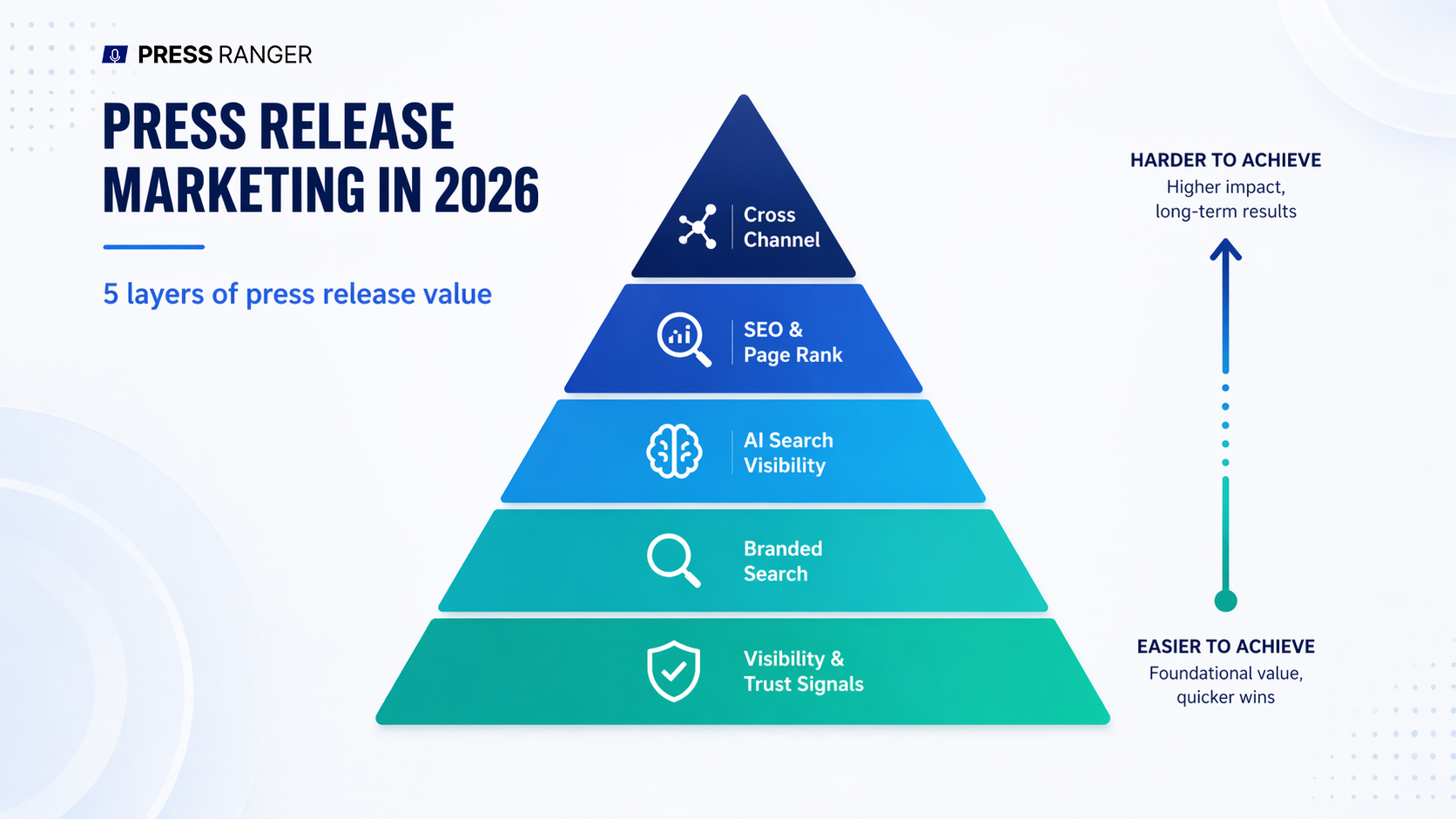
I think about press release value as a triangle with five distinct layers.
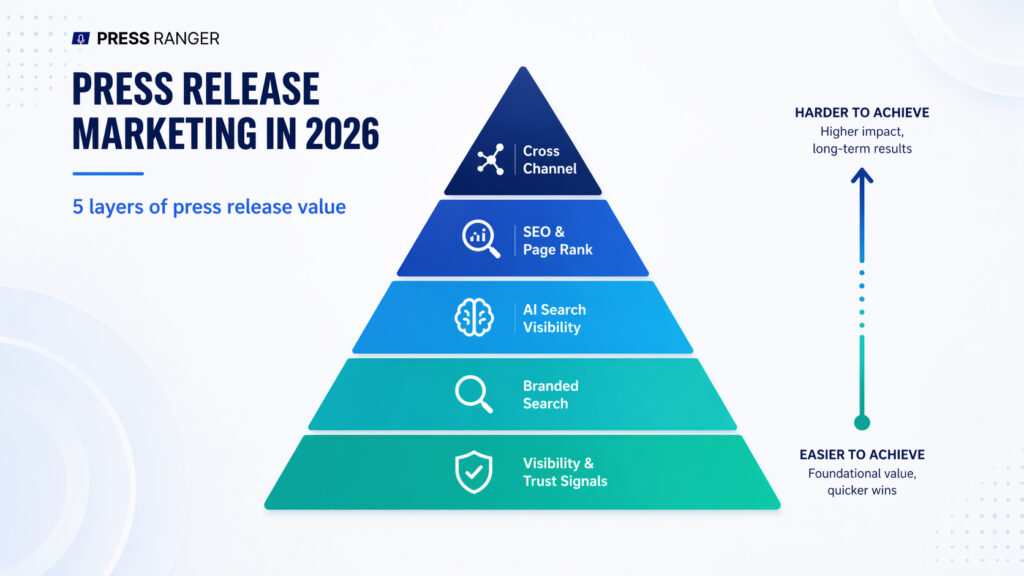
The bottom is accessible to everyone who distributes through a legitimate newswire. The top requires more planning, experience, and strategy but is still very achievable.
Every legitimate press release delivers value at the base while only carefully planned releases deliver value at the top of the triangle.
At the base of the triangle are outcomes nearly every real press release delivers:
"As Seen In" badges.
You know those publisher badges on websites that add social proof and increase conversion rates? Well, press releases can help you get those. Every press release gets published somewhere, so we can use publisher logos on our website after it does.
Very important: you need to get published on real publishers for this to be effective. Which logos has a bigger impact on social proof: FairtradeEZNews.info or Business Insider?
On Press Ranger, every release we do is guaranteed to be published on Business Insider, Market Watch, Yahoo Finance, and AP News so no matter what you announce, you get this widget for your website:

When a prospect visits your website and sees these logos, it creates instant credibility.
Backlinks and domain authority.
The placements created by a press release signal authority to Google. Yes, many of them are nofollow, but that does not matter. The domain authority and editorial context surrounding the link matter more than the link attribute itself.e
Similar to the above, high-quality publishers yield higher quality backlinks so it pays to use a legitimate press release service if you want to increase domain authority by any actual measure.
When someone Googles your company's name, what do they see? If you have a new company or it uses a common name, your users will need to sift through irrelevant results to find you and lose trust in you in the process. Getting your company to show up #1 when it's Googled is called "owning branded search" and is one of the core competencies of a press release.
Branded search is a trust moment. When prospects research your company, what appears in those results directly impacts whether they move forward or move on.
Press releases help ensure:
Many early-stage companies fail this test completely and it can be a red flag for serious buyers.
Key insight: press releases create value even if no one clicks. The presence of coverage matters as much as the traffic it generates. Press releases are often used in reputation management for this purpose alone.
We worked with a B2B SaaS company that published quarterly press releases for two years. When they saw low clicks coming from press releases, they almost canceled the program.
Then they ran a survey asking enterprise customers what made them comfortable signing six-figure contracts. Thirty-eight percent mentioned seeing media coverage during their research phase.
The press releases didn't drive traffic. They removed doubt during the consideration stage of a six-month sales cycle. That's a completely different value proposition than direct response marketing.
Search behavior is shifting faster than most marketing teams realize.
More users now ask questions inside ChatGPT, Perplexity, Microsoft Copilot, Google Gemini, and Grok instead of typing traditional queries into Google.
These AI systems don't crawl and index the web the same way search engines do. They train on specific data sources and prioritize information from trusted publishers.
When someone asks ChatGPT "What are the leading companies in [your category]?" or Perplexity "Who's innovating in [your space]?" the answer comes from content those systems have been trained on.
Press Ranger has been building for AI search since ChatGPT could search the web in October of 2024. Our proprietary content engine, AIWire, guarantees that our press releases get indexed by AI chatbots which helps you and your clients improve your rank and visibility within the newest digital marketing channel in a decade.
For deeper context on this emerging channel, we published a complete guide on using press releases for AI search visibility that walks through the mechanics, opportunities, and tactical implementation of ranking higher on AI search.
SEO is another key reason businesses use press releases and it's one that requires the most strategic planning. Press releases can improve your Google rank for specific keywords, but there are some caveats:
Existing authority matters. A brand with existing domain authority, quality backlinks, and content will see bigger increases from press releases than a brand new company with no foundation.
Keyword selection matters. Long-tail keywords and branded queries are easier than highly-competitive keywords. "AI-powered project management for remote teams" or "ProjectTool alternatives" offer better opportunities than generic terms. Lucky for you, long-tail keywords also mimic the sub-queries that AI chatbots use to determine answers provided by LLMs.
Competition matters. A single press release from a low-authority company won't outrank established players for high-volume, competitive keywords. You need to build a foundation of content for a brand before targeting high-intent commercial keywords with press releases.
Very direct summary: press releases can improve SEO but they don't overwrite competitive reality.
Contrary to what you read on the internet, a single press release can have a big impact. We see releases all the time that secure Google AI overviews, get cited on ChatGPT, and rank on Google for a competitive term. That's because a single release isn't just one piece of content. Press releases regularly create upwards of 500 individual placements, but here's a huge secret in press releases.
You can use these together with other channels. You can amplify earned media results, announce financial disclosures, stack and reference previous releases,
Some examples:
Layering press releases into your other marketing channels is easily their most powerful use case but it requires planning and execution to do correctly. My inbox is always open if you want to build a strategy for your brand.
Press release marketing success doesn't look like viral traffic spikes or immediate sales. It looks like structural changes to how your brand is perceived.
Success indicators:
These outcomes take time. They require consistency. They need quality distribution.
When all three align, press releases become one of the most cost-effective channels for building long-term authority.
Press Ranger exists for companies that want real press release distribution without the friction of traditional PR.
Core offering:
Who it's built for:
Interest in press release marketing is skyrocketing in 2026 because AI search is consistently using press releases when making recommendations to users. In addition, AI chatbots use brand citations as a proxy for authority and nothing is more effective at increasing brand citations as press releases.
How much does quality press release distribution cost?
Quality distribution ranges from $299 to as high as $3,000 depending on targeting, features, and publisher guarantees. Press Ranger has two tiers, Premium and Gold. Both guarantee that the release is published on Business Insider, Market Watch, Yahoo Finance, and AP News but Gold also includes AIWire which guarantees AI chatbot indexing.
How often should companies publish press releases?
Effective cadence ranges from monthly (for high-growth companies) to quarterly (for established brands). Consistency matters more than frequency. Irregular bursts of activity build less authority than predictable publishing patterns.
Do press releases still help with SEO?
Yes. When done correctly, Press releases generate backlinks from high-authority publishers, support brand search results, and help establish topical authority.
How do press releases support AI search?
AI systems like ChatGPT, Perplexity, and Copilot train on and reference trusted publisher content. Press releases distributed to major outlets get indexed in these systems, making your brand appear in AI-generated responses to relevant queries. Press Ranger's AIWire is a content engine purpose-built to index content into LLMs and is included on all Gold-tier press releases.
Can press releases help with fundraising?
Yes, significantly. Investors research companies extensively. Brand search results filled with coverage from Business Insider, Yahoo Finance, and MarketWatch create confidence. Press releases don't replace traction, but they remove friction during due diligence.
How long does it take to see results from press releases?
Within Press Ranger, initial placements and backlinks appear within 2 hours of distribution and are complete after 48 hours. Branded search impact becomes visible a few days after a release. Often times, our releases are cited in chatbots like ChatGPT and Google AI overviews within a few days.
Ready to start publishing press releases the right way?
Learn more about Wholesale press release distribution and get started with your first release today. No contracts. No hidden fees. Just quality distribution to publishers that actually matter.
About the Author: Steve Beyatte is the founder and CEO of Press Ranger. This guide reflects his real experience with press release marketing across B2B SaaS, fintech, and growth-stage companies. Steve built Press Ranger to give enterprise-grade PR tools to every business because he thinks everyone should be allowed to tell their story.
Learn how to write a good press release that gets media coverage. Our guide offers expert tips, proven formats, and real-world examples to boost your brand.
Struggling to get noticed? Explore 8 powerful press release headline examples with deep analysis and tips to help you write headlines that get results.
Discover the best press release distribution service to boost your PR strategy. Find the top options for effective and reliable distribution.