7 Powerful Email Pitch Sample Templates for 2025

Discover 7 powerful email pitch sample templates with in-depth analysis. Learn proven strategies to write pitches that get replies and drive results.

Posted on August 10, 2025 Blog
7 Powerful Email Pitch Sample Templates for 2025

In a world of overflowing inboxes, a generic email pitch is a guaranteed path to the trash folder. The difference between a deleted email and a game-changing opportunity often comes down to strategy, not just luck. This guide moves beyond theory to provide a deep, strategic breakdown of seven distinct types of email pitches that actually work. We won't just show you an email pitch sample; we'll dissect its psychology, structure, and tactical application so you can replicate its success.

This article is designed to be a practical playbook. We will analyze the core mechanics behind emails that don't just get opened-they get responses. You will learn the specific, actionable methods behind crafting a compelling cold outreach email, leveraging a warm introduction, and creating an irresistible curiosity gap.

The goal is to equip you with proven frameworks you can adapt for your own outreach campaigns, whether you're in marketing, sales, or building a startup. To complement these specific pitch types and ensure overall success, you can also explore broader guidance on effective professional email examples and templates. Let's dive into the samples that turn prospects into partners.

1. The Cold Outreach Pitch: Breaking the Ice with Precision

A cold outreach pitch is your digital handshake with a prospect who has never heard of you. Its primary goal is to cut through inbox clutter by being immediately relevant and valuable. This email pitch sample succeeds not by shouting the loudest, but by demonstrating that you've done your homework and have a genuine reason for reaching out. It’s a targeted strike, not a blanket bombing campaign.
The Cold Outreach Pitch: Breaking the Ice with Precision

When crafting your initial message to new contacts, leveraging effective cold email templates for sales can significantly improve your chances of breaking the ice. These templates provide a solid structure, which you can then infuse with deep personalization to make your message stand out.

Strategic Breakdown

The power of a great cold email lies in its structure. It moves the reader from "Who are you?" to "Tell me more" in just a few sentences. This is achieved by focusing on the recipient, not on yourself.

  • The Personalized Hook: The opening line is critical. It must connect directly with the recipient. This could be a reference to a recent company announcement, a post they shared on LinkedIn, or an award they won. It shows you're not just another mass email.
  • The Problem Agitation: Briefly touch upon a common pain point relevant to their role or industry. For example, for a marketing manager, you might mention the challenge of improving ROI on ad spend. This shows you understand their world.
  • The Value Proposition: This is where you introduce your solution, but frame it as a benefit, not a feature. Instead of saying, "Our software has an AI-powered analytics dashboard," say, "Our clients reduce their ad spend by an average of 20% by identifying wasted budget."
  • The Low-Friction Call to Action (CTA): Avoid asking for a 30-minute meeting right away. A softer CTA like, "Would you be open to a 15-minute call next week to explore if this could be valuable for [Company Name]?" reduces the perceived commitment and increases response rates.

Actionable Takeaways

To make your cold outreach effective, focus on these key tactics:

  1. Subject Line is King: Keep it short, personalized, and intriguing. "Idea for [Company Name]" or "Question about your recent project" often works better than a salesy title.
  2. The 20-Second Rule: Write your email so it can be fully understood in under 20 seconds. Busy professionals scan, they don't read. Use short sentences and bullet points.
  3. Prove You Did Your Research: Mentioning a specific competitor, a quote from their CEO, or a detail from their latest case study proves this isn't a generic blast. This is a core element of a successful email pitch sample.

2. The Warm Introduction Pitch: Leveraging Trust for Instant Access

A warm introduction pitch is the most powerful way to connect with a high-value prospect, as it leverages a mutual connection to establish immediate credibility. This approach bypasses the usual skepticism of cold outreach because it comes with an implicit endorsement. The shared relationship acts as social proof, significantly increasing open rates and securing positive responses. It transforms a cold ask into a trusted referral.

Building the strong professional relationships needed for these introductions is a long-term game. To learn more about nurturing these connections, you can explore strategies on how to build media relationships that last. This foundation is what makes a warm introduction email pitch sample so effective.

Strategic Breakdown

The effectiveness of a warm introduction hinges on respecting the relationship dynamics between all three parties. The email must honor the person making the introduction while clearly and concisely communicating value to the target recipient.

  • Acknowledge the Connector: The very first line should thank the mutual connection and state their role in the introduction. This immediately establishes context and credibility. For example, "Thanks, [Connector's Name], for making this introduction."
  • Provide Clear Context: Briefly explain how you know the connector and why they thought a conversation would be valuable. This reinforces the legitimacy of the introduction and helps the recipient understand the relevance.
  • Deliver a Concise Pitch: Get straight to the point. State who you are and the specific, compelling reason for the connection in one or two sentences. Focus entirely on the potential value for the recipient, not on a lengthy bio about yourself.
  • Take Ownership of Next Steps: Make it easy for the recipient. Clearly propose the next action and take the initiative away from the busy prospect. A great CTA is, "I've moved [Connector's Name] to BCC to spare their inbox. Would you have 15 minutes next week to discuss this further?"

Actionable Takeaways

To execute a warm introduction flawlessly, focus on clarity, respect, and efficiency.

  1. Get Permission First: Never use someone's name without their explicit consent. Always ask your mutual connection if they are comfortable making an introduction before you draft anything.
  2. Make the Introduction Easy: Offer to write a "forwardable email" for your connector. This is a short, self-contained message they can easily forward to the target, saving them time and ensuring your message is framed correctly.
  3. Move the Connector to BCC: After the initial introduction is made, immediately reply and move the connector to the BCC line. This shows respect for their time and keeps their inbox clean. This simple step is a hallmark of a professional email pitch sample.

3. The Problem-Solution Pitch

The problem-solution pitch is a classic and highly effective approach that hinges on empathy and deep industry knowledge. It begins not by introducing your product, but by articulating a specific, pressing problem that you know your prospect is facing. This method, rooted in methodologies like SPIN Selling and Solution Selling, establishes immediate relevance and positions you as a knowledgeable expert rather than just another vendor.

This type of email pitch sample works by creating a narrative: you identify a shared challenge, validate the prospect's struggle, and then elegantly introduce your service as the logical resolution. It shows you've done more than just find their email address; you understand their business context.

Strategic Breakdown

A powerful problem-solution email follows a clear, persuasive path. It guides the reader from recognizing a pain point to seeing a clear path toward a solution, with your offering at the center.

  • Problem Identification: Start by stating a well-researched, specific problem. Use data or reference a common industry challenge. For example, "With B2B buyer journeys now being 80% digital, many sales teams struggle to identify high-intent leads before competitors do."
  • Consequence Agitation: Briefly expand on the negative consequences of this problem. What does it cost them? This might be lost revenue, wasted resources, or security vulnerabilities. This step makes the problem feel more urgent.
  • Solution Introduction: Present your product or service as the direct solution to the specific problem you just outlined. Frame it clearly as the antidote to their pain. For instance, "Our platform addresses this by using AI to analyze buying signals across the web, flagging accounts ready for outreach."
  • Proof & Credibility: Back up your claim with a concise piece of evidence. A statistic, a mini-case study, or a mention of a well-known client can work wonders. Example: "Companies like [Similar Company] use us to get a 35% uplift in qualified pipeline."
  • Clear Call to Action (CTA): The CTA should offer to provide more information on solving the problem, not just on buying your product. A great CTA is, "Worth a brief chat to see how we could apply this for [Company Name]?"

Actionable Takeaways

To execute a flawless problem-solution pitch, focus on these critical elements:

  1. Lead with One Problem: Don't list every possible pain point. Focus your entire email on solving a single, significant challenge. This creates a sharper, more impactful message.
  2. Use Data to Define the Problem: Instead of saying "recruitment is hard," say "industry reports show it now takes an average of 42 days to fill a tech role." Specificity builds credibility and captures attention.
  3. Frame Your CTA Around a Solution: Your call to action should feel like the next logical step in solving their problem. "Learning more" is less intimidating than "getting a demo." This is a key detail for a high-performing email pitch sample.

4. The Social Proof Pitch: Building Trust with Authority

A social proof pitch leverages the power of influence by demonstrating that respected peers or industry leaders already trust and benefit from your solution. Instead of focusing on what you can do, it highlights what you have already done for others. This approach taps into a powerful psychological trigger: people are more inclined to adopt a solution if they see others, especially those they admire, have done so successfully.
The Social Proof Pitch

This email pitch sample works by immediately establishing credibility and creating a sense of FOMO (fear of missing out). It shifts the conversation from a speculative "what if" to a proven "here's how," making your claims more tangible and believable. Early enterprise pitches from companies like Slack, which mentioned usage by organizations like NASA, are classic examples of this strategy in action.

Strategic Breakdown

The effectiveness of a social proof email comes from its ability to borrow credibility from established names. It tells the prospect, "You're in good company," which de-risks their decision to engage with you.

  • The Credibility-First Opener: Start by immediately mentioning a well-known client or a compelling result. For example, "We recently helped [Respected Competitor/Industry Leader] achieve a 40% increase in lead conversion." This opener grabs attention and builds instant trust.
  • The Relevance Bridge: Directly connect the success of your existing client to the prospect's situation. State why this result is relevant to them. "Given your focus on expanding into the European market, just like [Client Name], I thought our approach might be of interest."
  • The Quantifiable Proof: Back up your claims with specific, hard numbers. Vague statements like "we improved their sales" are weak. Concrete metrics like "we helped them add $1.2M to their sales pipeline in Q3" are far more impactful.
  • The Inclusive Call to Action (CTA): Frame the next step as an opportunity for the prospect to join an exclusive group of successful companies. A CTA like, "Happy to share the case study on how we achieved this for them and explore if a similar strategy could work for [Prospect's Company]?" feels collaborative and value-driven.

Actionable Takeaways

To effectively deploy a social proof pitch, consider these tactics:

  1. Relevance is Paramount: Use client examples that are similar to your prospect in size, industry, or the challenges they face. Mentioning a Fortune 500 client to a small startup might be intimidating rather than inspiring.
  2. Get Explicit Permission: Always ensure you have clear, written permission from your clients before using their names or data in your outreach. A breach of trust here can damage your reputation significantly.
  3. Lead with the Metric: Don't bury your most impressive statistic. Place it in the subject line or the very first sentence to maximize impact. An excellent email pitch sample using this technique might have a subject like: "How [Client Name] cut costs by 30%."

5. The Personalized Value Pitch

The personalized value pitch is an evolution of cold outreach, moving beyond surface-level personalization into deep, strategic customization. Its purpose is to show the prospect not just that you know their name and company, but that you genuinely understand their business model, recent challenges, and specific opportunities. This highly researched email pitch sample proves you've invested significant effort before even hitting "send," instantly differentiating you from 99% of the competition.

This approach is particularly powerful in enterprise sales or when pitching high-value services. It demonstrates an expert-level understanding of the prospect's world, positioning you as a potential strategic partner rather than just another vendor. It’s about connecting your solution directly to a tangible, researched business initiative or pain point.

Strategic Breakdown

The strength of this pitch lies in its irrefutable evidence of research. It’s built on a foundation of specific data points that directly tie your value proposition to the prospect's current reality.

  • The Hyper-Specific Hook: The opening must immediately reference a specific, non-obvious detail. This could be a quote from their CEO in a recent earnings call, a strategic challenge mentioned in their annual report, or a new market they've entered.
  • The Insightful Problem: Connect your research to a specific problem or opportunity. For example, "I noticed in your Q3 report that you're expanding into the Latin American market, which often presents challenges with payment processing compliance."
  • The Tailored Solution: Present your value proposition as the direct solution to that specific, identified challenge. Instead of a generic benefit, you offer a bespoke one: "Our platform helped [Similar Company] navigate these exact cross-border payment regulations, reducing their compliance risk by 40% during their European expansion."
  • The Collaborative Call to Action (CTA): The CTA should be consultative. Try something like, "Would you be open to a brief discussion on how we might apply a similar framework to your LATAM expansion?" This frames the next step as a strategic collaboration.

Actionable Takeaways

To execute a personalized value pitch effectively, you must become a business detective:

  1. Become a Research Expert: Set up Google Alerts for your top target companies. Use tools like Owler or Crunchbase to track funding, acquisitions, and leadership changes. This research forms the backbone of a successful email pitch sample.
  2. Analyze Public Documents: Dive into annual reports, investor presentations, and press releases. These documents are gold mines for understanding a company's strategic priorities and stated challenges, which you can then address directly. For a deeper understanding of how to leverage such insights in your outreach, you can explore various digital PR strategies that rely on similar research principles.
  3. Connect to Their Tech Stack: Use tools like BuiltWith to understand a prospect's current technology stack. Mentioning how your solution integrates with or improves upon their existing tools shows an incredible level of detailed preparation.

6. The Curiosity Gap Pitch

The Curiosity Gap pitch is an email designed to create powerful intrigue by hinting at valuable information without fully revealing it. This psychological approach leverages the human brain's natural desire for closure, compelling the recipient to respond to learn more. Instead of leading with a direct offer, it presents a mystery that only a reply can solve, making it incredibly difficult for prospects to ignore.

The Curiosity Gap Pitch

This method, popularized in modern marketing by figures like Brian Dean, transforms a standard outreach into an irresistible puzzle. By creating a knowledge gap, you position yourself as the sole holder of the missing piece of information, making your follow-up seem essential rather than interruptive.

Strategic Breakdown

The effectiveness of this pitch hinges on creating an information imbalance that the recipient feels a strong need to correct. It moves the conversation from a sales context to one of discovery and insight.

  • The Intriguing Subject Line: The goal is to spark curiosity immediately. Subject lines like "The mistake 90% of [Industry] companies make" or "A quick question about [Prospect's Website]" create an open loop that begs to be closed.
  • The Knowledge Gap Opener: The first sentence presents a specific but incomplete observation. For example, "I noticed something interesting about your website's traffic source that your top competitors are doing differently." This implies you have exclusive data.
  • The Implied Value: You don't state your value proposition directly. Instead, you allude to the valuable insight or data you possess. The value is the information itself, which they can only get by engaging with you.
  • The "Unlock" Call to Action (CTA): The CTA is framed as the key to revealing the information. Instead of asking for a meeting, you offer to share the insight: "Happy to share what I found - is this the best email to send it to?"

Actionable Takeaways

To execute a Curiosity Gap pitch successfully, you must balance mystery with credibility:

  1. Deliver on the Promise: This is the most critical rule. If a prospect responds, you must provide genuine, high-value information. Failure to do so will destroy trust instantly and harm your reputation.
  2. Be Specific, Not Vague: "I have an idea for your company" is weak. "I found a potential optimization on your checkout page after analyzing [Competitor A]" is strong because it’s specific and credible.
  3. Keep it Professional: While you're creating intrigue, avoid clickbait or overly dramatic language that can come across as unprofessional or land your email in the spam folder. This is a crucial element for a successful email pitch sample using this technique.

7. The Mutual Interest Pitch: Building Rapport Through Common Ground

A mutual interest pitch moves beyond professional commonalities to build a personal connection. It's based on the timeless principle that people prefer to do business with individuals they know, like, and trust. This email pitch sample leverages shared interests, backgrounds, or experiences to create an immediate, genuine rapport before introducing the business proposal. It’s about finding a human connection in a digital world.

This approach transforms a cold interaction into a warm one by showing you see the recipient as a person, not just a job title. Researching their LinkedIn profile, personal blog, or social media activity can uncover valuable connection points, such as attending the same university, sharing a passion for a particular sport, or having worked at the same company in the past.

Strategic Breakdown

The strength of this pitch lies in its ability to establish a bond quickly, making your business proposition feel more like a friendly suggestion than a hard sell. It artfully transitions from personal connection to professional value.

  • The Sincere Common Ground Opener: The first line immediately establishes a shared link. This isn't flattery; it's a genuine point of connection. Examples include, "I noticed from your LinkedIn that you're also a marathon runner," or "As a fellow [University Name] alum, I wanted to reach out."
  • The Bridge to Business: After the personal hook, you need a smooth transition. A simple phrase like, "On a professional note," or "Given your role at [Company Name]," effectively pivots the conversation toward the reason for your email.
  • The Contextual Value Proposition: Connect your solution to their world, but now through the lens of a shared understanding. The initial rapport makes your value proposition more likely to be considered thoughtfully.
  • The Conversational Call to Action (CTA): The CTA should feel like a natural next step in a conversation, not a demand. Instead of a formal meeting request, try something like, "If you're open to it, I'd be happy to share a few ideas. Let me know what you think."

Actionable Takeaways

To execute a mutual interest pitch effectively, focus on authenticity and relevance.

  1. Conduct Deep, Respectful Research: Use LinkedIn, Twitter, and company bios to find authentic connections. Look for hobbies, alma maters, volunteer work, or past employers. Tools like Crystal can offer insights into their communication style.
  2. Keep the Personal Touch Brief: The mutual interest is the key to open the door, not the entire conversation. Mention it in the first one or two sentences, then pivot to the professional purpose of your outreach.
  3. Ensure Authenticity: Only mention interests you genuinely share or can speak to. If you claim to be a fan of their favorite sports team but know nothing about it, the attempt can backfire and damage your credibility. This is a crucial part of a successful email pitch sample.

7 Email Pitch Types Comparison

Pitch Type? Implementation Complexity⚡ Resource Requirements? Expected Outcomes? Ideal Use Cases⭐ Key Advantages
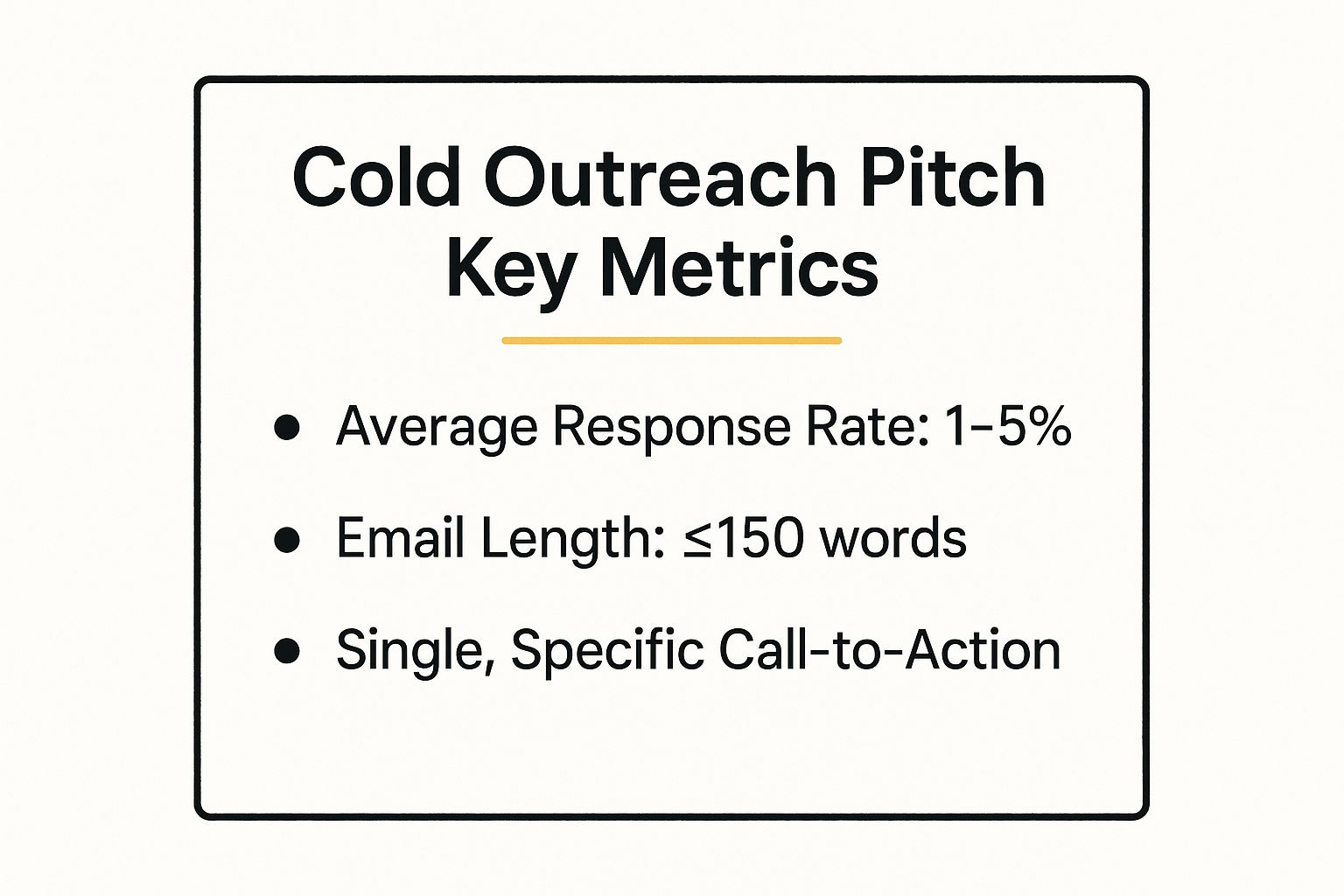
The Cold Outreach PitchModerate – requires significant research timeLow – scalable email campaignsLow response rate (1-5%)B2B software sales and serviceCost-effective; direct to decision-makers
The Warm Introduction PitchLow to Moderate – depends on network availabilityMedium – relies on mutual connectionsHigher response rate (15-30%)High-value partnerships, investmentsHigh trust and credibility; higher open rates
The Problem-Solution PitchModerate – needs deep industry knowledgeMedium – research and customizationModerate conversion rate (8-12%)Complex B2B solutions & consultingBuilds relevance and expertise; consultant-level credibility
The Social Proof PitchLow – requires client permission and accessLow to Medium – client assets neededHigh persuasion (85% find compelling)Established companies with big client rostersBuilds instant credibility; reduces perceived risk
The Personalized Value PitchHigh – very time-intensive per emailHigh – detailed, tailored researchHighest engagement ratesEnterprise sales and high-value dealsGenuine interest; differentiates outreach
The Curiosity Gap PitchLow to Moderate – creative copywriting neededLow – brief emails, strategic hooks25-40% higher open ratesContent marketing & business consultingCreates intrigue; emotionally engaging
The Mutual Interest PitchModerate – requires extensive social researchMedium – personalized info gatheringCreates 3x stronger initial connectionLong-term relationships, complex salesHumanizes process; builds personal rapport

From Sample to Success: Activating Your Outreach Strategy

We’ve explored a comprehensive suite of email pitch samples, from the directness of a cold outreach to the subtle intrigue of a curiosity gap hook. Each example serves not as a rigid script to be copied, but as a strategic blueprint. The true art of a successful pitch lies in understanding the underlying principles of each framework and then adapting them to fit your unique voice, your specific offer, and your target audience.

The most effective outreach rarely relies on a single tactic. Instead, it involves a strategic blend of the concepts we've covered. Imagine combining the authority of a Social Proof Pitch with the tailored insights of a Personalized Value Pitch. Or, consider opening a Problem-Solution email with a compelling Curiosity Gap subject line to maximize your open rate. The goal is to move beyond templates and into a more fluid, dynamic approach to communication.

From Framework to Actionable Workflow

Mastering the art of the pitch is only half the battle; scaling your efforts effectively is the other. As replies start coming in, managing that data becomes a critical new challenge. Implementing a system to automatically extract key information from responses, such as contact details, meeting requests, or specific feedback, is essential for maintaining momentum. For those looking to streamline their post-outreach workflow and enhance data extraction from replies, exploring email parsing best practices can significantly improve efficiency and ensure no opportunity is missed.

Your Path Forward: Test, Measure, and Refine

The journey from seeing an email pitch sample to achieving consistent outreach success is paved with data. Your next steps should be methodical and focused on learning.

  • Select Your Test Subjects: Choose two or three pitch frameworks from this article that best align with your current campaign goals. Don't try to test everything at once.
  • Establish Key Metrics: Before you send a single email, define what success looks like. Key metrics to track include open rates, reply rates, positive response rates, and ultimately, conversion rates.
  • Segment and Personalize: Apply the chosen frameworks to small, well-defined segments of your audience. The more you personalize, the clearer your results will be.
  • Analyze and Iterate: After a statistically significant number of sends, analyze the results. Which subject line worked best? Which call to action generated more replies? Use these insights to refine your approach for the next batch.

This iterative process transforms pitching from a guessing game into a predictable system for growth. Each email you send becomes a data point, helping you hone your message and get closer to the perfect pitch. The power is now in your hands to take these samples, infuse them with your brand's unique value, and build a truly effective outreach engine.


Ready to stop guessing and start pitching with data-driven precision? Press Ranger uses AI to find the most relevant journalists for your story and generates personalized pitches based on the strategies you've learned. Move from sample to success and scale your outreach by visiting Press Ranger today.

Related posts

Introducing the Press Ranger Blog

We're excited to announce the launch of the Press Ranger Blog. PR is changing fast and we want to make it move even faster. There are 10,000+ businesses using Press Ranger to manage PR campaig...