Unlock the future of search with Geo Generative Engine Optimization. Learn how to adapt your content strategy for AI-driven answers and stay visible.
Posted on July 30, 2025
Blog
Generative engine optimization, or GEO, is all about shaping your digital content so that AI-driven tools like ChatGPT and Gemini don't just find it—they understand it, trust it, and cite it. It’s a shift in thinking. While traditional SEO is a race for clicks and rankings, GEO is about making your brand’s content the foundational source for the answers AI generates. You're not just aiming to be found; you're aiming to be featured directly in the conversational search results.
Defining the New Rules of Visibility
Think of it this way: traditional SEO is like giving someone a flyer for your business. It has your name, what you sell, and where you're located. It points them in the right direction. GEO, on the other hand, is like sitting down with that person and having a detailed conversation, explaining exactly who you are, what makes you an expert, and why they should trust you. That rich, conversational context is exactly what AI models thrive on.
Generative engines aren't just "ranking" websites anymore. They're consuming, analyzing, and piecing together information from all over the web to build brand-new, direct answers. Your goal with GEO is to structure your content so these AI systems see it as an authoritative, reliable source worth quoting. This moves us away from simply optimizing for keywords and toward optimizing for genuine comprehension and trust.
From Keywords to Contextual Authority
The old playbook of matching keywords to search queries is quickly becoming outdated. An AI doesn't just register a search for "best pizza in Chicago"; it tries to understand what "best" truly means in that context. It digs for signals across countless sources—looking at the atmosphere, the authenticity of the ingredients, customer reviews, and what food critics are saying.
A smart generative engine optimization strategy means creating content that answers all those unspoken, implied questions. Instead of a simple menu, you'd provide detailed descriptions of your dishes, compare different pizza styles, and feature glowing customer testimonials. This is the kind of rich, contextual information AI models are designed to process and use. You’re essentially teaching the AI what makes your brand special. You can dig deeper into this idea in our guide on what generative engine optimization is.
Building Trust with AI and Humans
At its core, GEO is built on the foundation of E-E-A-T—Experience, Expertise, Authoritativeness, and Trustworthiness. These are the very same signals Google has been using for years to gauge content quality, and for AI, they’re even more important. Generative engines are built to favor information from sources they consider credible to avoid spitting out wrong or harmful answers.
A foundational GEO strategy emphasizes strong alignment with Google's E-E-A-T guidelines. This direct focus on credibility is a primary factor influencing content selection for AI-generated answers.
This is where backing up your claims with solid data becomes a game-changer. Research indicates that content backed by credible citations and statistics can see its visibility in AI-powered search results jump by 30-40% compared to content that doesn't. When you're transparent with your sources and clearly demonstrate your expertise, you build trust with both your human audience and the AI systems serving them.
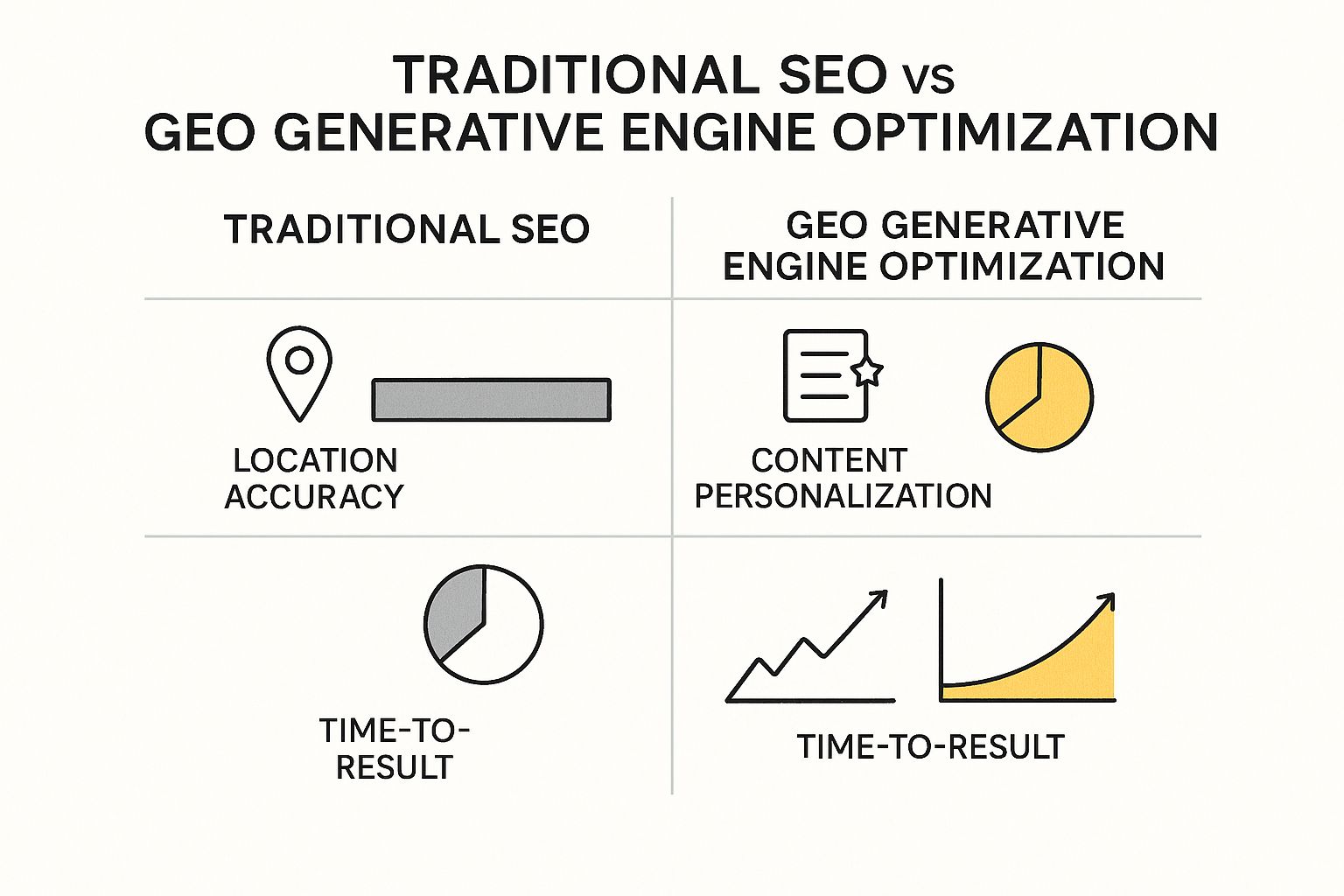
To make the distinction clearer, let's break down how GEO stacks up against the SEO methods we're all familiar with.
Traditional SEO vs. Geo Generative Engine Optimization (GEO)
Aspect
Traditional SEO
Geo Generative Engine Optimization (GEO)
Primary Goal
Drive clicks and achieve high rankings on SERPs.
Become a trusted, cited source in AI-generated answers.
Key Tactics
Keyword optimization, backlink building, technical site health.
Brand mentions in AI responses, accuracy of cited info, user trust.
This table shows that while the two disciplines share some roots, their objectives and methods are diverging.
Ultimately, the key takeaway is simple. Traditional SEO gets you discovered. GEO makes you the definitive source inside the AI's response, zeroing in on personalization and accuracy.
How Generative Engines Are Changing the Search Game
Before you can build a solid geo generative engine optimization strategy, you have to get a feel for the new playing field. Generative engines built on Large Language Models (LLMs)—think ChatGPT, Gemini, and Perplexity—are completely changing how people find information online. They aren't just librarians pointing you to the right bookshelf anymore. Now, they read all the books, understand the content, and write a custom summary just for you.
These platforms have moved way beyond simply indexing and ranking web pages. They consume, interpret, and synthesize huge amounts of data to create brand-new, conversational answers. Instead of a list of blue links, users get a direct response, often with sources cited. This means the goal of your content is no longer just about getting a click; it's about becoming a primary source for the AI's answer itself.
The New Gatekeepers of Information
It helps to think of each generative engine as having its own personality. ChatGPT might be the eloquent writer, Gemini the data-crunching analyst, and Perplexity the meticulous researcher. Each one runs on its own algorithms, has different priorities, and pulls from different data sources. This is a massive departure from traditional search, where optimizing for Google was pretty much the only game in town.
The AI market isn't a monolith, so a one-size-fits-all approach is dead on arrival. To get any traction, you have to tailor your content to the specific quirks of the platforms where your audience is asking questions. This means getting to know how each engine processes information and what it considers a signal of authority.
A recent, in-depth study looked at over 11,000 commercial queries across the top four generative AI chatbots in the U.S. and found the landscape is incredibly diverse. The analysis revealed a clear leader, with ChatGPT holding a 61.3% market share, followed by Google Gemini at 13.3%, Perplexity at 3.1%, and Claude AI at 2.5%. You can dig into the full findings of this generative engine analysis to see just how these market dynamics break down.
This data is a powerful reminder of why you need a targeted strategy. If you only optimize for one engine, you're likely ignoring a huge slice of your potential audience on another.
From Crawling to Comprehending
The fundamental change is the shift from simple web crawling to deep comprehension. Traditional search bots crawl your site to index keywords, follow links, and figure out the basic structure. Generative engines go much deeper, performing a semantic analysis to truly grasp the context, relationships, and ideas within your content.
In this new model, it’s not enough for an AI to know that your page mentions a topic. The AI needs to understand what your page says about it, why it's a credible source, and how that information connects to a user's specific query.
This deeper level of analysis makes certain elements of your content more critical than ever before.
Clear Structure: Using logical headings (H2s, H3s) and short paragraphs helps the AI follow your train of thought and identify key points.
Concise Summaries: Providing a clear, upfront summary gives the engine a quick-to-digest synopsis that it can easily use to construct an answer.
Explicit Citations: Linking to authoritative sources signals trustworthiness and allows the AI to verify your claims, which boosts your content's credibility.
Why Commercial Queries Matter
This evolution is especially important for commercial queries—the searches people make when they are close to making a buying decision. When someone asks an AI, "What's the best project management software for a small team?" the answer it generates can directly influence a major purchase.
If your content is built for generative engine optimization, it has a shot at becoming the trusted source the AI uses to formulate its recommendation. Instead of just fighting for a top-three spot on a results page, you’re now competing to be the authority cited inside the AI's direct, trusted answer. Securing that spot puts your brand right in front of high-intent buyers, making GEO an essential strategy for growth.
The Foundational Pillars of a GEO Strategy
So, how do you move from understanding what GEO is to actually doing it? A solid geo generative engine optimization strategy isn't about throwing tactics at the wall and seeing what sticks. It’s built on a few core pillars that work together to make your content something generative AI can easily grasp, trust, and use as a source.
Think of these pillars less as a checklist and more as an interconnected system. Each one helps translate your brand's expertise into a language that speaks to both people and AI models. Getting them right is the difference between simply being online and becoming an authoritative voice that directly shapes the answers AI gives to potential customers.
Mastering E-E-A-T for AI Trust
The first, and arguably most important, pillar is E-E-A-T. This stands for Experience, Expertise, Authoritativeness, and Trustworthiness. While it’s been a staple of Google's quality guidelines for years, it's even more crucial now. Generative AI is built to avoid spreading junk information, so it actively hunts for signals of credibility before it dares to cite a source.
This means your content can't just exist; it has to prove it's the real deal. You do this by transparently showing your work—think detailed case studies, citing credible data sources, and including author bios that prove you have real-world experience. Every claim you make should be backed up, creating a trail of trust that an AI can easily follow and confirm. Once an AI decides you’re a reliable source, your content jumps to the front of the line for being included in its answers.
Implementing Structured Data as a Universal Translator
If E-E-A-T is the soul of your content, then structured data (or schema markup) is its universal translator. Schema is basically a standardized vocabulary you add to your website's code. It doesn't change what users see, but it explicitly tells search engines and AI models what your content is about with zero guesswork.
For instance, without schema, an AI might get confused between "Apple," the tech giant, and "apple," the fruit. With the right schema, you can clearly label your business name, address, phone number, and opening hours, leaving no room for error.
This structured approach is fundamental. It’s like adding clear, bold labels to the files in your digital filing cabinet, ensuring an AI assistant can instantly find and correctly interpret exactly what it’s looking for.
This level of clarity is a game-changer for geo generative engine optimization. It allows an AI to pull precise details for its responses, like your business hours or customer ratings, straight from your code.
Adopting Conversational Content That Answers Questions
The third pillar is about shifting your writing style to be more conversational and question-oriented. Think about how people use generative AI—they ask real questions in plain language, not just a string of keywords. Your content needs to reflect that.
Instead of a generic article on "digital marketing," you should be creating content that directly answers questions like, "What's the best way for a small business to start with digital marketing?" or "How much should I really budget for social media ads?"
Here’s how you can put this into practice:
Use clear, question-based headings that mirror what people are actually asking.
Add FAQ sections to your pages that tackle common problems and hesitations head-on.
Write in a direct, approachable tone, almost like a knowledgeable friend giving advice.
This approach doesn't just resonate with human readers; it makes your content perfectly formatted for an AI to pull out neat, bite-sized answers.
Prioritizing Entity Recognition for Clarity
Finally, you need to focus on entity recognition. In this context, an entity is any well-defined thing: a person, a place, a company, or even a concept. Your job is to make the key entities in your content unmistakable to an AI. This is related to structured data, but it's also about how you write and link internally.
When you mention your company, link to your "About Us" page. When you talk about a key team member, link to their bio or LinkedIn profile. Clearly defining the "who, what, and where" helps the AI build a rich knowledge graph centered on your brand. To get this right, it's smart to explore the best generative search optimization tools, as these platforms can help you see how well AI is recognizing your key entities and streamline the whole process. Building an AI strategy for your brand is a crucial step from moving from search to reference.
By consistently reinforcing these entities, you're actively teaching the AI who you are and what you're an expert on, cementing your status as a go-to source.
Creating Content for AI Answer Generation
It's one thing to talk theory, but putting it into practice is where you'll see the payoff. Creating content that a generative AI not only finds but also trusts enough to cite means rethinking how you write and structure information. This isn't about chasing the latest algorithm; it's about becoming the clearest, most helpful authority on a subject.
The whole point of generative engine optimization is to make your content so well-organized and credible that an AI model sees it as a go-to source for crafting its answers. This involves taking a hard look at your current content and building new pieces with a fresh set of priorities, zeroing in on clarity, credibility, and genuinely solving the user's problem.
Auditing Content Through an AI Lens
Start with your most valuable content. But instead of reading it like a person, try to scan it like an AI would—looking for signals of structure and trust. You need to ask yourself some tough questions:
Are my headings actually helpful? A clever heading like "Our Secret Sauce" is confusing. An AI needs something direct, like "Our Unique Coffee Roasting Process," to understand the context immediately.
Is the most important info buried? AI models scan for quick, digestible answers. If your main point is tucked away in the sixth paragraph, it’s probably going to be missed entirely.
Am I showing my work? Linking out to reputable studies or data sources is a huge trust signal for an AI. It proves you've done your homework and aren't just making things up.
This kind of audit helps you spot the low-hanging fruit—the articles, blog posts, and service pages you can tweak quickly to make them more AI-friendly and, ultimately, more effective.
Crafting Content Optimized for AI Comprehension
When you’re creating new content or giving an old piece a facelift, a few key techniques make all the difference. To really get a handle on how to use artificial intelligence in your strategy, exploring resources on AI for content creation can give you a major leg up. These methods work hand-in-glove with GEO principles.
First, lead with a tight summary. Think of it as the abstract of a research paper or an executive summary. Put a clear, two-to-three-sentence overview right at the top that gets straight to the point. This gives the AI a perfect, ready-made snippet to use.
Second, use a clear heading hierarchy. Structure your content with H2s for the big ideas and H3s for the supporting details under them. This builds a logical roadmap that an AI can easily follow to grasp how all the concepts in your article relate to each other.
Think of a well-structured article as a detailed map for an AI. The clear headings and logical flow guide it straight to the most valuable treasure, massively increasing the chance your content gets used as a source.
Finally, and this is the most important part, obsess over satisfying user intent. Every piece of content you produce should be laser-focused on giving a user a complete and accurate answer to their question. If someone searches "how to choose a marketing agency," your content better deliver actionable steps, points of comparison, and red flags to look out for. When you satisfy the human user, you send the strongest possible quality signal to an AI.
Before and After: A GEO Transformation
Let's make this real. Imagine a pretty standard blog post about project management software.
Before GEO Optimization:
Title: The Power of PM Tools
Introduction: A long, rambling story about the history of project management.
Body: One massive block of text describing five different tools with no clear breaks.
Conclusion: A generic sign-off like, "Choose the right tool for you."
An AI would struggle to make sense of this. The key information is hidden, the structure is a mess, and the title is way too vague.
After GEO Optimization:
Title: How to Choose the Best Project Management Software in 2025
Summary: A punchy three-sentence paragraph at the top summarizing the key decision factors (team size, budget, features).
H2: Key Factors to Consider Before Choosing
H3s: Team Size and Scalability, Budget and Pricing Models, Core Feature Requirements (each with its own bullet points).
H2: Top 5 Software Options Compared (using a simple table for at-a-glance comparison).
H2: Frequently Asked Questions (FAQ)
This revised structure is a night-and-day difference. It's clean, direct, and perfectly formatted for geo generative engine optimization. It nails user intent, uses headings as signposts, and presents complex info in an easy-to-digest table—making it a prime candidate for an AI-generated answer.
Measuring Success in the Age of AI Search
You’ve probably heard it a thousand times: if you can't measure it, you can't improve it. This old business rule has never been more critical than it is right now, in this new world of AI-driven search. The dashboards we’ve relied on for years, filled with keyword rankings and click-through rates, are quickly becoming relics. A smart geo generative engine optimization strategy requires a completely different way of thinking about what "success" even looks like.
Traditional metrics just don't tell the whole story anymore. They were built for a time when success meant getting a user to click a link and land on your website. But in the age of AI search, a huge win might be when a generative engine names your brand directly in its answer—even if the user never clicks through to your site. Your brand gets the visibility and the stamp of authority, but your old analytics tools might not even see it happen.
To really prove the value of your GEO efforts, you have to shift your focus from simply acquiring traffic to influencing the information itself. This means you need to start tracking how often, and how accurately, your brand is showing up in AI-generated responses.
The New KPIs That Matter
The game has changed, and so have the ways we keep score. While organic traffic is still a piece of the puzzle, it's no longer the entire picture. To truly understand how you're performing in this new arena, you need a fresh set of Key Performance Indicators (KPIs) built specifically for the AI-powered search landscape.
These aren't just vanity metrics. They move beyond simple rankings to measure your brand's real-world influence and visibility within AI conversations. Tracking them is the only way to know what's actually working and to connect your GEO strategy to real business results.
Here are the critical metrics you need to start tracking:
AI Citation Rate: This is your most direct measure of GEO success. It simply tracks how often AI models cite your website, articles, or data as a source. A high citation rate is a clear signal that you're viewed as a trusted, authoritative source in your field.
Answer Box Share of Voice: This metric calculates your visibility within AI-generated responses for your most important topics. It answers a crucial question: "When users ask about our industry, how much of the AI's answer is actually informed by our content?"
Brand Mention Accuracy: It’s one thing to get mentioned; it’s another to be mentioned correctly. This KPI tracks the sentiment and factual accuracy of how your brand, products, and services are described in AI answers. The goal is to make sure the information being shared is both positive and true.
These metrics paint a much clearer picture of where your brand stands. They show not just if you're being found, but if you're being trusted.
Essential GEO Performance Metrics
To wrap your head around this new measurement landscape, it's helpful to see these new metrics laid out. They represent a fundamental shift from tracking user actions (clicks) to tracking informational influence (citations and mentions). Here's a quick summary of the metrics that are now essential for any serious GEO strategy.
Metric
Description
Why It Matters
AI Citation Rate
The frequency your domain is cited as a source in AI-generated answers.
This is the clearest indicator of authority and trust in the eyes of the AI.
Answer Box Share of Voice
The percentage of AI answers for key topics that are based on your content.
It quantifies your brand's informational dominance in your niche.
Brand Mention Accuracy
The sentiment and factual correctness of how your brand is portrayed in AI responses.
It protects your brand's reputation and ensures the AI is an ally, not a liability.
Zero-Click Visibility
How often your brand or information appears directly in an answer, not requiring a click.
It measures brand exposure in an environment where users get answers without visiting a site.
Lead Attribution from AI
Tracking leads and conversions that can be sourced back to an interaction with an AI answer.
This directly connects your GEO efforts to revenue and proves ROI.
Focusing on these KPIs will give you the data you need to refine your approach, demonstrate value to stakeholders, and ultimately win in the new era of search.
Tools for the GEO Marketer
This new reality of measurement naturally requires a new set of tools. Thankfully, a wave of specialized platforms is rising to the challenge, helping marketers get a handle on their performance. These tools are built to monitor AI-generated answers across various engines, track brand citations, and analyze your all-important share of voice.
Platforms are now rolling out dashboards designed specifically to monitor how content performs within generative AI. The screenshot above shows a great example of how a platform might visualize this, helping teams draw a straight line from a piece of content to its business impact. The key is the ability to tie specific articles or blog posts to their appearances in AI answers, giving you a crystal-clear view of your return on investment.
Early adopters of Generative Engine Optimization reported that 32% of their sales-qualified leads (SQLs) originated from generative AI search channels, up from zero within just a few months. This surge is driven by the adoption of specialized tools that track these new performance metrics. Discover more insights about top tools for generative engine optimization on Contently.com.
Showing this kind of direct impact on lead generation is how you get buy-in and budget for your GEO strategy. It shifts the conversation from fuzzy concepts like "visibility" to hard numbers and business growth. As you build out your PR and outreach, using the top press release distribution services of 2025 can give your content the boost it needs to get noticed and integrated by these AI engines.
Future-Proofing Your Brand with GEO
The surge in AI-powered search isn't just another passing trend. It signals a deep, fundamental shift in how people discover information and, in turn, how brands need to present themselves. Getting a handle on geo generative engine optimization isn’t about chasing a new marketing shiny object; it’s a strategic move to ensure your brand remains a credible, authoritative voice for years to come.
As generative AI weaves itself deeper into our daily routines, the distinction between writing for a human and structuring data for an AI is starting to dissolve. In reality, they are becoming two sides of the same coin. What’s at the core of this shift? A principle that has always mattered: authenticity. AI models are being trained to value clarity, depth, and trustworthiness—the very same things that build real, lasting connections with customers.
Building a Durable Competitive Advantage
Thinking about GEO is about more than just trying to land a mention in an AI-generated summary. It’s really about building a solid competitive advantage that’s hard for anyone else to copy. While your competitors are busy chasing yesterday's metrics, you can be building a deep reservoir of trusted, verifiable content that cements your brand as a go-to source in your field.
This is your chance to build a moat around your brand's authority. Every piece of well-structured, clearly-cited content you publish is another stone in that wall. It makes your brand not just visible but essential to the entire information ecosystem.
Mastering geo generative engine optimization is how you make sure your brand doesn't just survive the AI transition but actually thrives in it. The businesses that get on this now will become the recognized authorities of tomorrow, directly shaping conversations and guiding buying decisions.
Your First Step into the Future
The time to adapt is right now. These strategies aren't some far-off concepts; they are concrete steps you can take today. A great starting point is to audit your most important content, sharpen your core messages, and back up every claim with transparent sourcing.
Adopting this new way of thinking requires a mental shift:
From Clicks to Citations: The new goal isn't just a click. It's being cited as a trusted source, which holds far more authority.
From Keywords to Conversations: Think about shaping your content to answer the genuine, complex questions your audience has.
From Content to Credibility: See every article, case study, and webpage as a fresh opportunity to prove your expertise and build trust with the algorithms.
The future of search is conversational, contextual, and founded on trust. By making geo generative engine optimization a central pillar of your strategy, you’re not just optimizing for a machine. You're securing your brand's relevance and authority for the future.
Your Top GEO Questions, Answered
Jumping into a new way of thinking about optimization always sparks a few questions. As you start figuring out how geo generative engine optimization fits into your current marketing mix, it's completely normal to wonder how it all works together and what you should expect. Let's tackle some of the most common questions to clear things up and help you get started.
How Is GEO Different from Local SEO?
It’s a great question because both are about location, but they play in different sandboxes. Local SEO is all about making sure your business shows up on a map or in a local pack when someone searches for something like "coffee shop near me." It’s heavily focused on your Google Business Profile, local directory listings, and customer reviews to prove you physically exist and are relevant to that spot.
Geo generative engine optimization, on the other hand, is about becoming the trusted source an AI assistant quotes in its answer. The goal isn't just to be a dot on a map. It's to be the reason the AI says, "For a business meeting in downtown Austin, the best coffee shop is..." Getting there requires much deeper content that proves your expertise and authority on a topic, not just your address.
Here’s a simple way to think about it: Local SEO gets you a listing in the local directory. Geo generative engine optimization makes you the one the hotel concierge personally recommends, telling guests why you're the best choice.
Can Small Businesses Actually Benefit from This?
Absolutely. In fact, GEO can be a game-changer for smaller players. Small businesses are often sitting on a goldmine of specialized knowledge and genuine customer stories—exactly the kind of authentic material AI models are designed to recognize and reward. You might not have the ad budget of a huge corporation, but you can certainly out-write and out-expert them.
Think about a local bakery. They can create content detailing the unique history of their sourdough starter, where they source their heirloom wheat, and weave in real testimonials from loyal customers. This kind of detailed, passionate content screams expertise and trustworthiness (E-E-A-T), making the bakery a far more credible source than a national chain with bland, corporate web copy. It's how a small business can build a powerful digital reputation on what they know, not just what they can spend.
How Long Until I See Results from a GEO Strategy?
This isn't like flipping a switch on a paid ad and seeing immediate traffic. GEO is a marathon, not a sprint. You're building a foundation of authority, not just buying eyeballs for a day. You're carefully constructing a library of trustworthy content that signals your expertise to AI systems over time.
Generally, you should start seeing the first glimmers of progress within three to six months. These early signs might look like:
Your brand popping up in AI-generated answers for very specific, long-tail questions.
AI summaries starting to pull more accurate and detailed facts about your business.
New referral traffic from AI platforms showing up in your analytics reports.
Getting to the point where you're consistently cited for valuable, bottom-of-the-funnel questions will take longer. It depends on how quickly you can build out a solid content foundation and establish your digital authority. Consistency is everything here.
Ready to stop guessing and start getting your business featured in the press? Press Ranger's AIWire makes it easy to get content indexed into AI chatbots like ChatGPT, Perplexity, Grok, Microsoft Copilot, Gemini and more.
If you’ve ever poured your soul into a book only to hear crickets on launch day, you’re not alone. As a book marketing consultant, I’ve seen it happen to the most brilliant of authors—amazing...
We're excited to announce the launch of the Press Ranger Blog.
PR is changing fast and we want to make it move even faster.
There are 10,000+ businesses using Press Ranger to manage PR campaig...