
Introducing AIWire
The future of PR isn't just about being seen by humans—it's about being referenced by AI.
Learn how to write a press release that attracts attention. Our guide on how to write a press release helps you craft effective, newsworthy announcements.

Before you even think about writing a press release, you need to ask yourself one brutally honest question: Is this actually news? Getting this right is the difference between a successful campaign and an email that gets deleted in under three seconds.
A great press release isn't just a company update wrapped in a formal template. It’s a story. It has to be something a journalist can genuinely use to inform, engage, or surprise their audience. Think impact, timing, and a real human connection.
Let’s step into a journalist's shoes for a moment. Their inbox is a battlefield, flooded with hundreds of pitches every single day. Most are thinly veiled ads. Yours will only stand out if it solves their biggest problem: finding a fresh, relevant story that their readers will actually care about.
So, before you start typing, take a hard look at your announcement. Are you just shouting about your company's latest feature, or are you talking about the real-world problem it solves? An ad talks about what you did; a newsworthy story explains why it matters to people outside your company walls.
The trick is to find an angle that resonates. A simple software update isn’t news. But what if that update helps struggling small businesses slash their operating costs by 30% during an economic downturn? Now that's a story.
A common trap I see people fall into is assuming their internal excitement automatically translates to media interest. It doesn't. Journalists are gatekeepers for their audience, not an extension of your marketing team. You have to frame your announcement in a way that helps them do their job.
Pro Tip: If you're struggling to find the angle, talk to a customer. Ask them how your new product or service has changed their work or life. Their story is often far more compelling than any feature list you could write.
To help you vet your own ideas, I've put together a quick-reference table. These are the core elements I always look for when deciding if a story has a real shot at getting media coverage.
| Element | What It Means | Example |
|---|---|---|
| Timeliness | It’s happening now or connects to a current event, trend, or season. | Launching a tax-prep tool in March, just before tax season peaks. |
| Impact | It affects a large or significant group of people in a meaningful way. | A new technology that reduces plastic waste in a major industry. |
| Proximity | The story is local and relevant to the journalist's specific audience. | A national company opening a new headquarters that will create 200 local jobs. |
| Conflict | It involves a struggle, a challenge, or a David vs. Goliath scenario. | A small startup taking on an industry giant with a disruptive new idea. |
| Human Interest | It tells a personal, emotional, or relatable story about people. | A profile on the founder who overcame incredible odds to build their business. |
If your announcement checks at least one or two of these boxes, you’re on the right track. The more you have, the stronger your pitch.
Even with the explosion of social media, the press release hasn't gone anywhere. In fact, it's still a surprisingly vital tool. Recent research found that 48% of PR pros are actively writing them, and another 44% rely on them for research. You can see the full 2024 press release statistics here to get a better sense of their staying power.
Ultimately, a story that gets picked up is one that offers genuine value. When you ground your announcement in real impact, solid timing, and a human element, you’re not just writing a press release—you’re creating the foundation for a story that journalists will be excited to tell.
Think of a press release as a purpose-built tool. Every single piece has a job to do, and if one part fails, the whole thing can fall flat. Forget rigid templates for a moment. Instead, let's look at the strategy behind each section so you can build a release that journalists will actually want to read.
Your real mission here is to make a reporter's life easier. That means giving them information in a predictable, scannable format where they can find what they need in seconds.
Let's be blunt: your headline is everything. It’s your one and only chance to cut through the noise of a packed inbox and get a journalist to even consider opening your email. A great headline is specific, punchy, and tells the reader exactly why they should care.
Vague, clickbait-y titles get deleted. A reporter needs to know the core of the story from the headline alone. For instance, "TechCo Announces New Software" is forgettable. But what about this? "TechCo Launches AI Software That Slashes Small Business Accounting Time by 50%."
See the difference? The second one is a story in itself. It tells us:
That’s an angle a journalist can work with immediately.
Right after the headline comes your lead (or "lede") paragraph. This is the first paragraph, right after the dateline (e.g., "NEW YORK, NY – October 26, 2023 –"), and it needs to summarize the entire story in two or three tight sentences. This is where you have to answer the classic questions: Who, What, When, Where, and Why.
Think of it as the ultimate executive summary. A busy reporter should be able to write a short brief using only your lead paragraph. If you bury the key details later on, they'll never see them.
A strong lead gets straight to the point. It doesn't waste time with fluffy introductions or company background. It delivers the news immediately and authoritatively, establishing the relevance of your announcement from the very first line.
Once you've hooked them, the body of your press release is where you add the meat to the bones. These paragraphs are for supporting details, crucial context, and evidence that builds your case. This is your chance to really show why your news matters.
A vital part of the body is the quote. A good quote from a key person—a CEO, a product manager, or even a happy customer—brings a human element to the story that dry facts just can't match. It provides the "why" behind the announcement.
Knowing how to write a compelling release is more important than ever. The global public relations market is expected to grow from $107 billion in 2023 to more than $133 billion by 2027. This explosion in value is driven by new demands for skilled storytellers, a trend that 88% of PR pros believe is reshaping the industry.
For a great example of how all these pieces fit together in a real-world announcement, check out Worknet's June 2023 press release.
At the very end of your release, you’ll add a boilerplate. This is simply a short, standardized "About Us" paragraph that gives journalists the essential background on your company.
Keep it brief—just three to five sentences is perfect. It should clearly explain what your company does, who you do it for, and what sets you apart. This is a fundamental element of knowing https://pressranger.com/blog/how-to-write-a-good-press-release that looks polished and professional. Don't forget to include a link to your website here.
Finally, every press release needs to wrap up with media contact details. This tells a journalist exactly who to call or email for follow-up questions, an interview, or better photos. It shows you're ready and accessible.
Make sure you include the following for your designated contact person:
Making this information dead simple to find removes any friction and dramatically increases your odds of getting that coveted media coverage.
Let's be honest: quotes are often the weakest part of a press release. They can be a secret weapon, breathing life and personality into a dry announcement. But too often, they’re filled with robotic, jargon-stuffed statements that no one would ever actually say out loud.
Your goal is to give a journalist a quote so authentic they can copy and paste it directly into their article. A great quote shouldn't just repeat facts. It needs to add emotion, offer a unique perspective, or provide an opinion that gives your news some much-needed color.
The person you quote sends a strong signal to the journalist about what kind of story you're telling. The CEO is the default for big company news, but they aren't always the most compelling choice. Think about whose voice will have the most impact.
Here are a few alternatives to consider:
Picking the right voice can make your story far more relatable and trustworthy.
My Two Cents: Don't quote two or three executives saying the same generic thing. It's a waste of space. One or two powerful, distinct quotes will always be more effective. Quality trumps quantity every time.
Okay, you've picked your spokesperson. Now, how do you make them sound human? The biggest pitfall is writing something that reads like a marketing slogan.
Reporters have seen this a thousand times:
The Generic Corporate Quote: "Our team is excited to launch this next-generation solution, which will empower our clients to achieve their goals."
It’s meaningless. Instead, try telling a mini-story:
The Authentic, Human Quote: "We saw our customers spending hours every week on manual data entry, and we just knew there had to be a better way. This new tool gives them that time back, so they can focus on growing their business instead of fighting with spreadsheets."
See the difference? The second example shows empathy. It names a specific pain point and clearly explains how the product solves it. Getting this right can truly set your announcement apart, especially when paired with a strong, factual headline. If you need inspiration, we've got a great guide full of press release headline examples that can help you nail that part, too.
A final pro tip: read the quote out loud. If it sounds stiff or awkward, it is. Rewrite it. Use contractions like "it's" or "we've" and simpler words. It's your one chance to inject real personality into the release, so make it count.
Let’s be blunt. A poorly formatted press release is an instant trip to the trash folder. It screams amateur and, more importantly, it tells a journalist you don't respect their time.
Proper formatting isn't just about looking professional. It’s about making a reporter's job easier, and that should be your primary goal. Think of it as setting the table before serving a fantastic meal. If everything is where it should be, the experience is seamless. If it’s a mess, they won’t even want to take a bite.
Some elements are simply non-negotiable. They're the industry standard, and they immediately signal to a journalist that you know what you're doing.
A journalist's first glance is your only shot. A clean, well-structured document invites them to actually read what you've sent. A cluttered one is an easy excuse to hit 'delete'.
Once the structure is right, the next hurdle is your language. Corporate buzzwords are absolute poison in a press release. Your mission is to communicate a clear, direct message, not to sound like a business textbook.
Before you even think about hitting send, do a "jargon hunt." Comb through your draft and be ruthless. Is there any term or phrase that your cousin or a friend in a totally different field wouldn't understand? If so, kill it. Replace it with a simpler word or, if you absolutely must use it, provide a quick, plain-English explanation.
For instance, never say, "We leveraged synergistic paradigms to enhance user-centric workflows." Instead, try: "We used customer feedback to make our software easier to use." One is confusing and pretentious; the other is clear, confident, and actually says something.
A few finishing touches can make all the difference, signaling that you’re a pro who understands how this game is played.
You've written a brilliant press release. That's fantastic, but it's only half the battle. If your announcement doesn't land in front of the right people, all that hard work essentially disappears into the void. Modern distribution isn't about a shotgun blast approach; it's about precision, strategy, and getting your story to the people who will actually care about it.
You really have two main paths to choose from: using a newswire service or taking the time to build your own targeted media list. Each has its place, and the right choice depends entirely on your specific goals.
So, let's break down your options. On one hand, you have wire services like PR Newswire or Business Wire. These platforms offer immediate, massive distribution. They can push your announcement into thousands of newsrooms, databases, and websites in an instant. This is incredibly useful for things like official company disclosures or when you genuinely need to reach a broad, general audience as quickly as possible.
The downside? That massive reach is often impersonal and can come with a hefty price tag.
The other approach is building your own media list. This is all about quality over quantity. It means you're doing the legwork to research and identify the specific journalists, bloggers, and influencers who live and breathe your industry. It's definitely more time-consuming, but it allows for highly personalized outreach. From my experience, that personal touch is what builds real relationships and leads to more thoughtful, impactful coverage.
The reality is, a personalized email to one highly relevant journalist is often more powerful than a wire release seen by a thousand uninterested ones. You're not just sending news; you're starting a conversation.
Here's a quick table to help you weigh the pros and cons of each method.
Deciding between a wire service and direct outreach can be tricky. This comparison should help you choose the right approach for your announcement.
| Feature | Wire Service | Direct Outreach |
|---|---|---|
| Reach | Broad, extensive network of newsrooms and databases | Niche, targeted to specific, relevant journalists and media |
| Personalization | Low; typically a standardized, impersonal distribution | High; allows for customized pitches and relationship building |
| Cost | Often high, with costs based on length and distribution | Low financial cost, but high investment in time and research |
| Best For | Official announcements, financial reporting, mass market | Niche stories, product launches, building media relationships |
| Likelihood of Pickup | Guaranteed placement on partner sites, but low organic pickup | Higher chance of securing a unique, in-depth story |
Ultimately, the best strategy often involves a combination of both. But for most businesses trying to make a name for themselves, direct outreach is where the magic happens.
Your first job is to figure out who the right people are. Think about the journalists and bloggers who are already writing about your industry or for the audience you want to reach. Spend some time on social media, industry news sites, and even Google News to find reporters who are consistently covering your specific beat.
Once you have a list of names, the real work begins. You need to find their contact information and, more importantly, get a feel for what they actually write about. Read their last few articles. What angles do they take? What seems to get them excited? This research is the secret sauce for what comes next.
When you're ready to reach out, your email pitch needs to be personal and straight to the point.
If you want to go deeper on crafting the perfect outreach message, we've got a whole guide on how to pitch the media effectively.
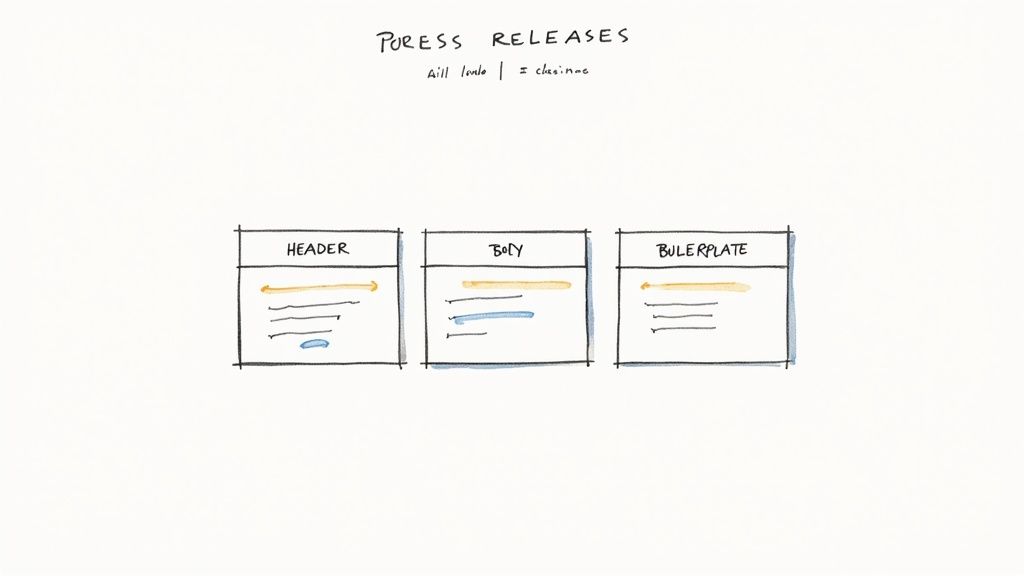
This visual breaks down how to structure your press release to make it as easy as possible for a busy journalist to scan and understand.
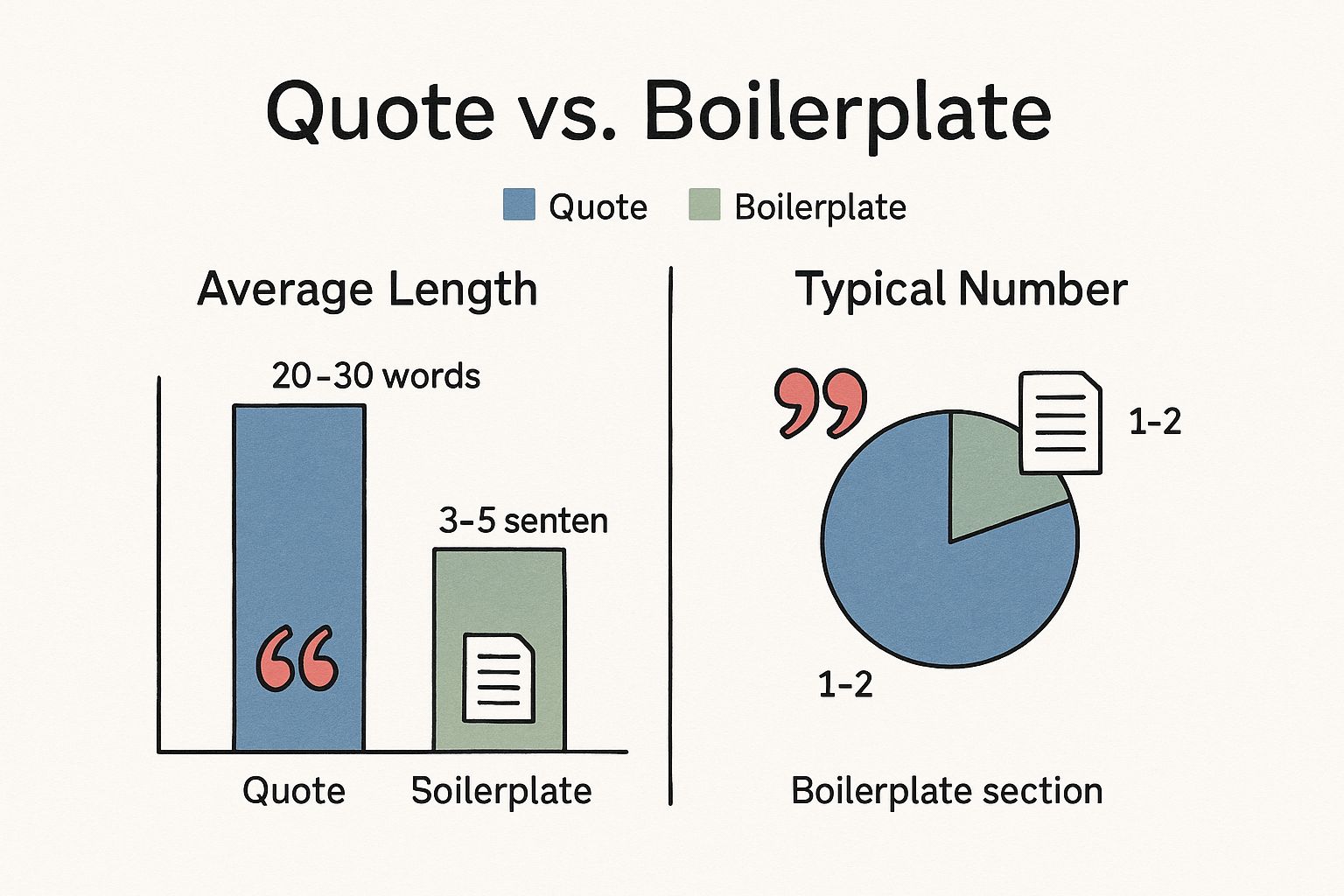
The key takeaway here is brevity and impact. Short, punchy quotes add a human element, and a concise boilerplate at the end gives them all the essential context they need without the fluff.
Let's talk numbers for a second. Effective distribution is what turns your announcement into tangible brand visibility. Data shows that 68% of businesses report increased brand exposure from their press releases. Interestingly, only 8% see them as a direct tool for acquiring clients, which really highlights their primary role in building recognition and authority.
The effort has a surprisingly long shelf life, too. A full 30% of businesses get contacted by journalists months or even a year after a release goes out.
But it’s not always easy. The biggest challenge, according to 42% of businesses, is simply reaching the right journalists in the first place. This is why a targeted, thoughtful distribution strategy is non-negotiable.
Your press release is just one piece of a much larger puzzle. To get the most out of your efforts, think about how each announcement fits into your broader strategies for building brand awareness and maximizing its long-term value.
https://www.youtube.com/embed/mpmCdyVLRZM
Once you get the hang of writing press releases, you'll find there are still a few nagging questions that always come up. Think of this as your quick-reference guide for those finer points. Getting these details right—from timing your send to handling multimedia—is what separates a professional pitch from an amateur one.
These are the real-world answers to the questions we hear all the time.
Keep it between 400 and 500 words. I know it's tempting to include every last detail, but this length has become the industry standard for a very good reason: it respects a journalist's time. A single-page release is concise and scannable. Anything longer feels unfocused and is likely to get tossed.
Your job is to be thorough but brief. Give them enough information to understand the story and its importance, but leave out the fluff. If a reporter is interested and needs more, trust me, they'll reach out.
A press release isn't a blog post or a deep-dive article. It's a specific tool built for one job: delivering news quickly and efficiently. Stay tight, get to the point, and make it easy to read.
Yes, but only if they genuinely enhance the story. High-quality media can make your announcement far more compelling and dramatically increase engagement. After all, a release with strong visuals is a lot more attractive to an editor than a wall of text.
The trick is how you include them. Never attach large files directly to your email—it's a surefire way to land in the spam folder. Instead, do this:
This gives journalists easy access to assets like professional headshots, product photos, infographics, or a short video without clogging their inbox.
A polite follow-up is perfectly fine, but you have to handle it carefully. Being patient and professional is key. The fastest way to get on a reporter's bad side—and potentially blacklisted—is by sending pushy or aggressive follow-ups.
My rule of thumb is to wait at least a couple of business days after sending the release. Then, send one brief follow-up email. Use it as a gentle reminder, and if you have a small new detail to add, even better. If you still don't get a response after that single attempt, it’s time to let it go and move on.
While there's no single "magic" time that works for everyone, years of experience point toward mid-week mornings.
Of course, the best strategy is always to know the specific cadence of the journalist and publication you're targeting.
Ready to stop guessing and start getting noticed? Press Ranger uses AI to build targeted media lists, draft compelling press releases, and send personalized pitches for you. No more expensive PR firms or endless cold emails. Let’s make headlines together. Find out more at https://pressranger.com.
The future of PR isn't just about being seen by humans—it's about being referenced by AI.
Email deliverability isn’t just about good copy—it’s about history. Warm-up tools simulate safe sending patterns, build reputation, and keep your campaigns out of spam while giving you clear data on where your emails actually land.
Learn how to write a good press release that gets media coverage. Our guide offers expert tips, proven formats, and real-world examples to boost your brand.