
The Best Ways to Track AI Traffic via Google Analytics (GA4)
Discover effective strategies to track AI traffic and enhance your website's performance using GA4 dashboards.
Discover essential public relations for startups. This guide offers proven strategies to build brand credibility, secure media coverage, and drive growth.

It's a common mistake for founders to think of public relations as a "nice-to-have"—something for big corporations with big budgets. In reality, that’s a perspective that can stunt a startup's growth and leave it stuck in the shadows. For a startup, public relations isn't a luxury; it's the strategic art of building the kind of credibility and crafting the kind of compelling story that paid ads just can't buy. It's the engine that makes your startup not just seen, but actually believed in, remembered, and trusted.

Think of your startup as a brilliant idea whispered in a crowded, noisy room. Without a microphone, that whisper gets lost. PR is that microphone. It’s a foundational tool designed to build genuine credibility, spark organic interest, and create long-term brand value that becomes a powerful competitive edge.
Unlike established companies with built-in reputations, startups are building from ground zero. You’re often working with a shoestring budget and need to gain traction fast to win over customers, attract talent, and secure investment. This is precisely where a smart PR strategy becomes your most powerful ally.
Every new venture starts with a trust deficit. It's the first major hurdle. Why should anyone—a customer, an investor, a potential hire—believe in your product, your mission, or your team? PR tackles this problem head-on.
When a credible third party, like a journalist from a respected publication or a well-known industry influencer, talks about your startup, it’s a game-changer. It’s an endorsement that provides validation you simply cannot purchase.
This concept is called earned media, and it’s incredibly powerful. Research shows that PR can deliver conversion rates 10 to 50 times higher than traditional advertising. Why? Because it builds authentic trust instead of just broadcasting a sales pitch.
A strong PR presence does more than just polish your image; it directly fuels business growth. Thoughtful media coverage can:
This kicks off a powerful flywheel effect: positive press leads to business growth, which in turn creates more newsworthy stories to tell. Effective public relations for startups is about making sure your story reaches the right audience at the right time to keep that wheel spinning.
For an early-stage company trying to make every dollar count, knowing the difference between PR and advertising is crucial. They serve very different purposes, and understanding them helps you build a smarter marketing budget.
| Aspect | Public Relations (PR) | Advertising |
|---|---|---|
| Primary Goal | Build credibility and trust through third-party validation. | Generate direct sales and leads through paid placement. |
| Control | You can influence the story, but can't control the final output. | You have complete control over the message, placement, and timing. |
| Cost | Earned media is typically lower cost but requires time and effort. | Guaranteed placement comes with a direct, often high, media cost. |
| Longevity | A strong news story can provide long-term credibility and SEO value. | The impact ends as soon as you stop paying for the ad. |
At the end of the day, advertising is about buying attention, while PR is about earning it. Both have their place, but for a startup looking to build a lasting foundation of trust and authority, PR often delivers a much higher return on investment over the long haul.
To get public relations right, you have to understand the core components first. It’s not just about firing off a press release and crossing your fingers. That’s a recipe for disappointment. A real PR strategy is a thoughtful blend of different tactics, all working together to help you grow.
Let's cut through the jargon and get straight to what matters for a startup. We'll break down the concepts of earned and owned media, and then see how the powerful PESO model ties everything together.
When most people think of "PR," they're thinking of earned media. This is the coverage you earn because your story is genuinely newsworthy, not because you paid for it. We're talking about news articles, TV spots, podcast interviews, and glowing online reviews.
Think of it this way: imagine a highly respected industry analyst praises your software in a major publication. That endorsement is priceless. Why? Because it’s authentic and comes from a trusted, independent source. That's earned media in action, and it’s the fastest way to build the kind of trust that startups desperately need to survive and thrive.
Owned media is every channel you control completely. This is your company blog, your website, your social media accounts, and your email newsletter. This is your home turf—the place where you get to craft your story exactly how you want it, without any outside filters.
If earned media is the analyst's review, your owned media is your website’s demo video, your detailed case studies, and the "About Us" story that explains your mission. A solid owned media strategy gives people a place to land when they hear about you, ensuring they find a compelling, professional home for your brand.
This chart gives you a bird's-eye view of how high-level PR goals should connect directly to the day-to-day tactics you execute.
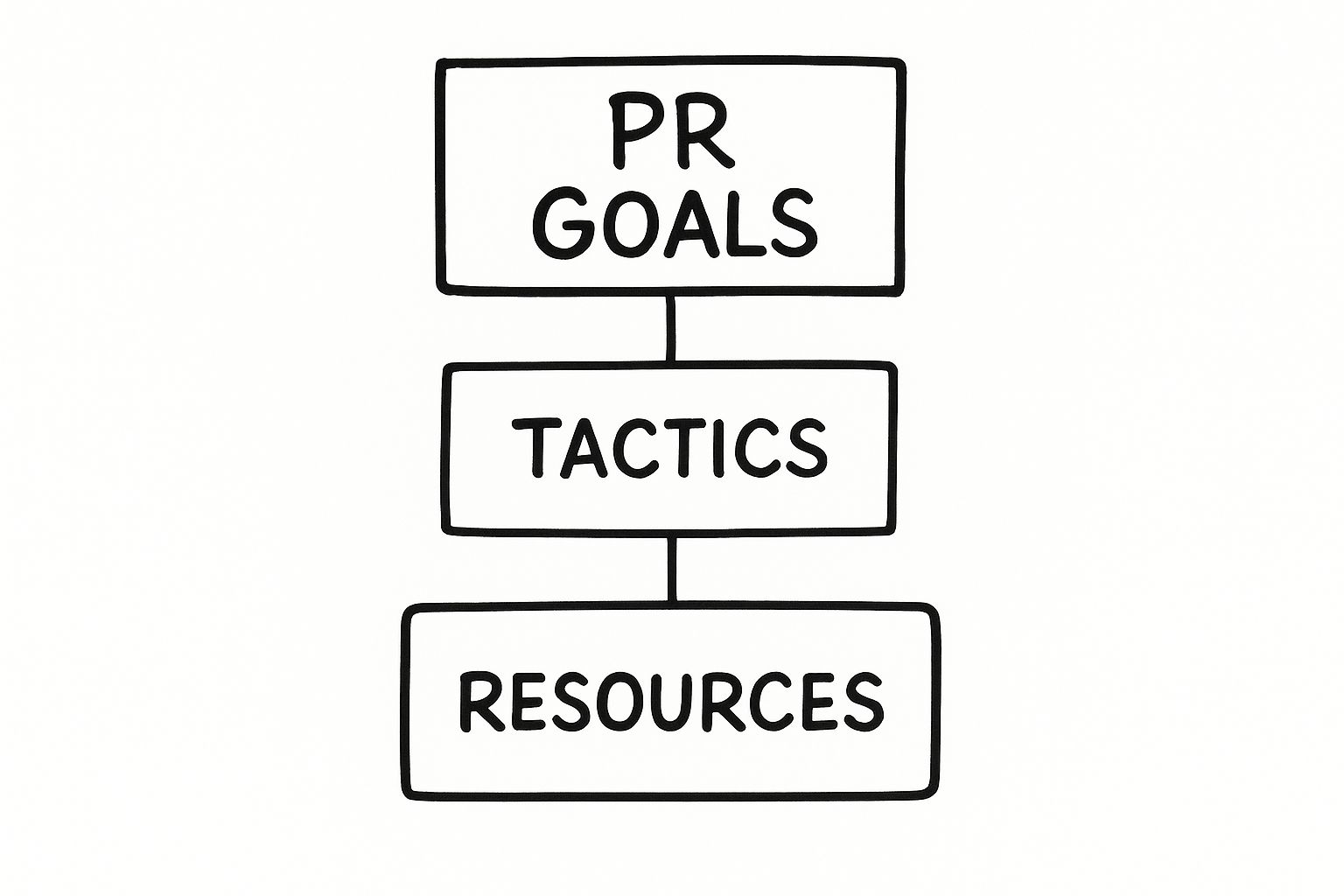
As you can see, every single PR activity—from writing a blog post to pitching a journalist—needs to serve a bigger strategic purpose.
So how do you make all these pieces work in harmony? That’s where the PESO model comes in. It’s a framework that integrates Paid, Earned, Shared, and Owned media. While many startups lean heavily on earned and owned to save money, understanding the full picture is key to building a truly powerful PR engine.
The real magic happens when you stop treating these as separate silos. A smart strategy creates a flywheel effect. For example, you might run an ad (Paid) pointing to a new research report on your blog (Owned). A journalist sees the report and writes an article about its findings (Earned), which your followers then begin discussing and circulating on LinkedIn and Twitter (Shared).
This integrated approach makes sure your message is consistent and amplified across every channel. It transforms one-off PR "hits" into a sustainable system for brand growth.
Of course, a complete playbook also prepares you for the tough times. This includes having a plan for effective social media crisis management. When things go sideways, your owned and shared channels are your first line of defense, making it critical to have a response strategy ready before you ever need it.
Alright, let's get down to business. Turning all this theory into a real, working public relations strategy is where the rubber meets the road. I know building a PR plan from scratch feels like a huge undertaking, but it's a skill any founder can get the hang of. It all boils down to one thing: translating that fire in your belly into a clear, compelling story that the media—and your future customers—simply can't ignore.
Think of your strategy as your North Star. It’s the guiding light that ensures every press release you write, every tweet you send, and every relationship you build is done with purpose. Without it, you're just throwing things at the wall and hoping something sticks, which rarely works.
Before you can shout your story from the rooftops, you need to know exactly what you're saying. Your core message is the very essence of your startup, boiled down into a powerful, memorable statement. This isn't just about what you do; it’s about why it matters. Nail this, and you'll have a consistent message to use everywhere.
Once you have your message, you can set clear, achievable goals. And I don’t mean vague ambitions like "getting press." A strong PR goal for a startup looks more like this:
See the difference? These kinds of objectives turn PR from a fuzzy concept into a measurable part of your growth machine.
Your PR goals should always tie directly back to your business goals. If you're chasing investment, you need to be in publications that VCs actually read. If you're launching a new product, you should be targeting outlets that reach the earliest of early adopters. It’s that simple.
Here's something a lot of founders miss: your audience isn't just your customers. When it comes to PR, you’re trying to win over several different groups, and each one cares about something different.
Figuring out what each of these audiences wants to hear from you is the secret to crafting a message that truly lands.
The PR game has changed so much. Over the past 15 years, it’s shifted from a world of fax machines and phone calls to a deeply integrated, data-driven field. Today, it's not uncommon for startups and small businesses to dedicate 30-40% of their PR budgets to micro-influencer campaigns, because that authentic word-of-mouth is gold. To see how tech is shaking things up, you can discover more insights about 2025 PR and marketing trends on Cascade Communications.
The right tech gives a small, scrappy startup a massive leg up. Modern platforms can automate the grunt work—like building media lists and tracking mentions—so you can focus on strategy and building real relationships. You can explore a whole range of these in our guide on the top tools for public relations. By using the right software, you can run a surprisingly sophisticated PR program without a giant team or budget, making every single effort count.
This is where the rubber meets the road. All the strategy in the world doesn't mean much if you can't get your story in front of the right journalists. For many founders, this is the most intimidating part of PR, but it's more about building genuine connections than it is about aggressive selling.
Think of it this way: a journalist isn't some gatekeeper you need to trick. They're a professional looking for a great story. Your job is simply to make it easy for them to see why your startup’s story is the one they should tell their audience.
Your first move should never be to blast a generic email to every reporter you can find online. That’s a surefire way to get your domain blacklisted and your reputation shot. Instead, you need to put on your detective hat. The goal is to build a small, highly targeted list of journalists who actually cover your industry, your competitors, or the specific problems you solve.
Start by looking at the publications your ideal customers read. Who writes the articles you find compelling? Who covers companies in your space? Use social media and industry tools to find reporters who have recently written about your niche.
Journalists get flooded with dozens, sometimes hundreds, of pitches every single day. The vast majority get deleted in seconds. To have any chance of standing out, your pitch has to be personal, concise, and genuinely newsworthy. Forget cold calling; a sharp, well-crafted email is your best weapon.
A great pitch isn't about you—it's about the journalist's audience. How does your news help their readers? Why should they care about it right now?
Your subject line is the single most important part of your pitch. It has to be compelling and crystal clear. Skip the clickbait and vague promises. A good subject line could be "Story Idea: How [Your Startup] is Tackling [Specific Problem]" or "New Data: Report Shows [Interesting Stat] in [Your Niche]."
Here’s a simple framework for a winning pitch:
You sent your carefully crafted pitch, and now you’re hearing… nothing. Don't panic. Journalists are juggling multiple deadlines, and your email might have just gotten lost in the shuffle. A polite follow-up is totally acceptable, but you have to do it right.
Wait about three to five business days before sending a follow-up. The best approach is to simply reply to your original email with a brief, polite nudge. Something like, "Just wanted to gently bump this in your inbox in case it's of interest. Happy to answer any questions!" is often all you need.
If you don’t hear back after one follow-up, it’s usually best to move on. Pestering a journalist is the fastest way to burn that bridge for good. Remember, building these connections is a long game, and learning how to build media relationships that last is a skill that will pay off for years to come.
Getting media attention isn't getting any easier. Recent data shows that 71% of PR professionals expect earned media to become harder to secure over the next five years. For startups that need this coverage to build credibility, that’s a sobering trend.
In response, 61% of PR pros are now using AI to sharpen their media targeting and personalize their outreach. As you can see from these PR statistics and trends from a Clutch survey, using smart tools is no longer a luxury for public relations for startups—it's essential for cutting through the noise.
Forget thinking of social media as just another marketing channel. For startups today, it's a central pillar of any smart PR strategy. Platforms like LinkedIn and X (formerly Twitter) are no longer just for posting company updates; they've become essential tools for telling your story directly to your audience, building real relationships with journalists, and managing your reputation on the fly. That direct line is gold for a startup.
Think of it this way: social media is your very own broadcast network. You don't have to wait for a reporter to pick up your story. You can get it out there yourself, completely unfiltered. This gives you control of the narrative, lets you test what messages land, and helps you build a community that’s invested in your mission long before they ever think about buying from you.
One of the smartest PR plays you can make on social media is positioning your founder as a genuine expert in your field. This isn't about empty bragging; it’s about consistently sharing valuable insights. Journalists are always on the hunt for credible sources to quote, and a founder with a strong, insightful social media feed is an absolute gift to them.
To pull this off, you need to be strategic. Pick the one or two platforms where your ideal audience and the reporters who cover your industry actually hang out. For B2B, that's almost always LinkedIn. For getting into fast-moving industry chatter, X is king.
When you do this consistently, your founder stops being just another CEO. They become a trusted thought leader—the kind of person whose opinion matters and who reporters actively seek out for a quote.
So you've landed a fantastic press feature. Great! But its job isn't done. Social media is how you turn that one win into a massive echo. Sharing your media hits across your social channels is absolutely crucial for squeezing every last drop of value out of them and showing your followers, investors, and potential customers that you have serious momentum.
The goal is to create a feedback loop. Your social media presence helps you earn media, and your earned media coverage, in turn, fuels your social media content, building credibility and engagement. It’s a powerful cycle that can accelerate a startup’s growth.
But don't just post your press clippings. Use these platforms to give people a peek behind the curtain. Share team milestones, talk about the real challenges you're working through, and remind people of the "why" behind your company. This is how you humanize your brand and build a community that's genuinely rooting for you to succeed.
The numbers back this up. Over 91% of businesses are now on social media for a reason. With 71% of Gen Z customers discovering new brands on these platforms, it’s a channel startups simply can’t afford to ignore. And the fact that 90% of users follow at least one brand shows just how ready people are to connect. You can discover more insights on digital PR statistics at BlueTree.Digital. By actively participating, you can build a loyal following and shape your own story in a way that traditional media alone never could.

So, how do you actually prove your PR strategy is working? For founders and investors who need to see a return on every dollar, "raising awareness" just doesn't cut it. You need to connect your media coverage to cold, hard data that shows business growth.
Think of it this way: getting a million impressions is like knowing a million people drove past your billboard. It’s interesting, but did anyone pull over and walk into the store? True measurement is about tracking who took that next step. It’s about proving PR is a strategic investment, not just an operational expense.
The first, most crucial step is to stop obsessing over vanity metrics. A big feature story is fantastic, but its real value lies in what happens after someone reads it. You need to focus on metrics that draw a straight line to your startup's bottom line.
These are the key performance indicators (KPIs) that actually matter:
This is the fundamental difference between different types of media. For a deeper dive, our guide on earned media vs paid media explains why that single backlink from an article can be so much more powerful than a paid ad.
Once you're tracking the right numbers, the final piece of the puzzle is sharing that success with your board, investors, and internal team. You have to tell a compelling story with your data. Don't just dump a spreadsheet in their inbox; build a narrative that connects PR activities to real business goals.
Instead of saying, "We got 5 million impressions," you can say, "Our feature in Tech Today drove 500 new visitors to our site, resulting in 30 qualified leads and contributing to a $10,000 increase in our sales pipeline." That's the kind of language that speaks to business impact.
When it comes time to report your progress, it helps to see how others do it well. Reviewing some solid project status report examples can give you a great framework for presenting your wins. A clear, concise report translates your PR victories into a format leadership understands and values, cementing its role as a strategic driver of growth.
Diving into public relations for the first time can feel like learning a new language. You've got questions, and that's a good thing. Let's walk through some of the most common ones I hear from founders to clear things up and help you get started on the right foot.
Honestly, you should be thinking about PR from day one. But "thinking" about it and "doing" it are two different things. The right time to kick off a real campaign is when you have a concrete, newsworthy event to talk about.
This doesn't always have to be a product launch. Maybe you just closed a big funding round, landed a game-changing partner, or have some fascinating data from your early users. The key is to have a "hook"—a tangible milestone that proves you're building something real. A vague idea won't catch a reporter's eye, but a solid achievement gives them a real story to tell.
This is the classic "it depends" question. PR costs can range from a few bucks for software tools to a $15,000 monthly retainer for a high-end agency. It’s a massive spectrum. For early-stage startups, I suggest thinking about it in terms of what you'd spend on other channels. How much would it cost to get the same brand awareness and credibility through paid ads?
Here’s a rough breakdown to give you a sense of the numbers:
Your budget should mirror your goals. If you just want one or two solid media mentions a quarter, you can get by with a smaller investment. If you're trying to make a huge splash for a launch, you'll need to put more resources behind it.
The number one mistake I see is founders treating PR like it's advertising. They send pitches that just list product features, forgetting that a journalist's job is to tell a story that engages their audience, not to promote your product.
Another huge error is the "spray and pray" approach—blasting a generic email to hundreds of reporters. This is the fastest way to get your domain blacklisted and burn valuable relationships before they even start.
But perhaps the most destructive mistake is impatience. Founders are used to the instant feedback of performance marketing, but PR is a long game. It’s about building relationships and earning trust. Expecting major headlines overnight will only lead to frustration and giving up on a strategy that just needed more time.
This really boils down to your two most precious resources: your time and your money.
DIY PR is a fantastic option if you're long on time but short on cash. Doing it yourself forces you to truly understand what makes your company interesting and helps you build authentic, direct connections with journalists. The trade-off? It’s a serious time sink. Researching contacts, writing pitches, and doing follow-up is practically a part-time job.
Hiring an agency or a freelancer makes sense when your budget allows it and you need to see results more quickly. You're not just paying for their time; you're paying for their experience, their hard-won media contacts, and their ability to guide your strategy. This can dramatically speed up the process and let you focus on what you do best—running your business.
Ready to stop guessing and start getting featured? Press Ranger uses AI to build targeted media lists, draft personalized pitches, and get your story in front of the right journalists. No experience needed. Let’s make headlines together. Find out more at Press Ranger.
Discover effective strategies to track AI traffic and enhance your website's performance using GA4 dashboards.

We're excited to announce the launch of the Press Ranger Blog. PR is changing fast and we want to make it move even faster. There are 10,000+ businesses using Press Ranger to manage PR campaig...
Learn how to build brand awareness with our guide. We cover proven tactics from brand identity to content strategy that boost visibility and build trust.