
Top Tools for Public Relations to Boost Your Strategy
Explore essential tools for public relations to enhance your media outreach, monitoring, and reporting efforts. Discover the best tools today!
Learn what is a boilerplate in a press release, why it matters, and how to craft an effective one with tips and examples. Read our complete guide now!

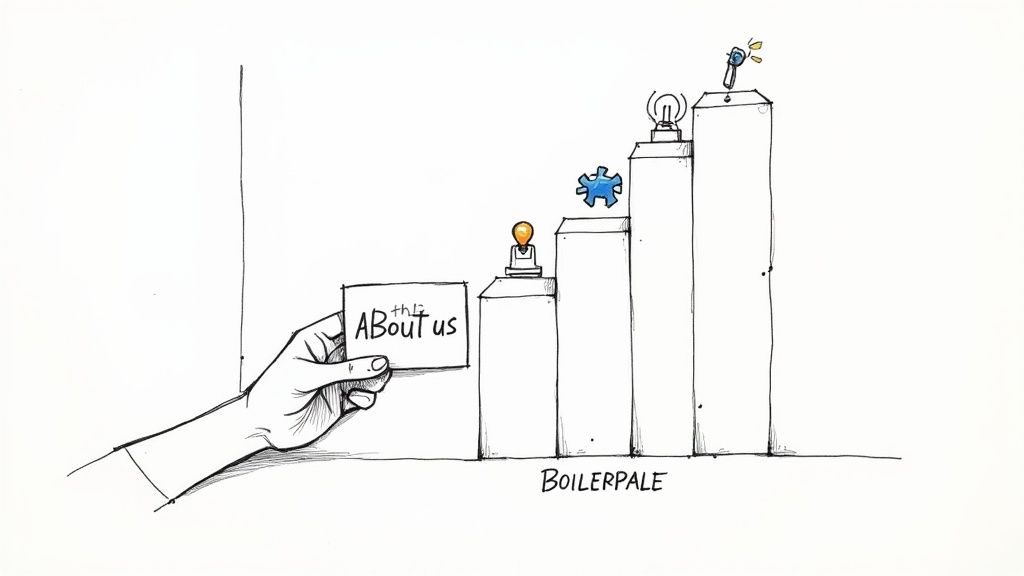
Let's get straight to it. Think of a press release boilerplate as your company's official signature. It’s that short, standardized "About Us" paragraph you see at the end of an announcement, telling journalists—in a nutshell—who you are, what you do, and why it matters.

Picture a press release as a formal letter delivering big news. The boilerplate is the digital business card you clip to the bottom. It's not part of the main story; instead, it provides essential, unchanging context about your organization. Its primary job is to give busy journalists and readers a quick, reliable snapshot of your company's identity so they don't have to go digging for it.
This standardized paragraph is a true staple of professional public relations. In fact, it's estimated that over 85% of professional press releases include a boilerplate, which really underscores its role in effective communication. You can see its importance reflected in guidelines from industry leaders like PR Newswire.
A well-crafted boilerplate is your first tool for building brand identity and consistency. It ensures every piece of news you share carries your core message and makes a journalist's background research faster and more accurate.
By including this section, you're the one controlling the narrative around your brand’s mission, scale, and market position. While the press release headline and body focus on what's new, the boilerplate anchors it with what's foundational. Our detailed press release template in AP style shows you exactly where it fits into the overall structure of a release.
So, what should you actually put in it? Let's break down the most critical components.
A strong boilerplate isn't just a random assortment of facts. It's a carefully constructed summary that includes several key pieces of information. This table outlines the must-have elements.
| Component | Purpose and Description |
|---|---|
| Company Identity | State your full company name and where you are headquartered. This is the most basic, non-negotiable element. |
| Mission Statement | A brief, one-sentence summary of your company's purpose or vision. This answers the "why" behind your work. |
| Core Offerings | Clearly describe your key products, services, or the primary problem you solve for customers. |
| Market Position | Include a key fact that establishes credibility, such as years in business, number of customers, or notable awards. |
| Call to Action | A direct link to your website, encouraging readers to learn more. |
Nailing these five components ensures your boilerplate is not just present, but powerful—giving journalists and readers everything they need to understand your company at a glance.
Ever wonder how to make a great impression that lasts? Think of your press release boilerplate as your company's silent ambassador. It’s not just the last paragraph of your release; it's a powerful tool working behind the scenes to build trust and solidify your brand's story, long after the main news has faded.
When a journalist is scrambling to meet a deadline, they don't have time to dig for basic information about your company. Your boilerplate is their shortcut. It hands them a ready-made, official summary, making their job easier and instantly establishing your credibility. This consistent, professional snapshot appears with every release, reinforcing who you are.
A well-written boilerplate does more than just inform; it builds brand recall. By presenting the same core message time and time again, you create a unified front. Journalists, and even regular readers, begin to recognize your company and what it stands for, which is a huge advantage in a crowded market.
Don't just take my word for it—the numbers back this up. Industry data shows that press releases with a solid boilerplate can boost a journalist's recall of a company by up to 40%. What’s more, 72% of journalists admit they use the boilerplate to double-check key company facts before deciding if a story is worth covering. You can see more stats on how boilerplates influence media relations on DesignRush.
Your boilerplate is the anchor of your press release. While the news provides the immediate value, the boilerplate provides the lasting context and authority.
To really make your boilerplate work as that silent ambassador, honing your effective written communication skills is non-negotiable. It ensures your message isn't just consistent but also sharp, clear, and persuasive. This is your chance to leave a professional, lasting impression that cements your brand's identity with every single release you send out.
Writing a boilerplate can feel like a chore, but it's really just a simple, step-by-step process. Think of it less as a mandatory sign-off and more as your company's compact, powerful elevator pitch. Each piece you add builds on the last, creating a summary that works hard for your brand long after the main news is read.
To get this right, you first need a consistent brand voice. A great starting point is developing comprehensive brand guidelines. This groundwork ensures your tone and message are always aligned, no matter where your boilerplate appears.
Let's start with the basics. State your official company name and where you’re headquartered. It might seem obvious, but this is non-negotiable information that immediately grounds your boilerplate in reality and gives journalists essential context.
Next, get to the heart of it. What's the "why" behind what you do? Distill your entire company's purpose into one clear, compelling sentence. A powerful mission statement immediately tells people what you stand for and sets the stage for everything else.
For example: "Our mission is to make sustainable energy accessible to every household, driving the transition to a cleaner future."
With the "why" established, it’s time for the "what." Briefly explain your key products or services. Ditch the corporate jargon and focus on the value you deliver or the problems you solve for your customers. Keep it specific, but keep it brief.
The infographic below shows how these core components—your company overview, mission, and contact details—come together to create a solid boilerplate.
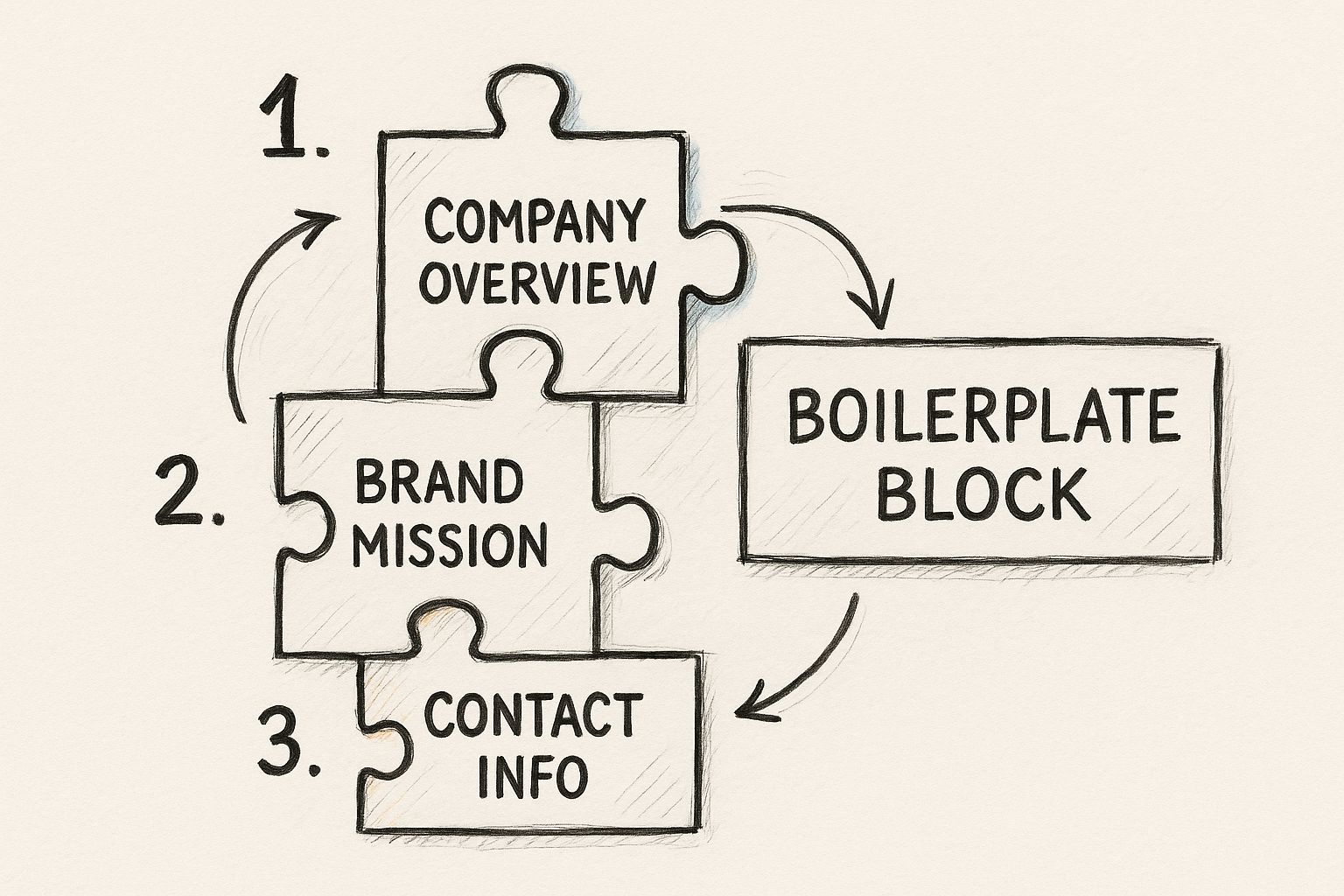
As you can see, each part connects to form a single, unified block of information that's easy for anyone to digest.
So, what makes you different? This is where you add a punch of credibility. It doesn't have to be long, just impactful.
A few ideas include:
Don't leave them hanging! Tell the reader what to do next. Every single boilerplate should end with a direct link to your company’s website. This is your simple, clear invitation for journalists and anyone else who’s interested to dive deeper.
Follow these five steps, and you’ll have a boilerplate that not only completes your press release but genuinely strengthens your PR efforts. To see how this piece fits into the bigger picture, take a look at our full guide on How to Write a Good Press Release.
Theory is one thing, but seeing how the pros do it is where the real learning happens. Let's break down some boilerplate examples from companies you definitely know. We’ll look at a tech giant, a non-profit, and a startup to see how they each nail their "About Us" summary.
When you're a company as massive as Google, how do you possibly sum it all up in one paragraph? You focus on the big picture.
Google’s boilerplate is a masterclass in communicating enormous scale without getting lost in the weeds. It smartly anchors everything to its core mission.
About Google
Google's mission is to organize the world's information and make it universally accessible and useful. Through products and platforms like Search, Maps, Gmail, Android, Google Play, Chrome and YouTube, Google plays a meaningful role in the daily lives of billions of people and has become one of the most widely-known companies in the world.
See what they did there? They didn't list every single Google product—that would be impossible. Instead, they mentioned a handful of heavy hitters (Search, YouTube, Android) that immediately resonate with almost everyone.
This approach lets them talk about their massive impact—"billions of people"—and market position without sounding arrogant. It's confident, clear, and all tied back to that simple, powerful mission.
For non-profits, the boilerplate has to do double duty. It needs to inform the media while also inspiring potential donors and volunteers. The Trevor Project walks this line perfectly.
About The Trevor Project
The Trevor Project is the leading suicide prevention and crisis intervention organization for LGBTQ young people. The organization works to save young lives by providing support through free and confidential 24/7 crisis services. To learn more about The Trevor Project, please visit www.TheTrevorProject.org.
This is incredibly direct and powerful. In just two sentences, you learn:
It's packed with crucial information, leaving no room for ambiguity. The final sentence is a simple, effective call to action that directs people who want to help or learn more right where they need to go.
Startups face a unique challenge: they need to sound credible and established, even when they're the new kid on the block. A great boilerplate can help define a market category and build instant trust.
Take a look at how Aura does it.
About Aura
Aura is a mission-driven technology company dedicated to creating a safer internet for everyone. We believe that people should be able to live their digital lives without fear. Aura's all-in-one digital safety solution is a proactive, personalized, and easy-to-use service for the whole family. Trusted by millions, Aura was named one of the "Best Apps for Families" by a leading industry publication. For more information, visit Aura.com.
This boilerplate does a lot of heavy lifting. It kicks off with a strong, relatable mission—who doesn't want a safer internet? Then it clearly explains its product category: an "all-in-one digital safety solution."
The real magic is in the final sentences. It establishes trust by mentioning it's "Trusted by millions" and adds a powerful dose of social proof by citing an industry award. In just a few lines, Aura goes from being an unknown name to a credible solution.
Of course, here is the rewritten section with a more natural, human-written tone.
You can write the perfect press release, but a sloppy boilerplate can undo all that hard work in a single paragraph. Think of it as your company's official sign-off. If it's weak, confusing, or outdated, it erodes the credibility of your entire announcement.
It’s surprisingly easy to get it wrong, but most errors fall into a few common traps.
This is probably the biggest and most common mistake. Companies get so caught up in trying to sound important that they cram their boilerplate full of corporate buzzwords, technical acronyms, and vague, meaningless phrases.
Before: "Our company leverages next-gen paradigms to synergize scalable, disruptive technologies, empowering B2B clients to unlock unparalleled value streams in the new digital ecosystem."
What does that even mean? A busy journalist trying to understand what you do will just be confused and frustrated. They'll either ignore it or, worse, decide your company is all talk and no substance.
A much smarter approach is to just say what you do in plain English. Write it so your grandmother could understand it.
After: "We provide easy-to-use inventory management software for small retail businesses. Our platform helps store owners track stock, manage orders, and reduce waste, saving them time and money."
See the difference? It's clear, direct, and instantly understandable.
Your boilerplate is a summary, not your company's life story. I've seen some that ramble on for several hundred words, detailing every funding round and product feature since the company’s inception.
Nobody has time for that. Keep it tight. A good rule of thumb is to stay under 150 words. Any longer and you risk your key message getting lost in a wall of text.
This one is a silent killer. Companies write a boilerplate, drop it into their press release template, and then forget about it for years.
An outdated boilerplate mentioning old awards, retired products, or past milestones just looks careless. It signals to journalists that you don't pay attention to detail. Make it a habit to review your boilerplate at least twice a year. You should also give it a refresh after any significant company event, like a rebrand, a merger, or a major product launch. It's a simple step that keeps your brand looking professional and current every single time.
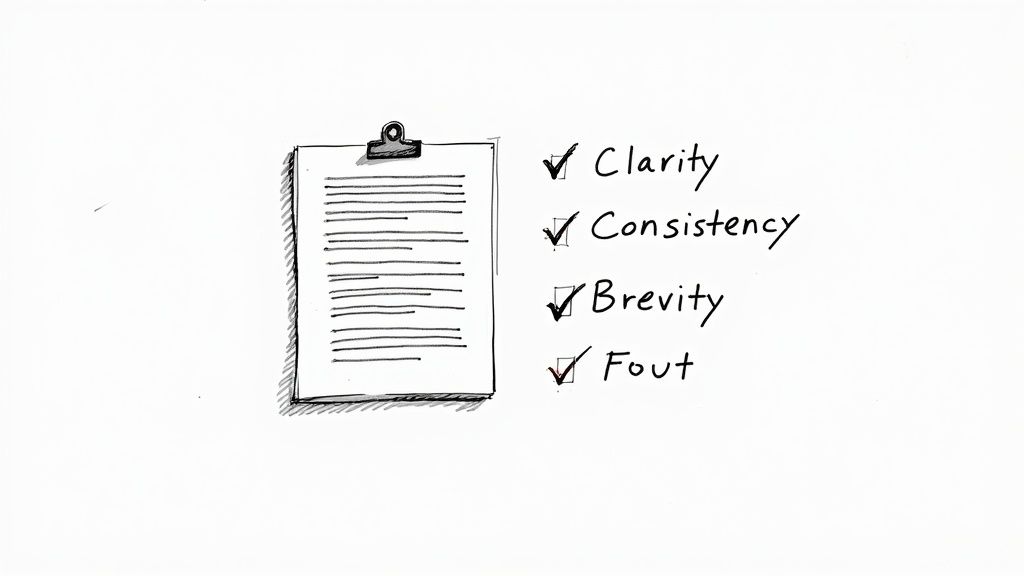
Think of your boilerplate as a core part of your company's wardrobe—it needs to stay in style. It's not a one-and-done task; this little paragraph is a living piece of your brand that should grow and change right along with your business.
Letting your boilerplate get stale is a surefire way to look out of touch. It can really ding your credibility with journalists and partners who count on that section for a quick, accurate snapshot of who you are now.
A good rule of thumb is to give it a thorough review at least once a year. Most companies, as noted in Newswire's analysis of boilerplate practices, refresh theirs every 1 to 2 years to keep up with shifts in their strategy or market position.
But sometimes, waiting for that annual check-in isn't an option. Certain business events are so significant they demand an immediate update.
You should have your boilerplate on your radar anytime something fundamental about your company changes. These events are clear signals that it’s time for a rewrite:
When you treat your boilerplate as the dynamic tool it is, you make sure every press release you send out is sharp, accurate, and builds trust. Getting this right is a small but crucial part of learning how to pitch the media effectively.
Still have a few things you're wondering about? Let's tackle some of the most common questions that pop up when people are crafting their press release boilerplate.
Think short and sweet. You’re aiming for a single, tight paragraph, somewhere in the ballpark of 50 to 150 words. The whole point is to give a journalist a complete snapshot of your company at a glance, not to bog them down with your life story. Stick to the essentials: who you are, what you do, and what you stand for.
Absolutely. In fact, you should! Consistency is one of the biggest perks of having a solid boilerplate. Using the same standardized text for all your general announcements helps build a clear and recognizable brand identity over time.
Now, you might occasionally want to make a tiny adjustment if you're targeting a very specific niche audience, but the core of who you are and what you do should always stay the same.
It's tempting, but it's best to keep the boilerplate itself clean and focused on your main message. A link to your website is non-negotiable, but a string of social media links can make it feel cluttered.
The proper home for your social handles is in the Media Contact section of your press release. That’s where journalists expect to find them.
Ready to get your story in front of the right journalists? With Press Ranger, our AI-powered tools help you craft the perfect press release, find relevant media contacts, and send personalized pitches in just a few clicks. Stop guessing and start making headlines.
Explore essential tools for public relations to enhance your media outreach, monitoring, and reporting efforts. Discover the best tools today!
Discover our deep-dive analysis of a public relations strategy example for crisis management, influencers & more. Steal these actionable tips for your brand.

Discover the best press release distribution service to boost your PR strategy. Find the top options for effective and reliable distribution.