What Is Answer Engine Optimization and How It Works
Discover what is answer engine optimization (AEO) and why it's the future of search. Learn practical strategies to get your content featured by AI engines.
Posted on August 2, 2025
Uncategorized
Olly Cooper
PR specialist @ Press Ranger
For years, we've been laser-focused on one thing: getting our websites to the top of Google's search results. We obsessed over keywords, backlinks, and meta descriptions, all in the name of securing that coveted spot among the ten blue links. But that world is rapidly changing.
Enter Answer Engine Optimization (AEO). Simply put, AEO is the practice of crafting and structuring your content so that AI-powered search engines can easily find it, understand it, and serve it up as a direct answer to a user's question. It's a shift from optimizing for clicks on links to optimizing for providing definitive answers.
The Big Shift: From Search Engines to Answer Engines
Think about your own search habits lately. When you ask Google a question, you're not always looking for a list of websites to dig through. You want a quick, accurate answer right there on the results page. The same goes for conversations with AI tools like ChatGPT or Perplexity. This is the new reality.
This fundamental change in how people find information is why Answer Engine Optimization (AEO) is no longer a "nice-to-have"—it's becoming a necessity. In fact, some analysts predict a staggering 25% drop in traffic from traditional web search by 2026, precisely because AI is getting so good at delivering answers directly. If you want to learn more about this trend, you can explore the impact of this shift on digital marketing.
Thinking "Answer-First"
To stay relevant, we have to start thinking "answer-first." The old mindset was, "How do I rank for this keyword?" The new, more effective question is, "How can I provide the absolute best, most direct, and clearest answer to what my audience is asking?"
This requires a new approach to content creation—one that prioritizes clarity, conciseness, and a structure that's easy for machines to read and process. The goal is to make your content the most logical and trustworthy source for the AI to choose.
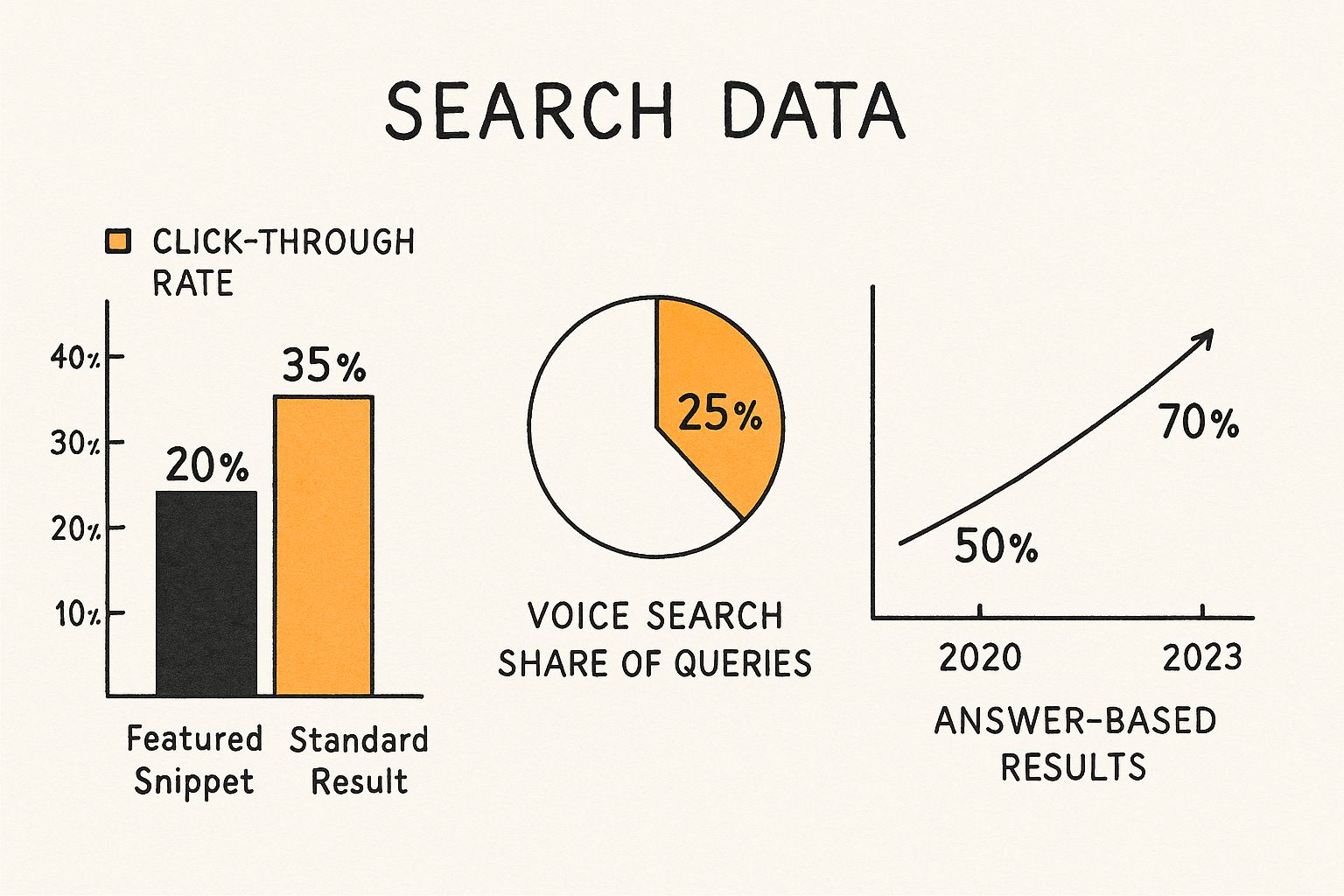
As you can see below, getting featured in an answer-style format like a featured snippet dramatically increases your visibility and the likelihood of getting that click.
The data is clear: being the source of the answer is far more valuable than just being another link on the page.
To really grasp the difference, let's break down how the old and new worlds of search compare.
Traditional Search vs Answer Engines at a Glance
The following table lays out the core differences between the keyword-focused world of traditional SEO and the answer-focused realm of AEO. It highlights just how much the game has changed.
Aspect
Traditional Search (SEO)
Answer Engines (AEO)
User Goal
To find a list of relevant websites to browse
To get a direct, immediate, and trustworthy answer
Engine's Goal
To rank webpages by relevance and authority
To synthesize information and provide a single best answer
Primary Metric
Keyword rankings, organic traffic, backlinks
Getting featured in snippets, voice search, AI chats
Content Focus
Long-form content targeting keywords
Concise, factual, well-structured, easy-to-parse data
Interaction Style
User types a query, clicks a link, and reads
User asks a conversational question, receives an instant summary
As you can see, the shift is from discovery to delivery. Traditional SEO helps users find potential answers, while AEO ensures your content is the answer.
The Core Idea: AEO isn't about throwing away everything you know about SEO. It's an evolution. It’s about layering a new focus on top of your existing efforts—a focus on clarity, authority, and structure. By doing this, you're not just optimizing for Google's old algorithm; you're preparing your content to be the go-to source for the AI-driven answer engines of today and tomorrow.
How Answer Engines Understand Your Content
To get your content featured, you have to stop thinking like a traditional SEO and start thinking about how the machine itself thinks. Forget the old model of a search engine just pointing you to a book on a shelf (a webpage). The new model is a brilliant research assistant who has already read every book, understood the core concepts, and is ready to give you the exact answer you need, right now.
These modern answer engines don't just scan for keywords. They're designed to deeply comprehend the meaning, context, and intent behind the words on a page. Understanding the underlying algorithms that power search engines is the first step, as it reveals how they process information. This foundation is what allows you to create content that speaks to both people and machines.
Ultimately, this whole process is a symphony of a few core technologies working in harmony. Once you know what they are and what they're looking for, you can intentionally structure your content to be the most logical, authoritative choice for a direct answer.
The Brains Behind the Answer
So, what's really going on under the hood? It all boils down to a couple of key components. Answer engines use natural language processing (NLP) to figure out what a user really means, moving way beyond simple keyword matching. Then, they use knowledge graphs and structured data to connect that query to a vast web of verified information.
Here’s a simple breakdown of the main players:
Natural Language Processing (NLP): This is the tech that lets the AI understand human language in all its messy, conversational glory. It's how an engine deciphers the intent behind "how do I fix a leaky faucet," recognizing the user needs a step-by-step guide, not just a page that happens to contain those words.
Knowledge Graphs: Think of this as the AI's own massive, interconnected encyclopedia of facts. It’s a web that links entities—people, places, brands, concepts—and understands the relationships between them. When your content clearly defines these entities, you help the AI plug your brand directly into its knowledge base, cementing you as a trusted source.
The Key Takeaway: Your goal is to make it incredibly easy for these systems to digest your content. The clearer and more structured your information is, the better your chances of being chosen as the definitive answer. This is where structured data becomes your secret weapon.
Using Structured Data as a Label
Structured data, which is usually implemented with schema markup, is like putting a perfect, universally understood label on your content. It’s a bit of code that doesn't show up on the page for users but speaks directly to search engines, telling them exactly what they're looking at.
For example, you can use schema to label your page as a "HowTo" guide, an "FAQPage," or a "Product."
This removes all the ambiguity for the AI. Instead of it trying to guess if your article is a recipe, your schema markup explicitly states: "Hey, this is a recipe. Here are the ingredients, here are the cooking instructions, and here's the prep time." This is a fundamental tactic in both AEO and its close cousin, which is known as Generative Engine Optimization.
When you provide this kind of crystal-clear structure, you make your content perfectly machine-readable and primed to be pulled directly into a featured snippet, a voice search result, or a conversational AI response.
Why Fewer Clicks Can Mean More Value
Let's be honest: the idea of AI answer engines "stealing" your hard-earned traffic can be unsettling. After all the work you've put into climbing the SERPs and boosting visitor counts, seeing those numbers drop feels like a step backward.
But this is where we need to make a crucial mental shift. The game is no longer about winning the most clicks; it's about attracting the right clicks.
This is the central paradox of AEO. While you might see fewer total visitors coming to your site, the ones who do arrive are far more valuable and ready to convert.
The Power of Pre-Qualified Visitors
Think about the user's journey. When someone gets an AI-generated summary, their initial, surface-level question has been answered. Your content has already done the heavy lifting, establishing your authority and satisfying their immediate curiosity right there in the search results.
So, if they still click through to your website, what does that tell you? It means they're past the "just looking" phase. They are actively looking for more detail, a specific product, or the next step in their process. They’ve moved from asking "What is...?" to thinking "Where can I get...?".
The AEO Paradox: You're essentially trading a high volume of low-intent traffic for a lower, more focused volume of high-intent traffic. Every click you get from an answer engine is from someone who already sees your value and wants to engage more deeply.
This isn't just theory; it has a real, measurable impact on the bottom line. Data shows that visitors who come from AI-powered search results convert at a significantly higher rate. For example, one insurance company saw a 3.76% conversion rate from its AI search visitors, compared to just 1.19% from traditional organic traffic. An e-commerce site experienced a similar lift, with a 5.53% conversion rate from AI-sourced visitors versus 3.7% from organic. You can discover more insights about these findings on amsive.com.
Shifting Your Focus from Volume to Value
This pattern shows us that a dip in overall traffic isn't a red flag—it's a sign of a more efficient and effective marketing funnel. Instead of drawing in thousands of casual browsers, AEO helps you connect with hundreds of genuinely interested prospects.
Your key performance indicators (KPIs) need to evolve to reflect this new reality. Start tracking what really matters:
Conversion Rate: How well does your AI-driven traffic convert compared to other channels?
Lead Quality: Are the leads coming from AI search better qualified and more likely to close?
Customer Lifetime Value (CLV): Do these pre-qualified visitors turn into more loyal, higher-value customers over the long term?
By embracing this shift, you can confidently move away from chasing raw traffic numbers and focus on what truly drives growth: cultivating a more profitable and engaged audience.
Core Strategies for Answer Engine Optimization
Knowing the what and why of AEO is a great start, but the real magic happens when you start putting these ideas into practice. The good news? You don't have to throw your entire marketing playbook out the window. Think of AEO as a new layer you're adding to your existing SEO efforts, fine-tuning them for an AI-driven world.
At its heart, the goal is straightforward: make your content the most direct, authoritative, and easy-to-understand answer out there. This all boils down to creating fantastic content, structuring it so machines can understand it, and building a reputation as a go-to expert in your field.
Create Comprehensive and Concise Content
The bedrock of any AEO strategy is content that gets straight to the point. It’s about shifting your focus from broad, generic keywords to the specific, conversational questions your audience is actually asking.
Put yourself in their shoes. If someone searches for "What is AEO?", their next thought will likely be, "How do I implement AEO?" and then, "What tools do I need for AEO?" Your content needs to anticipate this entire chain of thought and answer each question clearly and logically. To keep up with the demand for this kind of high-quality, targeted content, many teams are turning to powerful AI content generators to scale their production efficiently.
Implement Structured Data Markup
If you want to speak directly to an answer engine, structured data (often called schema markup) is the language you need to use. It’s a bit of code you add to your website that acts like a set of labels, telling the AI exactly what each piece of your content is about. No more guesswork.
By using schema, you're essentially pre-packaging your information for the AI. You're saying, "Hey, this section is a list of Frequently Asked Questions," or "This page is a step-by-step How-To guide." This makes it incredibly easy for the engine to grab your content and feature it directly in an answer card or rich snippet.
Some of the most useful schema types for AEO include:
FAQPage: Perfect for pages built around a list of questions and answers.
HowTo: Ideal for any content that provides step-by-step instructions.
Article: Helps define the author, publication date, and headline for your blog posts or news articles.
Person/Organization: Establishes your brand or key team members as known entities.
Build Topical Authority and Entity Recognition
Answer engines don't just look for the right answer; they look for the right answer from a source they trust. Earning that trust means building topical authority—proving you have deep expertise on a particular subject. The best way to do this is by creating content clusters.
This strategy involves publishing a comprehensive "pillar" page on a broad topic (like "A Complete Guide to Small Business PR"). You then support that pillar with numerous "cluster" pages that explore related subtopics in detail (like "How to Write a Press Release" or "Building a Media Contact List"). This interconnected structure sends a powerful signal to AI that you're a definitive resource on the subject.
At the same time, you need to focus on entity optimization. In the world of AI, an entity is any clearly defined thing or concept—a person, a company, a product, or a brand. By consistently getting your brand name (the entity) mentioned in high-quality, relevant content across the web, you help the AI build connections between your brand and your area of expertise. This is how you go from being just another website to a recognized authority in the AI's "mind."
Now, let's pull these strategies together into a practical checklist you can use to get started.
Actionable AEO Checklist
This checklist breaks down the key AEO strategies into concrete steps. Use it as a roadmap to ensure your content is perfectly primed for answer engines.
Strategy Area
Key Action
Tool or Metric to Use
Content Creation
Identify and answer long-tail, conversational questions.
AnswerThePublic, Google's "People Also Ask"
Content Creation
Create topic clusters with pillar and cluster pages.
Ahrefs, SEMrush (for topic research)
Content Creation
Write clear, concise answers at the top of your articles.
By systematically working through these areas, you can build a robust AEO foundation that not only serves your users better but also positions your brand as a trusted authority in the eyes of AI-powered search engines.
How AEO Builds On Your Current SEO Strategy
It’s easy to think of Answer Engine Optimization (AEO) as some entirely new field, forcing you to throw out everything you know about SEO. But that's not the case at all. AEO isn't about starting from scratch; it’s about upgrading the skills and strategies you’ve already mastered.
Think of it this way: AEO stands on the shoulders of good, old-fashioned SEO.
Your website’s technical health is a perfect example. A fast, mobile-friendly, and crawlable site isn’t just an SEO best practice—it’s a non-negotiable for AEO. Answer engines simply won't pull information from a site that’s slow or frustrating to use. The same goes for high-quality backlinks, which continue to signal authority and tell every kind of engine that your content is trustworthy.
These fundamentals are your ticket to the game. AEO is how you start to win.
From Keywords to Conversations
The biggest mental shift you'll need to make is moving beyond simple keywords and embracing full-blown conversations. For years, the SEO game was about zeroing in on specific, often short-tail, keywords. AEO asks you to zoom out and understand the entire chain of questions a user has.
So, instead of just targeting "small business accounting," an AEO mindset has you mapping out the entire user journey:
"What's the easiest accounting software for a small business?"
"How much should a small business budget for accounting?"
"Can I handle my own accounting as a small business owner?"
This fundamentally changes how you build content. You’re no longer creating a page to rank for a single term. You’re building a comprehensive resource designed to satisfy a user's complete line of questioning.
The core mindset shifts from “What keywords are people searching for?” to “What questions do people need answered?” This simple reframe guides your entire content process toward creating genuinely helpful, user-first information.
From Density to Depth
This focus on answering questions makes old tactics like keyword density completely irrelevant. Answer engines couldn't care less how many times you repeat a phrase. What they do care about is the clarity, accuracy, and overall depth of the information you provide.
A piece of content built for AEO gets straight to the point. It gives a direct answer right away, then spends the rest of the article adding valuable context, supporting details, and solid evidence. This approach naturally builds your topical authority, proving you’re a genuine expert on the subject. AEO also comes into play for local searches, a topic we explore further in our guide to Geo-Generative Engine Optimization.
Your new, evolved workflow combines the best of both worlds:
The Foundation (SEO): Start with a technically sound, secure website that has a healthy backlink profile.
The Research (AEO): Dive into conversational query research to pinpoint the exact questions your audience is asking.
The Creation (AEO): Develop in-depth content that answers those questions directly and with authority.
The Structure (AEO): Use tools like schema markup to explicitly tell machines what your answers are.
By blending these approaches, you aren't replacing your SEO. You’re future-proofing it, making sure your brand stays visible and valuable as search continues to evolve into an answer-first experience.
Preparing Your Brand for the Future of Search
Let's be clear: the shift toward answer engines isn't just another passing trend. It’s a fundamental change in how people find information, and it's here to stay. To remain visible, your brand needs to stop thinking about one-off tactics and start embracing continuous adaptation as AI technology evolves. Success isn't found in a magic keyword list anymore.
The most powerful long-term strategy for answer engine optimization is surprisingly simple: become the most trusted, go-to voice in your field. This means consistently publishing content that is clear, factually correct, and genuinely useful. When AI models recognize your website as a reliable source of truth, they'll naturally start pulling your content for answers, putting you directly in front of people at their moment of need.
Adopting a Proactive Mindset
Instead of scrambling every time there's an algorithm update, it's time to get ahead of the curve. Your focus should be on building an unshakable brand reputation and establishing deep, undeniable topical authority. Think of it as building a fortress of expertise—it's a durable competitive advantage that no new technology can easily tear down.
Embracing AEO is about more than just surviving a shift in search; it’s about choosing a better way to connect with your audience. You are moving from interrupting their journey with ads to becoming an integral part of their solution.
This approach demands a real commitment to quality and a dedication to understanding what your audience really wants to know. For brands willing to step up, the rewards are immense. As you begin creating more answer-focused content, you'll also want to explore a related strategy. You can learn more in our guide to Generative Engine Optimization to make sure you're ready for every aspect of AI search.
The future of search belongs to brands that provide direct, authentic value. By adopting AEO, you change your role from a marketer chasing a click to an expert offering the definitive answer. This is how you build real, lasting relationships with customers today.
Frequently Asked Questions About AEO
As you start to work AEO into your marketing, you're bound to have some questions. It's a different way of thinking, after all. This section tackles the common questions that pop up when moving from traditional SEO to an answer-first approach.
Can I Do AEO Without Traditional SEO?
No, you really can't. AEO is the next step in SEO's evolution, not a separate path. AEO builds directly on top of solid SEO fundamentals. Things like a technically healthy website, quality backlinks, and a smooth user experience are the non-negotiable starting point for any AEO work.
Think of it like building a house. Your SEO is the concrete foundation. AEO is the frame, the walls, and the roof you build on top of it. Without that solid base, any AEO efforts you try to implement will be unstable and likely collapse.
How Do I Measure AEO Success?
Measuring answer engine optimization success means adjusting your lens. You'll need to look beyond just organic traffic numbers and keyword rankings and start tracking metrics that show direct value and visibility in new places.
AEO success isn't just about getting more traffic; it’s about attracting better traffic. The real goal is to measure how well you're providing value before the click, and how that early value turns into highly qualified interest in your business.
Here are the key metrics to start watching:
Visibility in AI Answers: Keep an eye on how often your brand gets mentioned or cited in featured snippets, "People Also Ask" sections, and AI chat responses.
Conversion Rates from AI Traffic: Is the traffic coming from an answer engine result converting better than traffic from standard organic search? It often does because these visitors are further along in their journey.
Reduced Bounce Rate: When a user's initial question is already answered on the SERP, they arrive on your site looking for the next level of detail. A lower bounce rate from this group is a great sign they're finding what they need.
What Is the First Step in AEO?
The single most important first step is a mental shift in how you create content. Don't get bogged down in technical details like schema markup right away. First, you have to get the substance right.
Start by digging into the most common, nagging, and important questions your ideal customers have. Once you identify those questions, your mission is to create the absolute best, most thorough, and clearest answer to each one that exists anywhere online. Truly helpful content is the bedrock of AEO.
Ready to get your brand featured as the definitive answer? Press Ranger uses AI to connect you with the right journalists and publishers, helping you build the authority that powers a successful AEO strategy. Let's make headlines together.
If you’ve ever poured your soul into a book only to hear crickets on launch day, you’re not alone. As a book marketing consultant, I’ve seen it happen to the most brilliant of authors—amazing...
Personalization is the heart of meaningful communication — it’s what transforms a message from generic to genuinely engaging. By tailoring your press releases to reflect the language, tone, and priorities of your audience, you make every word feel written just for them.