Learn how to build backlinks naturally with actionable strategies. This guide covers link-worthy content, outreach, and digital PR for lasting SEO success.
Posted on July 19, 2025
Blog
Olly Cooper
PR specialist @ Press Ranger
If you want to build backlinks the right way—the way that actually lasts—you need to stop thinking about "building" and start thinking about "earning." It's a subtle but crucial shift. Forget about clever tricks and shortcuts. The most durable, high-impact links come from creating genuinely exceptional content and fostering real relationships in your niche.
This isn't just about ticking off an SEO task; it's about making your website a go-to resource that people want to reference. That's how you win in the long run.
The True Foundation of Earning Links
Let's get straight to the point. The heart of natural link building is creating assets so genuinely useful, insightful, or entertaining that other site owners and editors feel compelled to link to them. This isn't a quick hack. It's a strategic pillar that aligns perfectly with how search engines like Google are built to operate. You're aiming to become a trusted authority, not just another site begging for links.
This idea goes all the way back to Google's original PageRank algorithm. At its core, a link from Page A to Page B was treated as a vote of confidence. When a well-respected site links to your content, it’s a powerful signal to search engines that your page is credible and provides real value.
The formula itself shows that not all votes are created equal—a link from a major authority site carries far more weight than one from an unknown blog. This is why quality trumps quantity every single time.
The Crucial Mindset Shift: From Building to Earning
Adopting an "earning" mindset is more than just semantics; it's your best defense against Google algorithm updates designed to penalize manipulative tactics. Sure, some black-hat shortcuts might give you a temporary boost, but they come with enormous long-term risk.
A natural backlink profile is diverse and grows organically over time. It's the byproduct of great marketing, valuable content, and genuine industry engagement—not just a checklist of SEO tasks.
This sustainable approach focuses on building a brand and a library of content that people respect and reference on their own accord. You're creating assets that work for you long after you've hit "publish."
Spotting the Difference: Natural vs. Artificial Links
It's vital to understand the difference between white-hat (natural) and black-hat (artificial) link building. One is based on merit and earning trust, while the other is all about trying to game the system.
To make this crystal clear, let's compare the two approaches.
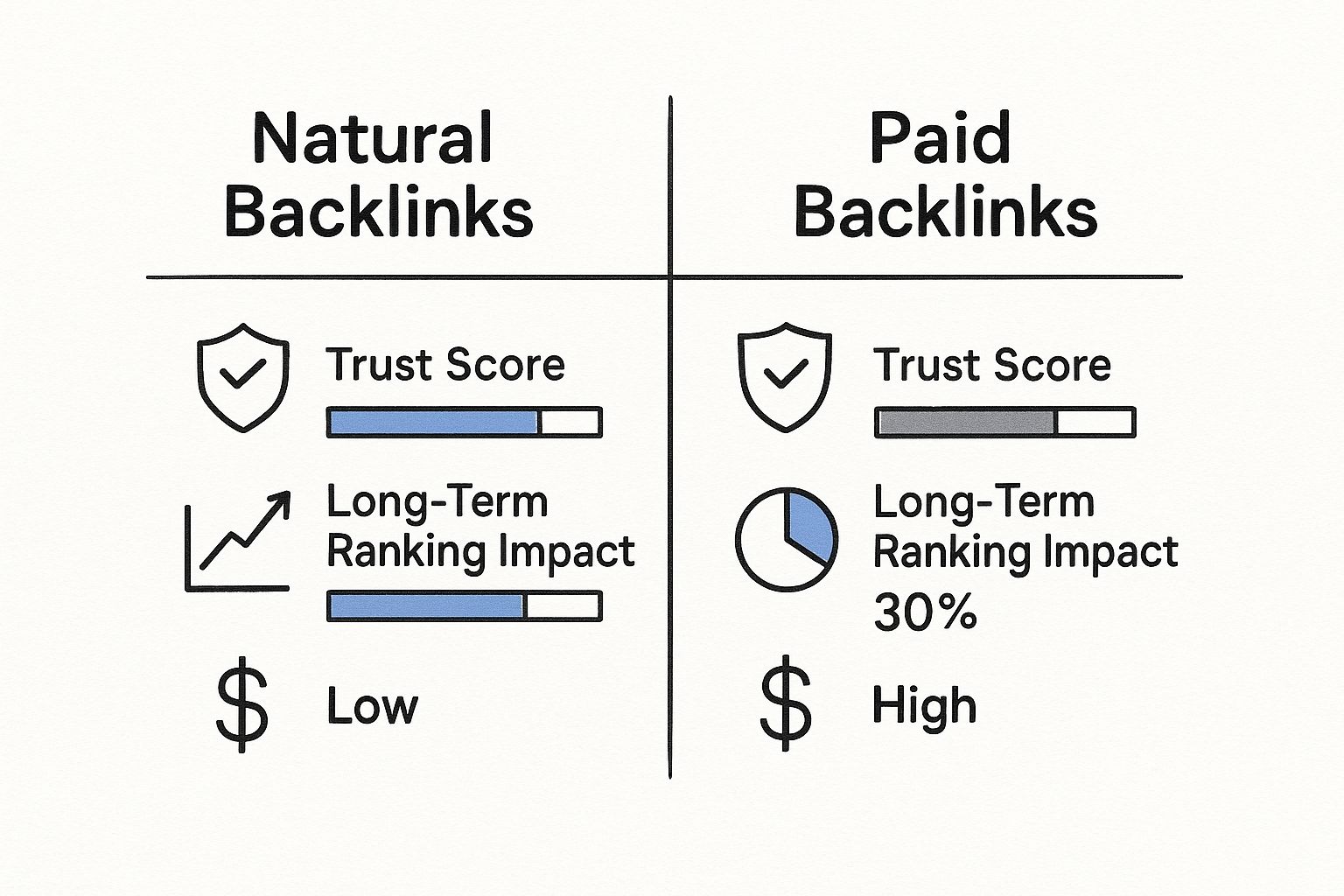
Natural vs Artificial Backlink Strategies
Characteristic
Natural Link Building (Recommended)
Artificial Link Building (Avoid)
Foundation
High-quality, original content that provides real value.
Thin, low-quality content, or no content at all.
Method
Earned through outreach, relationships, and creating linkable assets.
Paid links, private blog networks (PBNs), excessive link exchanges.
Risk Level
Low. Aligns with search engine guidelines and builds long-term authority.
High. Vulnerable to penalties and can wipe out rankings overnight.
Longevity
Sustainable. Links are durable assets that provide lasting value.
Temporary. Links are often removed or devalued by algorithm updates.
Anchor Text
Varied and natural-sounding (brand name, descriptive phrases, URLs).
Over-optimized with exact-match keywords, creating a spammy pattern.
Source Quality
Relevant, authoritative websites within your industry.
Irrelevant, low-authority, or spammy websites.
As you can see, the path of natural link building is the only one that leads to sustainable growth and a resilient online presence.
Chasing risky shortcuts can get your site slapped with a Google penalty, effectively making you invisible in search results. In stark contrast, a single earned link from an authoritative site is an asset that can drive traffic, build credibility, and boost your authority for years to come.
Ultimately, natural backlink building is just good marketing. By focusing on these foundational principles, you're not just building a link profile; you're building a reputable brand that both people and search engines will trust for the long haul.
Creating Content That Naturally Attracts Links
You've probably heard the advice to "create great content" a thousand times. Frankly, it’s become meaningless jargon. To earn backlinks that actually move the needle, you need to think beyond just "great." Your goal should be to create a linkable asset—a piece of content so genuinely useful that other people in your industry feel compelled to reference and share it.
What makes something a linkable asset? It’s a resource that solves a real, painful problem for your audience. Think of the definitive guide you always return to, the original research study everyone cites, or that free tool you’ve bookmarked. That’s the kind of value we're talking about. You want to produce something so essential that linking to it becomes a no-brainer for other creators.
Why Linkable Assets Are a Game-Changer
Let's be honest, not all content is created equal when it comes to earning links. A standard blog post might get a few social shares, but a data-heavy report or an exhaustive tutorial is what gets cited by authoritative sites. The reason is simple: linkable assets offer unique value that can’t be easily replicated.
These pieces become the evergreen pillars of your strategy, quietly attracting backlinks for months or even years. More importantly, they establish your brand as an authority that helps people, building trust with your audience and, by extension, with search engines.
Crafting Content That Demands a Link
This isn't about luck; it's about being intentional. Instead of just picking a topic and writing, your mission is to create the single best resource on that subject anywhere on the internet. This means finding the gaps in what's already out there and creating something more thorough, better-researched, or more visually engaging.
From my experience, a few content types consistently pull in high-quality links:
Original Research & Data-Driven Articles: Journalists and bloggers are always hunting for fresh stats to back up their claims. When you conduct your own survey or analyze unique data, you become the primary source. Anyone who wants to use your findings has to link back to you.
Ultimate Guides & In-Depth Tutorials: A truly comprehensive guide that covers a topic from A to Z becomes an indispensable resource. When you create the go-to page for a complex subject, others will gladly link to it rather than reinvent the wheel.
Free Tools & Calculators: A simple, practical tool that solves a recurring problem is a powerful link magnet. Think of a mortgage calculator, a headline analyzer, or a keyword density checker. They provide ongoing value that people will reference time and time again.
If you're feeling stuck, it can help to look at some fresh content marketing ideas to get the creative juices flowing and find an angle that hasn't been done to death.
The Power of Smart Formatting and Framing
How you present your content is just as crucial as the information itself. Nobody wants to cite a wall of text, no matter how brilliant it is. This is especially true for long-form content, which demands thoughtful organization to be effective.
Use clear headings, short paragraphs, bullet points, and custom graphics to make dense information scannable and easy to digest. Embedding videos is another smart move. The data is clear: just including relevant media can make your content significantly more link-worthy.
Even the way you frame your title has a measurable impact. Structuring headlines around questions often makes them more intriguing to both readers and other writers looking for sources.
Here’s a reality check:94% of all web pages have zero external backlinks. Yet, articles that push past 3,000 words get 3.5 times more backlinks on average. Add a couple of videos, and you could see a 55% lift. Titles starting with 'What' or 'Why' also attract 25.8% more links. This isn't guesswork; it's a proven formula.
When you combine unique value with strategic presentation, you're not just creating content anymore. You're building a repeatable system for producing resources that others will naturally want to link to. That’s the real secret to earning high-quality backlinks without begging for them.
The Art of Personalized Outreach: It’s All About the Human Connection
Let's be honest. Even the most incredible piece of content can't just sit there and expect to get noticed. It needs a nudge. That’s where outreach comes in, but I’m not talking about spammy, copy-and-paste emails. I’m talking about building real connections that lead to real, high-quality backlinks.
The whole game is moving away from mass email blasts and toward messages that actually resonate with another human being. It’s about proving you’ve done your homework and respect their time. A great pitch feels less like a request and more like the start of a valuable conversation.
Pinpointing the Right People to Contact
Before you write a single word of your pitch, you have to know who you're writing to. Sending a brilliant email to the wrong person is a complete waste of everyone's time. Your goal is to find the specific people who actually have a reason to care about what your content says.
I always look for the authors, editors, or website managers who have recently written about or linked to content similar to mine. It's a dead giveaway that they're actively interested in the subject. Steer clear of generic inboxes like "[email protected]" if you can help it. I use tools like Hunter.io, but honestly, some good old-fashioned snooping on LinkedIn can often uncover the direct email of the person you need to reach.
How to Craft a Pitch That Actually Gets Opened
Your subject line is everything. It's your one shot to stand out in a sea of emails. Forget about generic titles like "Link Request" or "Content Suggestion"—they scream "delete me."
Instead, try to spark a little curiosity or show immediate value. I've had success with approaches like these:
An intriguing question: "Quick question about your post on [Topic]"
A genuine compliment: "Loved your take on [Specific Subject]"
A clear value-add: "Some data for your next [Topic] roundup"
Once they open it, your first sentence has to seal the deal. This is where you prove you’re not a robot. Start with a real, specific compliment about their work. Mention a specific article, a point they made on a podcast, or even something they posted on social media.
The secret to great outreach is simple: show, don't just tell. Prove you understand their work and their audience before you ask for a single thing. This small act builds instant trust.
Sticking to key email personalization best practices isn't just a suggestion; it's the foundation for getting results. That little bit of extra time you invest can completely change your success rate.
Writing a Compelling, Human-Centered Pitch
After your personalized opening, get to the point. Quickly explain why you’re reaching out and, most importantly, how your content helps their audience. Don't just pitch your content; frame it as a resource that makes their existing work even better.
For instance, instead of the tired, "Here's my article, please link to it," try a more helpful angle: "I noticed in your guide to [Topic] you touched on [Related Point]. I actually just published a detailed case study with some new data that expands on this, which I thought your readers might find valuable."
This isn't just theory; it's backed by data. It takes about 8 days on average for an outreach email to result in a backlink. But here's a kicker: simply using the person's first name can increase your chances of getting that link by at least 50%. It makes the person on the other end feel seen and valued.
Following Up and Building Real Relationships
So many people send one email and give up if they don't hear back. Big mistake. A simple, polite follow-up can easily double your response rate. Just wait about a week and send a gentle nudge. People are busy, and your first email might have just slipped through the cracks.
But the ultimate goal here isn't just one link; it's to start a professional relationship. If they link to you, always send a thank-you note. Keep up with their work and engage with it on social media. Learning how to build media relationships that last is what turns a one-off win into a long-term partnership filled with future collaborations and mutual support.
Winning High-Authority Links with Digital PR
Sure, great content and smart outreach are the bread and butter of link building. But what if you could land your brand on the digital front page of a major publication? That’s where a more proactive strategy comes in: Digital PR.
Forget the old-school "spray and pray" press releases. Modern Digital PR is about strategically positioning yourself as an expert source for journalists who are already writing stories and need insights. It completely flips the script. Instead of you chasing links, reporters start seeking out your expertise.
Honestly, this is one of the most effective ways I've seen to earn backlinks from truly authoritative domains. We're talking about household names like Forbes and Business Insider. A single link from a site like that can be worth more for your SEO than dozens of links from smaller blogs combined.
Becoming a Go-To Source for Journalists
The secret here is becoming a reliable source for journalists on a tight deadline. Reporters in every industry are constantly on the hunt for quotes, data, and expert opinions to make their articles more credible. When you can give them a sharp, insightful contribution, they'll often give you a backlink as credit.
So, how do you find these reporters? You could try wading through thousands of emails or endlessly scanning social media, but that's a recipe for burnout. This is where specialized platforms have really changed the game, connecting you directly to journalists looking for sources.
These services act as a bridge between experts like you and the media, centralizing requests so you can easily find relevant opportunities.
HARO (Help a Reporter Out): The classic, go-to platform for journalist queries.
HERO (Help an Expert Reporter Out): A similar service that's also great for finding media requests.
Featured.com: Another popular platform for discovering opportunities to contribute your expertise.
Twitter #journorequest: A surprisingly effective, real-time way to find reporters who need a source right now.
Keeping an eye on these channels is your ticket to sharing what you know and getting some incredible backlinks in return.
Streamlining Your Digital PR Efforts
Let's be real: manually sifting through hundreds of daily requests on these platforms can quickly become a full-time job. The real trick to succeeding with Digital PR is to automate the discovery process so you can pitch you or your clients with maximum efficiency. You want to see only the opportunities that perfectly match your niche.
The most powerful Digital PR strategies don't rely on manual effort. They use smart systems to filter the noise, allowing you to focus your energy on crafting the perfect pitch for high-value opportunities from publications like Forbes and Business Insider.
This is exactly where a tool like Press Ranger becomes a game-changer. It acts as a HARO pitch request database, centralizing opportunities from all the big sources—HARO, HERO, Featured, and even Twitter's #journorequest hashtag—into one clean dashboard. No more wading through thousands of emails.
Imagine you're a financial advisor. You could set up notifications for keywords like "investment tips," "retirement planning," or "stock market trends." The moment a journalist posts a relevant query, you get an alert. This lets you jump on the opportunity and respond with a timely pitch while it's still hot.
This targeted approach completely transforms your link-building efforts. You're no longer just shouting into the void with cold emails. You're providing direct value to journalists who are actively looking for it, which is the key to turning your expertise into powerful, authority-building links. This method is a cornerstone for anyone looking to see how authors can turn PR into a long-term visibility strategy and build a sustainable engine for growth.
Using Social Media to Amplify Your Content
While most link-building strategies involve actively chasing down links, there's another, more subtle layer to add to your game: social media. It’s easy to write off platforms like X (formerly Twitter) or LinkedIn because their outbound links are typically tagged as 'nofollow'. This means they don't directly pass on that precious SEO authority.
But writing them off entirely is a huge mistake.
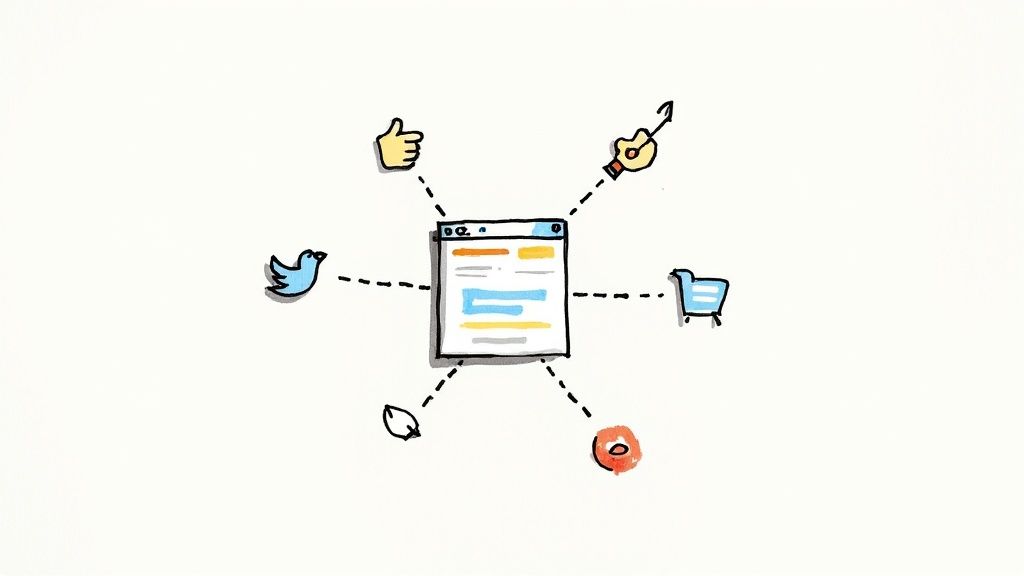
Think of social media as your content’s amplification engine. Your goal isn't to get a 'nofollow' link from a single post. The real objective is to use that post to put your content right in front of the people who matter—the journalists, bloggers, and industry leaders who can give you the valuable 'dofollow' links you’re actually chasing.
Turning Social Signals into Backlink Opportunities
When you share your latest ultimate guide or a new data-driven report, you're starting a ripple effect. Every share, comment, and like is a social signal that pushes your content beyond your immediate circle of followers. This is precisely how you break into new audiences and catch the eye of content creators looking for their next great source.
Picture this: a well-respected blogger in your niche is scrolling through their LinkedIn feed and sees your insightful post. They click the link, love your article, and decide it's the perfect resource to cite in their upcoming weekly roundup. Boom. A simple social share has just blossomed into a high-quality, relevant backlink.
The real power of social media in a natural link-building strategy is its ability to create discovery moments. You're not just sharing content; you're engineering opportunities for your work to be found by those who can provide authoritative endorsements.
As a bonus, this approach also diversifies your traffic sources and builds brand authority, making your site more resilient and trusted in the long run.
Choosing the Right Platforms and Strategy
Of course, not all social platforms are created equal for this kind of work. The key is to zero in on where your target link-givers—the people you want links from—actually spend their time.
For most B2B brands, that's going to be LinkedIn and X. If you're in a more visual niche, a platform like Pinterest can be a goldmine for driving traffic to infographics and visual guides, which often get picked up and linked to by other sites.
A winning strategy involves more than just dropping a link and hoping for the best. To really make this work, you need to be intentional.
Tag relevant people and companies. When you share, make a point to thoughtfully tag any experts or brands you mentioned in your article. This is a direct, non-spammy way to put your content on their radar.
Join the conversation. Find active discussions on X or in LinkedIn groups that are related to your content's topic. Position your article as a genuinely helpful resource that adds value to the conversation.
Customize your posts. Don't just copy-paste the article title. Pull out a surprising statistic, turn a key point into a thought-provoking question, or write a compelling summary to hook people in and earn that click.
Even though social media generally provides 'nofollow' backlinks, consistently sharing your best work on the right channels dramatically increases its visibility. This leads directly to a higher chance of earning organic backlinks from bloggers and journalists who discover your content.
This social amplification contributes to a healthier, more diverse backlink profile and a steady stream of referral traffic. You can explore a variety of public relations tools to help manage and track these efforts. By strategically putting your best content into the right social streams, you stack the odds in your favor for it to be discovered and earn the natural links that truly matter.
Common Questions About Natural Link Building
If you're diving into natural link building, you've probably got questions. It's a complex part of SEO, and it's smart to be curious. Let's tackle some of the most common ones I hear from people trying to build real authority for their brand.
How Long Does It Really Take to See Results?
This is the big one, isn't it? Everyone wants to know when the hard work pays off. The honest answer is: it’s a long game. We're not talking about an overnight fix; this is a serious investment in your site's authority.
Sure, you might land your first few amazing backlinks within weeks of launching a killer piece of content. That's a great feeling. But seeing a real, tangible lift in your organic traffic and rankings? That takes a bit more patience.
As a general rule, you should plan on seeing a meaningful impact within 6 to 12 months of consistent, focused effort. Of course, this timeline isn't set in stone. It can speed up or slow down based on:
Your Niche: Trying to rank in a super-competitive industry like finance or marketing will naturally take longer than a less crowded space.
Your Content's "Wow" Factor: Truly exceptional, genuinely helpful content that people want to share will attract links much faster.
Your Outreach Hustle: A steady, personalized, and relentless outreach effort will always accelerate your progress.
The most important thing is to stick with it. The high-quality, earned backlinks you get this way build a rock-solid foundation that will support your SEO for years. It's worth the wait.
Are Paid Backlinks Ever a Good Idea?
I get this question a lot, and the answer isn't a simple yes or no. Let’s be crystal clear: directly buying backlinks just to manipulate Google's algorithm is a direct violation of their guidelines. It's a shortcut that can get you a nasty penalty, tank your rankings, or even get your site booted from the search results entirely.
But there's a gray area: paid promotion.
Think about paying for a sponsored post on a high-quality blog in your industry. This is a totally legitimate advertising tactic. The key difference here is all about transparency and intent.
As long as the link in that sponsored post is properly tagged with a rel="sponsored" or rel="nofollow" attribute, you're usually in the clear. Your goal isn't to trick Google—it's to get your brand in front of a new audience and drive referral traffic.
Ultimately, Google wants to know why you're doing it. Are you trying to game the system, or are you paying for placement to reach real people? The first approach is a dangerous gamble. The second can be a perfectly valid part of your overall marketing mix.
How Do I Know If My Link Building Is Actually Working?
Success in link building is about so much more than just racking up a high number of backlinks. A truly successful campaign moves the needle on the metrics that actually matter to your business.
To get the full picture of your ROI, keep an eye on these four key areas:
Referring Domains: This is arguably a more critical metric than your total backlink count. The goal isn't just more links; it's links from a wide variety of new, authoritative sites. One link each from ten different relevant websites is infinitely more powerful than ten links from the same one.
Organic Traffic Growth: Jump into your analytics and look for a steady upward trend in visitors from search engines. Pay close attention to the specific pages you're building links to. If organic traffic to those pages is climbing, that's a fantastic sign your strategy is paying off.
Keyword Ranking Improvements: Start tracking your search positions for your most important keywords. As you earn authoritative, relevant links pointing to a page, you should see it start climbing the ranks for its target terms.
Referral Traffic: A great backlink does more than just pass "link juice"—it sends you real, interested visitors. Check your analytics to see how many people are clicking through from the sites that link to you. This is proof that your links are placed in front of an engaged audience.
What Tools Make Digital PR and Outreach Less Painful?
While there's no substitute for genuine, manual outreach, trying to do it all by hand—especially Digital PR—is a recipe for burnout. The goal is to work smarter, not harder. Manually digging through thousands of journalist requests is a massive time sink.
This is where a few good tools can be a game-changer. They streamline the whole process, helping you find journalists who are actively looking for sources just like you. The opportunities start coming to you.
For instance, a platform like Press Ranger pulls together pitch requests from all the major sources—think HARO, HERO, Featured, and even the #journorequest hashtag on Twitter—into one place. You can set up alerts for keywords relevant to your expertise. So when a writer from a publication like Forbes or Business Insider needs an expert in your field, you get notified instantly and can pitch them while the opportunity is still hot. It turns a manual grind into a targeted, efficient way to land those top-tier backlinks.
Tired of wading through thousands of emails to find a single PR opportunity? Press Ranger centralizes journalist requests and uses AI to help you land press in top-tier publications. Stop chasing links and start letting high-authority opportunities come to you. Let's make headlines together.
Personalization is the heart of meaningful communication — it’s what transforms a message from generic to genuinely engaging. By tailoring your press releases to reflect the language, tone, and priorities of your audience, you make every word feel written just for them.
Learn how to write a press release that attracts attention. Our guide on how to write a press release helps you craft effective, newsworthy announcements.