6 Public Relations Strategy Example Breakdowns for 2025
Discover our deep-dive analysis of a public relations strategy example for crisis management, influencers & more. Steal these actionable tips for your brand.
Discover how PR in healthcare enhances patient trust, ensures compliance, and elevates your reputation with modern strategies.


When you hear "public relations," you might think of flashy product launches or celebrity apologies. But in the world of healthcare, PR plays a much more fundamental role. It’s the critical, often delicate, work of building and safeguarding the trust between medical organizations and the public they serve.
This isn't just about spinning a story. It's about translating complex, sometimes intimidating, medical information into messages that are clear, correct, and compassionate. It’s a field that carries immense ethical weight and operates under a microscope of strict regulations.
Think of healthcare PR less as marketing and more as the art of building a reliable bridge. On one side, you have the intricate world of medical science, clinical trials, and health policy. On the other, you have the people who need to make sense of it all—patients, their families, and the broader community. Healthcare PR is that bridge.
Unlike general PR, which might be focused on boosting sales for a new smartphone, healthcare PR handles information that can genuinely change lives. That’s why accuracy and empathy aren't just nice-to-haves; they're the absolute foundation of the job.
In an industry where credibility is your most valuable asset, reputation management is everything. A single mistake or a poorly worded statement can shatter public confidence that took decades to earn. This is why the best PR professionals in this space are more than just communicators; they are strategic counselors and guardians of trust.
At its heart, the goal is to cultivate communication that is consistently clear, ethical, and human. Whether you're a small local clinic or a world-renowned research institution, this mission is paramount. It breaks down into a few key responsibilities:
PR in healthcare is fundamentally about responsible storytelling. It’s about sharing the human side of medicine—stories of groundbreaking research, patient courage, and community health triumphs—in a way that is both compelling and completely compliant.
For instance, imagine a hospital acquires a new robotic surgery system. The PR team’s job isn't to simply issue a press release announcing the new tech. Their real work is to explain what this advancement means for a patient. They translate the technical jargon into tangible human benefits: safer procedures, shorter hospital stays, and a quicker return to normal life.
Ultimately, great healthcare PR helps an organization be seen as more than just a provider of medical services. It establishes them as an essential, trustworthy partner in the community's health. It’s a careful blend of science, strategy, and genuine sincerity.
A strong public relations program in the healthcare world doesn't just happen. It’s built on a sturdy foundation of intentional, interconnected strategies that all work together to build trust and protect an organization’s integrity. Think of it like the pillars supporting a grand building—each one is absolutely essential for the entire structure to remain stable and successful.
These are the core functions that every effective PR in healthcare strategy must master. If you neglect one, you risk weakening the whole thing, leaving your organization exposed to reputational harm or a breakdown in public trust.
The key is to remember who sits at the heart of it all.
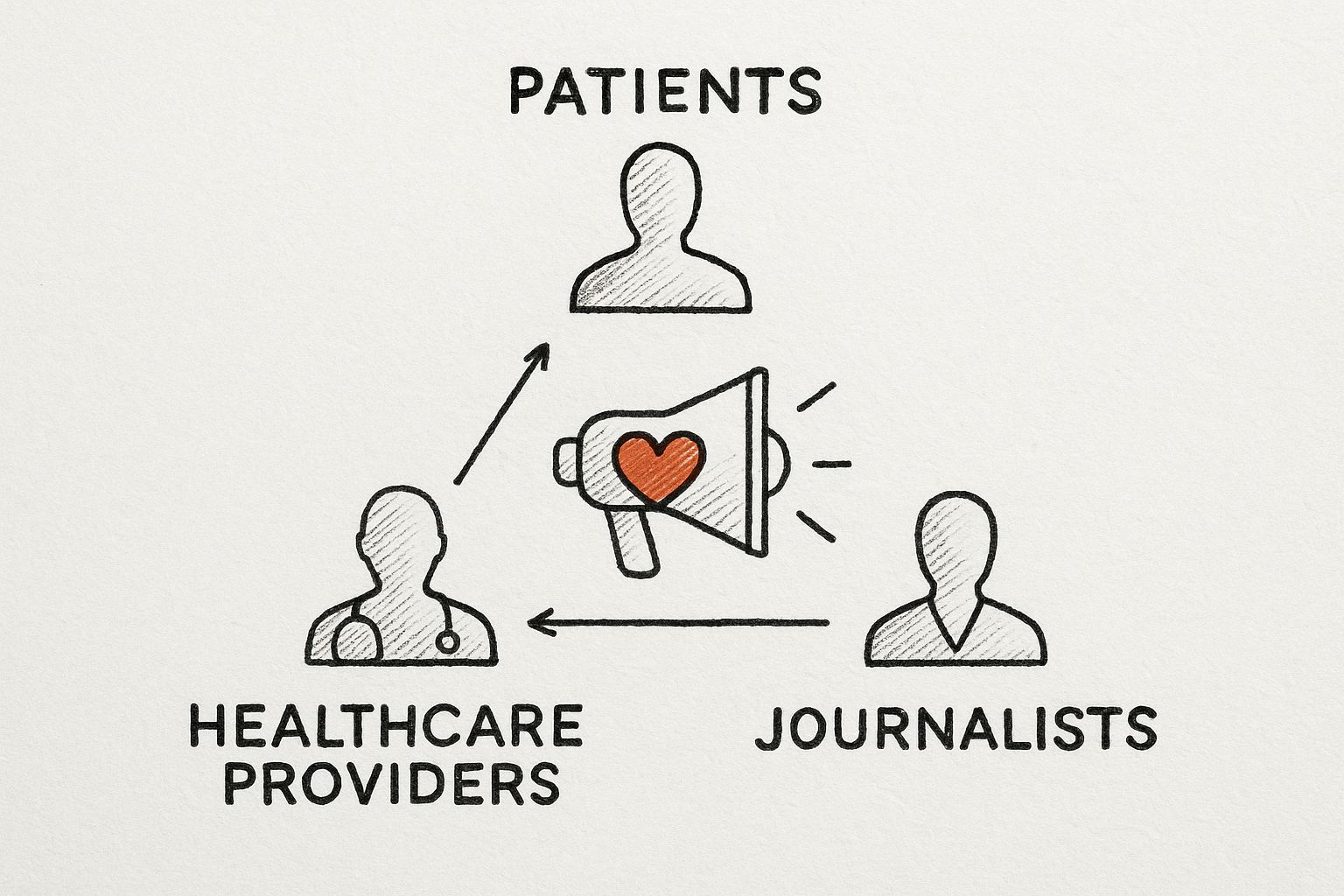
As you can see, truly successful communication keeps patients, providers, and the media at the very center of the message. This creates a powerful, interconnected network built on confidence and credibility.
To bring this to life, we can break down a comprehensive healthcare PR strategy into its fundamental components. These pillars represent the ongoing work required to build and maintain a positive public presence.
Below is a table summarizing these core pillars and what they aim to achieve.
| Pillar | Primary Objective | Key Activities |
|---|---|---|
| Reputation Management | To proactively build and maintain a positive public image and deep reservoir of goodwill. | Storytelling, sharing patient successes, promoting research, thought leadership. |
| Community Engagement | To establish the organization as a genuine, caring partner in the community's health. | Hosting health fairs, sponsoring local events, partnering with non-profits. |
| Media Relations | To cultivate positive relationships with journalists and become a trusted source for health news. | Proactive outreach, press releases, media training, expert positioning. |
| Crisis Communication | To protect the organization's reputation and maintain trust during a negative event. | Developing response plans, stakeholder communication, transparent updates. |
Each of these pillars plays a unique role, but they are most powerful when they work in concert, reinforcing one another to create a resilient and respected brand.
This is the day-in, day-out work of shaping how the public sees your organization. It's about consistently telling your story—highlighting patient successes, groundbreaking research, and deep community involvement—before someone else tries to tell it for you.
The whole point of this pillar is to build a deep reserve of goodwill and credibility. While it can often feel more like an art than a science, it's a critical component for long-term survival, especially for newer organizations. In fact, many foundational PR principles are universal, which is why our guide on public relations for startups can be a fantastic resource for any growing healthcare entity.
Great healthcare PR doesn't stop at the clinic doors. It means getting out there and actively participating in the health of the community you serve. This pillar is all about action, not just words.
Common activities include things like:
These efforts forge authentic connections and position your organization as a true partner in public health. This groundwork is vital, especially as the industry grows. The healthcare communications market is projected to skyrocket to USD 36.42 billion by 2030, a surge driven by the increasing demand for better patient engagement. You can read more about these shifting healthcare communication trends to understand how they're shaping the market.
These last two pillars are two sides of the same coin. Media relations is the strategic art of building relationships with journalists, bloggers, and influencers who cover the health and medicine beat. It’s about becoming their go-to, trusted source for accurate information, which helps ensure fair and positive coverage when you have good news to share.
On the flip side, you have its defensive counterpart.
Crisis communication is the detailed plan you put into action when something goes wrong—whether it's a data breach, a medical error, or a public health emergency. A well-rehearsed crisis plan allows you to respond swiftly, transparently, and effectively to minimize damage and begin the hard work of rebuilding trust.
Without a solid crisis plan, even the most stellar reputation can be shattered in an instant.
When you're working in healthcare PR, you quickly learn that rules aren't just red tape—they're the very foundation of trust. Think of it like being a tightrope walker. On one side, you have the exciting task of telling powerful stories that resonate with people. On the other, you have a solemn duty to uphold strict legal and ethical standards. Your balancing pole? A rock-solid understanding of the two big regulatory players: the Health Insurance Portability and Accountability Act (HIPAA) and the Food and Drug Administration (FDA).
One wrong move isn't just a slap on the wrist. It can lead to massive fines and, worse, a devastating blow to your reputation that could take years, if ever, to repair. Getting these rules right isn't just a good idea; it's the price of admission for doing PR in this field.
At its core, HIPAA’s Privacy Rule is all about protecting what's known as "individually identifiable health information." For a PR pro, this translates to a simple, unbreakable rule: you never, ever share a patient's story, their picture, or even a seemingly minor detail without their clear, written permission.
And I don't mean a quick "is this okay?" email. The consent form has to be specific, spelling out exactly what information you'll be sharing, where you plan to use it, and for how long.
For instance, a hospital can't just send out a press release celebrating a patient's amazing recovery from a new procedure and mention their name. That requires a signed authorization. The same goes for posting a glowing patient testimonial on the hospital's Instagram feed. To keep your strategies above board, it's smart to work from a comprehensive HIPAA compliance requirements checklist. It helps you build a process for getting consent and keeping that sensitive data locked down.
The main takeaway is straightforward:
Patient privacy is sacred. Always get explicit, written permission before featuring any patient in your public communications. When in doubt, de-identify the information completely.
While HIPAA is about patient data, the FDA is focused on how you talk about medical products like drugs and devices. The FDA’s job is to make sure that any promotional claim you make is truthful and not misleading. This brings us to a crucial concept called "fair balance."
Fair balance means exactly what it sounds like. Any piece of content, whether it's a website or a video ad, has to present a product's benefits and its risks with equal weight. You can't scream about a drug's benefits in a huge, bold font and then whisper its side effects in tiny print at the bottom of the page. That balance has to be consistent everywhere.
Here’s how fair balance looks in the real world:
Ultimately, getting through this regulatory maze comes down to being diligent and truly committed to ethical communication. By making patient privacy and balanced promotion your top priorities, you build a kind of trust that makes your organization’s reputation stronger and sets you up for success in the long run.
The conversation around healthcare has fundamentally shifted. It's no longer confined to the four walls of a clinic. Today, that conversation starts online. Patients aren't just passively waiting for their next appointment; they're actively searching on Google, scrolling through social media, and reading health blogs for answers. This means that for any modern healthcare organization, effective PR in healthcare is completely tied to a strong digital presence.
Think of your website, social media pages, and email newsletters as your new front door. They're often the very first interaction someone has with your brand. This gives you an incredible chance to educate people, build a real community, and establish trust long before a patient ever steps foot in your facility. The trick is to create useful, evidence-based content that speaks directly to the questions people are actually asking.
This isn’t just a trend; it's the new reality. A staggering 72% of healthcare advertising budgets are now funneled into online channels. This spending is simply following patient behavior—studies show 65% of patients are already researching their health concerns online before they even think about booking a consultation.
A smart digital strategy is about more than just broadcasting information. It’s about cultivating a genuine two-way conversation and building supportive online spaces where patients feel seen and heard. That means you have to listen just as much as you talk.
Using digital listening tools can be a game-changer. They let you monitor what people are saying about your organization, your competitors, and important health topics. This gives you a direct line into public sentiment, helping you spot common questions or even misinformation that you can then address head-on. This proactive approach is a cornerstone of any effective digital PR plan. You can learn more about this in our guide to digital PR strategies.
To truly protect and shape your organization's image online, you need to master social media reputation management and stay tuned in to public perception.
A quick and compassionate response is non-negotiable. Research shows that 91% of patients now expect an answer from providers within 24 hours. Simply acknowledging a comment or question, even if it's just to say you're looking into it, shows you're paying attention and that you care.
To keep your digital efforts consistent and impactful, a content calendar is an absolute must. This simple tool helps you plan, organize, and roll out your communications in a structured way. It ensures you’re hitting a good mix of topics and speaking to all the different groups in your audience.
Your content calendar should be organized around key themes. For example:
By planning your content this way, you turn your digital channels from a simple megaphone into a go-to resource center. This not only bolsters your reputation but also provides a real, tangible service to your community—strengthening the very foundation of your PR work.
Artificial intelligence isn't just a buzzword from a sci-fi movie anymore; it’s a very real and practical tool that's fundamentally changing how PR in healthcare gets done. It's best to think of AI not as a replacement for human communicators, but as a brilliant assistant that can handle the grunt work—automating routine tasks, spotting hidden patterns in data, and serving up insights that guide our decisions.
This shift is incredibly freeing. It allows PR professionals to step away from the tedious, manual parts of the job and concentrate on what humans do best: building authentic relationships, telling powerful stories, and making sharp, strategic choices. With AI doing the heavy lifting on data analysis, our time and talent are freed up for more creative and impactful work.
One of the biggest game-changers AI brings to the table is its ability to process enormous amounts of information in the blink of an eye. Modern media monitoring tools, powered by AI, can scan thousands of news articles, social media feeds, and online forums to get a real-time pulse on public sentiment. It’s like having an early warning system for a brewing crisis, helping teams spot negative chatter and jump on it before it spirals.
On top of that, machine learning algorithms can sift through demographic and psychographic data to build incredibly precise audience profiles. Imagine launching a public health campaign for diabetes prevention. Instead of a broad, one-size-fits-all message, you can now target at-risk groups with messages crafted specifically for them, making the campaign far more effective.
AI is also streamlining the way healthcare providers talk to patients, making interactions faster and more helpful. For instance, AI-powered chatbots on a hospital's website can instantly answer common questions about visiting hours, how to schedule an appointment, or where to find billing information.
AI’s impact is measurable. By 2025, 64% of healthcare organizations report that AI directly affects their business success. The data shows AI tools can boost patient engagement by 45% through better audience targeting. Meanwhile, AI chatbots can slash response times by 80% and improve patient satisfaction by 35%.
This kind of automation doesn't just give patients quicker answers. It also frees up your human staff to handle the more complex or sensitive conversations that truly require a dose of empathy and critical thinking. By integrating AI, PR becomes a smarter, more responsive function that’s better prepared to meet the needs of today's patients. To get a sense of the bigger picture and how technology is evolving, it’s worth reading up on broader AI innovations transforming healthcare delivery and thinking about how they'll shape our PR strategies down the road.
Knowing the theory is one thing, but seeing it work in the real world is where the lessons really hit home. The true power of PR in healthcare shines when we look at how real organizations handle both the exciting opportunities and the inevitable challenges.
Let's break down two very different scenarios to see these principles come to life.
Picture this: a regional hospital is about to open a brand-new, cutting-edge cardiology center. The goal isn't just to put out an announcement. It's to cement the center's reputation as the go-to place for heart care in the entire region.
Instead of just sending out a generic press release, their PR team built a thoughtful, multi-stage campaign.
First up was human-interest storytelling. The team found compelling (and fully HIPAA-compliant) patient stories that powerfully illustrated the life-saving impact of the new center's technology and expertise. These weren't blasted out to everyone; they were pitched as exclusives to local TV news, leading to heartfelt segments on the evening news.
At the same time, they worked to position the center's lead cardiologist as a true thought leader. This meant writing and placing op-eds in regional papers on topics like preventative heart health and getting her booked on popular local radio shows to share her knowledge.
The grand opening itself was a community event, not a corporate ribbon-cutting. They offered free health screenings and family-friendly activities, which created a wave of positive social media buzz.
The result? The launch felt like a genuine service to the community, not just a business move. Before the doors even officially opened, the center had built a stellar reputation and already had a waiting list of patient inquiries.
Now, let's flip the script to a much trickier situation. A public health agency needs to announce new, fairly complicated guidelines for infection control. The information is dense, and the potential for public confusion or media misinterpretation is incredibly high.
This is where crisis communication skills are used proactively.
Rather than just dropping a technical document online and hoping for the best, the communications team took a much more strategic route:
This transparent, multi-pronged approach allowed the agency to control the narrative and solidify its position as a trustworthy source of information. A huge part of their success hinged on a well-written announcement, and you can learn more about how to write a good press release in our guide.
These two cases perfectly illustrate that great PR in healthcare is all about strategic, empathetic, and clear communication, no matter the situation.
Diving into public relations for the healthcare industry often brings up some very specific questions. It's a unique field where the art of communication meets the hard science of medicine and the strict rules of regulation. Let's tackle some of the most common questions I hear from people trying to navigate this space.
This is the big one. Unlike a simple sales campaign, you can't just track direct revenue to measure the success of PR in healthcare. The real return on investment is built on trust and reputation, which requires a more nuanced approach.
Think of it as a blend of different metrics that, together, paint a clear picture of your impact.
Here are the key performance indicators I always recommend focusing on:
If you remember only one thing, let it be this: never, ever treat a patient's story like a typical marketing asset. Their experience is protected health information (PHI), plain and simple.
Using a patient's story without their explicit, written, HIPAA-compliant consent isn't just a misstep; it's a massive legal and ethical disaster waiting to happen.
Always prioritize patient privacy above any communication goal. A single violation can cause irreparable harm to your organization's reputation and lead to substantial fines. Never assume consent is implied; always get it in writing.
Absolutely. Public relations isn't just a game for massive hospital systems. For smaller practices, PR is one of the most powerful tools for building a rock-solid local reputation and connecting directly with the community you serve.
A small clinic can punch well above its weight by focusing on hyperlocal strategies. For instance, you could:
These focused efforts build a deep foundation of trust that attracts new patients and keeps them coming back. It proves that great healthcare PR isn't about budget; it's about being a valuable, visible part of your community.
Ready to build trust and get your organization the positive attention it deserves? Press Ranger uses AI to connect you with the right journalists, craft compelling press releases, and publish your story on major news sites. Let's make headlines together. Discover Press Ranger today.
Discover our deep-dive analysis of a public relations strategy example for crisis management, influencers & more. Steal these actionable tips for your brand.
Learn how to write a press release that attracts attention. Our guide on how to write a press release helps you craft effective, newsworthy announcements.

Investors want numbers. Journalists want narratives. Learn how to deliver both.