
How to Rank Anything on ChatGPT (Part 3)
Part 3: free third-party platforms that earn AI citations, including LinkedIn articles, Quora, Reddit, Facebook Pages, Product Hunt and Medium.
Posted on September 19, 2025
AI Search

steve
This piece was originally sent as an email via New Feature Friday on September 19th, 2025.
Hey team,
Happy Friday. Today I’m continuing my ultra-popular series on How to Rank Anything on ChatGPT. If you’ve been living under an email rock, I’m happy for you but make sure to read Part 1 and Part 2 so that today’s email makes sense.
Ok, you’re caught up, right? That means we know that LLMs overweight authoritative domains, build consensus across sources, and broadly favor the “listicle” style format. Therefore, we need to seed answers in this format where chatbots actually look.
In simple terms, “as seen in multiple places” >> “as seen on your own blog”.
As a side note, Press Ranger’s Wholesale press release distribution does this for you by indexing content on AI chatbots like ChatGPT, Gemini, Perplexity, etc. across real, reputable publishers like Business Insider, Market Watch, Yahoo Finance, AP News, etc. but we can also do this for free. In fact, that's today's topic.
We’re going to talk about how to get more AI citations by creating high-ranking third-party content for your brand to increase AI citations for free.
Before you do this, your brand should have:
- A live website with basic SEO strategy in place
- A primary keyword/query target that you want to rank for that’s winnable for your brand (be realistic)
- 3 blog posts targeting the query on your own domain that are human written and high quality
- Claimed pages on all major social platforms
- A primary review capture site with some 5-star reviews (dependent on your niche)
If you don’t have the above, stop what you’re doing and fix that first. Then, let’s make some content.
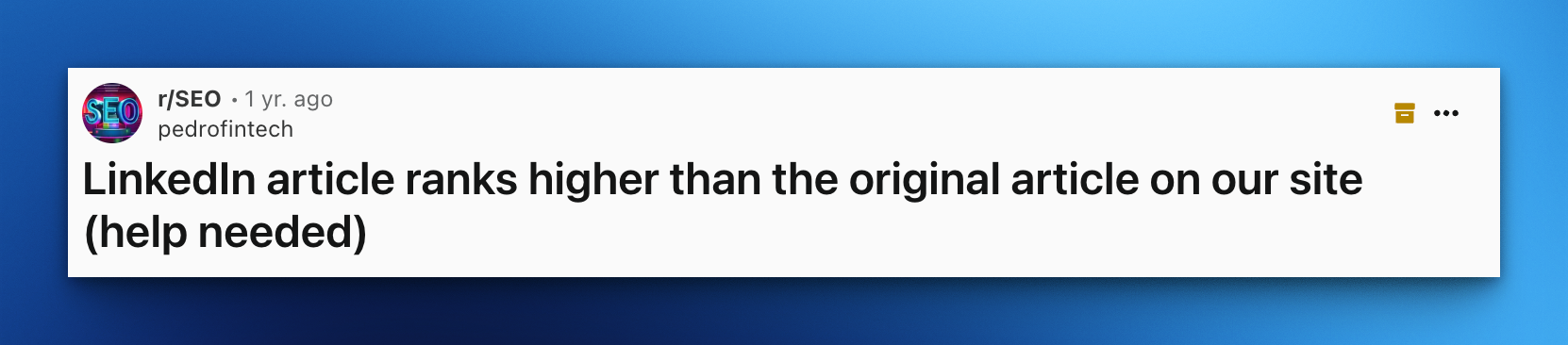
1) LinkedIn Articles
What it is: I do not mean LinkedIn posts. I mean long-form articles that live on your LinkedIn profile and company page. These are highly discoverable in LinkedIn + increasingly visible to LLMs due to identity + engagement signals.
What to publish: Case studies, “playbooks,” teardown threads converted to articles, and industry POVs with data.
Pro tips: Pin your best Article to your profile. Repurpose into a PDF and attach to a feed post for extra reach.
Pitfalls: Don’t make it a sales page. Lead with useful, quotable info.
2) Quora
Why it works: While everyone fights for shelf space on Reddit, Quora answers still rank in Google and show up as LLM citations for “how/which/best” queries.
What to publish: Specific answers to commercial-adjacent questions (e.g., “best PR software for startups,” “how to get PR without an agency”).
How to do it (quick):
- You only care about questions that rank. Find key targets in Google with this search “site:quora.com {your target query}”
- Write concise, structured answers with bullets, short paragraphs, and a final mini-summary.
- Add neutral comparisons and mention competitors (credibility > shilling).
- If you link, link no more than once to a deep resource (guide, case study)—not your homepage.
Pro tips: Monitor for and answer new questions early.
Pitfalls: Generic fluff. Low quality answers will get collapsed.
3) Reddit
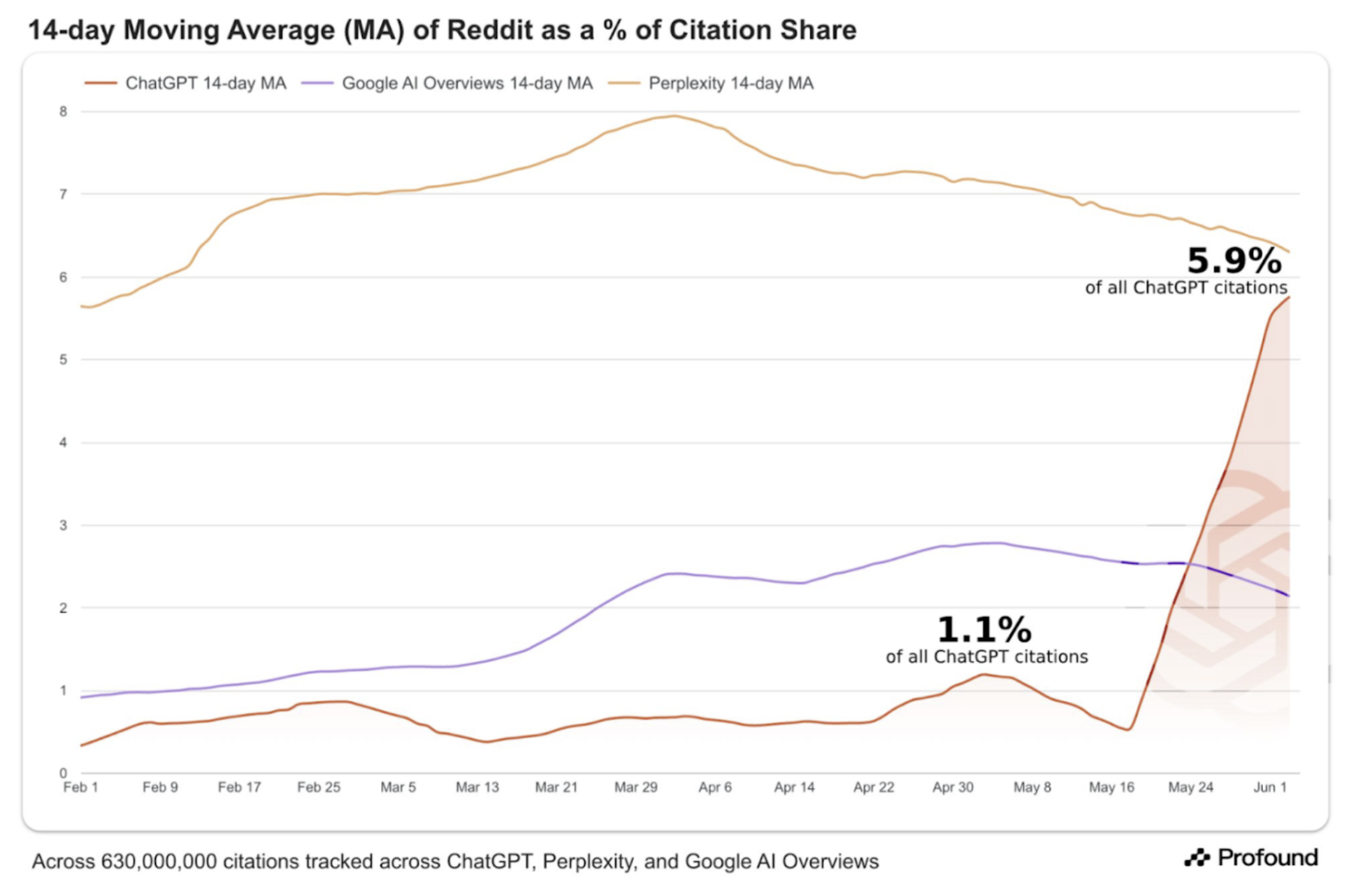
Why it works: I’ve talked about Reddit a ton and it deserves all of the hype. Reddit is the most-cited domain on the internet. LLMs love it because humans do the spam prevention. Humans love it because there’s less spam (less obvious spam, perhaps?)
What to publish: Value-first comments, how-to walkthroughs, and results breakdowns. Natural product mentions should be 5% of your comment. Do not shill. Think: “Here’s exactly how we got X coverage; steal this checklist.”
How to do it:
- Google: site:reddit.com "your target query" → list top 30 threads.
- Join relevant subs; read the rules.
- Comment with 95% value, 5% disclosure.
Pro tips: Everyone shilling on Reddit tells you to create "fancy spam" so it feels real. This works but you can save your time and just disclose who you are and provide good answers to questions. Offer to help a Redditor using your expertise in a thread. Say who you are and don’t shill. You’ll earn saves + karma and you can mention your brand without getting flagged.
Pitfalls: Overt self-promo = ban. Warm up accounts before using.
4) Facebook Pages
Why it works: Facebook Pages are making a renaissance of late. LLMs are ingesting public updates as lightweight authority signals.
What to publish: Short updates with clear summaries, fresh media room links, and press release highlights.
How to do it (quick):
- Post recaps of launches with a 3-bullet summary.
- Attach images (placements, charts) and one deep link.
- Create Events for launches, webinars, or reports (events get unique URLs and are indexable).
Pro tips: Cross-post to your personal profile (public) when appropriate.
Pitfalls: Don’t duplicate to your Twitter/X feed. Facebook favors native media.
5) Product Hunt
Why it works: If you’re working with a software brand, a Product Hunt launch is a free, high-authority profile regardless of how the launch does. After the launch, your product gets its own Product Hunt forum (kind of like a subreddit). Threads you create here get indexed across all key channels and can rank well.
What to publish: It’s a waste of time to post launch summaries and feature updates. Focus on use-case specific mini-case studies, ex “How I used (brand) to (solve primary problem your users have)”. Write for founders and tech nerds.
Pitfalls: Shilling will get you banned very quickly.
6) Medium
Why it works: Medium ranks fast, gets scraped often, and supports a wide variety of content formats.
What to publish: Human written, high-quality guides, listicles, and explainers; “lessons learned” in first-person. Medium loves detailed, cited, long-form content.
Pro tips: Refresh content quarterly (and change the title to denote the last update) to keep recency signals up. Cite sources. Write in first person. Add TLDR and FAQ blocks.
Examples:
- My experience choosing the best PR software (Updated September 2025)
- I tried every payroll software on the market (full guide and comparison)
- A full review on 10 of the best AI visibility tools (Q4 2025 version)
Pitfalls: Don’t post duplicate content. Pick pillar pieces only. Don’t have AI write these (they will get flagged).
7) Ongoing and/or Untested Experiments
This is a gold rush here and enterprising nerds like me are actively digging for it. Everyone is trying to find new content surface areas that rank well in AI search. The following publishers are in my orbit but I have not been able to prove results with them yet. These are not endorsements, but if you're nerding out on all of this you should know about:
- HubSpot Community
High authority domain with a popular forum but moderation remains a key barrier. High-quality/authentic content is likely to perform well here. (Hat tip Indexsy). - Notion
A growing rumor is that public Notion pages can also be cited by ChatGPT - GitHub
Gists and repos can rank better than you’d imagine. In fact, I have a growth hack to increase domain authority that involves GitHub and another popular platform that you can email me about. - Claude/Qwen/Perplexity Pages
Many AI chatbots can publish pages with your content on their high authority domain, so why can’t we use them to increase our content footprint? Well, it turns out you can. These are likely to be patched as quickly as they are discovered but real nerds do claim there is value here at the moment. (Hat tip Jesper Nissen)
Isn’t this a lot of work?
Yes! A few notes for you:
- Just chip away
This doesn’t need to be perfect and you don’t need to dedicate your life to this (let me do that). Just spend an hour here and there chipping away at this list and the other recommendations in this series. Write some Reddit posts on a Sunday morning. Re-post your Business Insider placements to your Facebook page. Make sure your blog is good. Consistency beats one big sprint and then nothing. - When the bar is low, just step over it
If you’re in a less competitive niche, you probably don’t need to do that much to win AI search. For something like “best yoga studio in Des Moines” or “accounting software for breweries” the bar is low. A handful of listicles, a couple of reviews, amplify them with AIWire, add some fresh content on your site and I'd bet on you to win. Don’t overcomplicate it: in under-served niches, showing up is half the battle. - This helps other stuff, too
I'm writing a guide to rank higher in AI search but all of the actions are helpful for much more than just AI search. SEO, brand awareness, PR, sales, and marketing all get a lift when you do these things. - Stop looking for your next thing
This is it. Brands are going to learn this, try it, mess it up, and need to hire someone. This new structure completely resets the playing field and makes it possible for new agencies to win big. If you want to do something new, start acontent marketing agencyLLM SEO Agency.
Let’s pause here. We’re deep in the weeds of AI search. How are you? Do you like this? Send me a ‘MORE’, send me a meme, send me a high five. Let me know. I’ll do more next week if you guys like it.
And if you’ve read this far, you get a sneak preview of Press Ranger’s new marketing plan:
Jump to another part of the How to Rank Anything on ChatGPT series:
Sign up for New Feature Friday
We ship a new feature every week, and tell you about it in a snarky Friday email. Covering the intersection of PR, Brand, and AI Search.