12 Affordable press release distribution You Should Know
Discover the top 12 affordable press release distribution strategies and tips. Complete guide with actionable insights.
Discover how PR distribution software streamlines media outreach. Learn to choose the right platform, automate campaigns, and amplify your brand's message.

So, what exactly is press release distribution software?
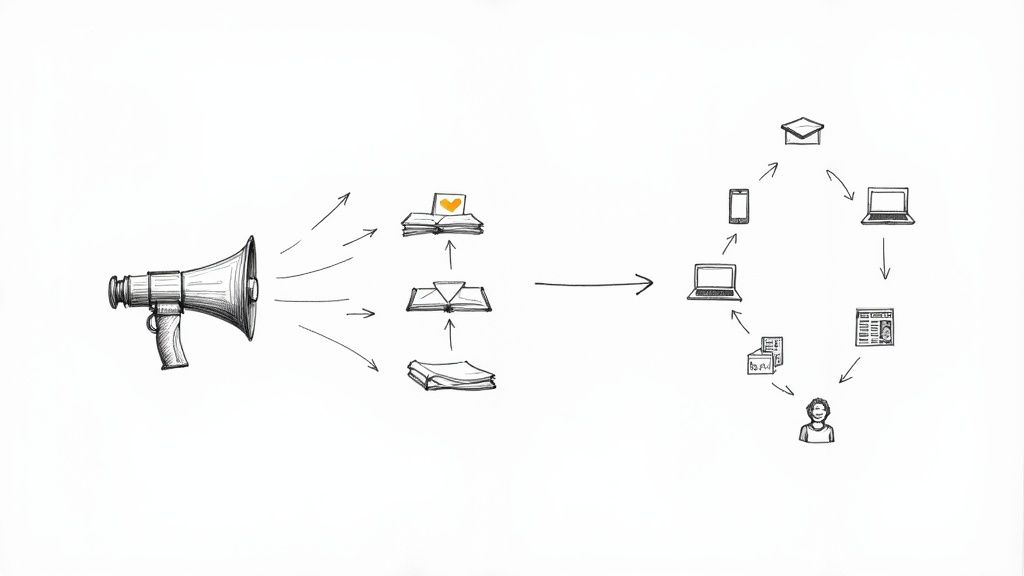
Think of it like this: You could try to shout your big news from a rooftop, hoping the right people happen to walk by and hear you. Or, you could use a high-powered broadcast system that delivers your message directly to every influential journalist and media outlet that needs to hear it. That's the difference between old-school manual PR and using modern press release distribution software.
At its core, this software tackles one of the biggest headaches in public relations: getting your news in front of the right eyes, at precisely the right moment. Instead of spending days, or even weeks, painstakingly building media lists and sending one-off emails, these platforms provide instant access to massive, constantly updated databases of media contacts. You can slice and dice these lists by industry, location, or a journalist's specific beat, ensuring your pitch is always relevant.
This isn't just about saving time; it's a fundamental shift in how PR gets done. By automating the grunt work, PR pros are freed up to focus on what truly matters: crafting compelling stories, building genuine relationships with the media, and thinking strategically. In today's 24/7 news cycle, that speed and focus can be the difference between a story that lands and one that gets lost in the noise.
The industry has certainly taken notice. The global software distribution market, which these platforms are a part of, was valued at around USD 129.6 billion in 2024. It's projected to rocket past USD 536.2 billion by 2035, a clear signal that automation is no longer a luxury but a necessity in PR. You can find more on these market trends to see just how rapidly the field is evolving.
The difference in efficiency is night and day. Let's break down the workflow to see how using a dedicated platform changes the game.
| Task | Manual PR Process | PR Software Process |
|---|---|---|
| Media List Building | Days of research, hunting for contacts, verifying emails. | Instant access to a searchable, pre-vetted database. |
| Pitch Customization | Manually personalizing each email (or using clumsy mail merge). | Dynamic fields and templates for quick, scalable personalization. |
| Distribution | Sending emails one by one or in small, risky batches. | Scheduled, targeted sends to thousands of contacts in minutes. |
| Follow-Up | Guessing who opened your email; manual tracking in a spreadsheet. | Automated tracking of opens, clicks, and engagement. |
| Reporting | Manually compiling "as seen in" links; difficult to measure ROI. | Real-time analytics dashboards showing media pickups and campaign impact. |
As the table shows, software transforms a series of manual, time-consuming chores into a cohesive and measurable process.
This infographic paints a vivid picture of the efficiency gains across time, reach, and cost when you move from a manual process to an automated one.
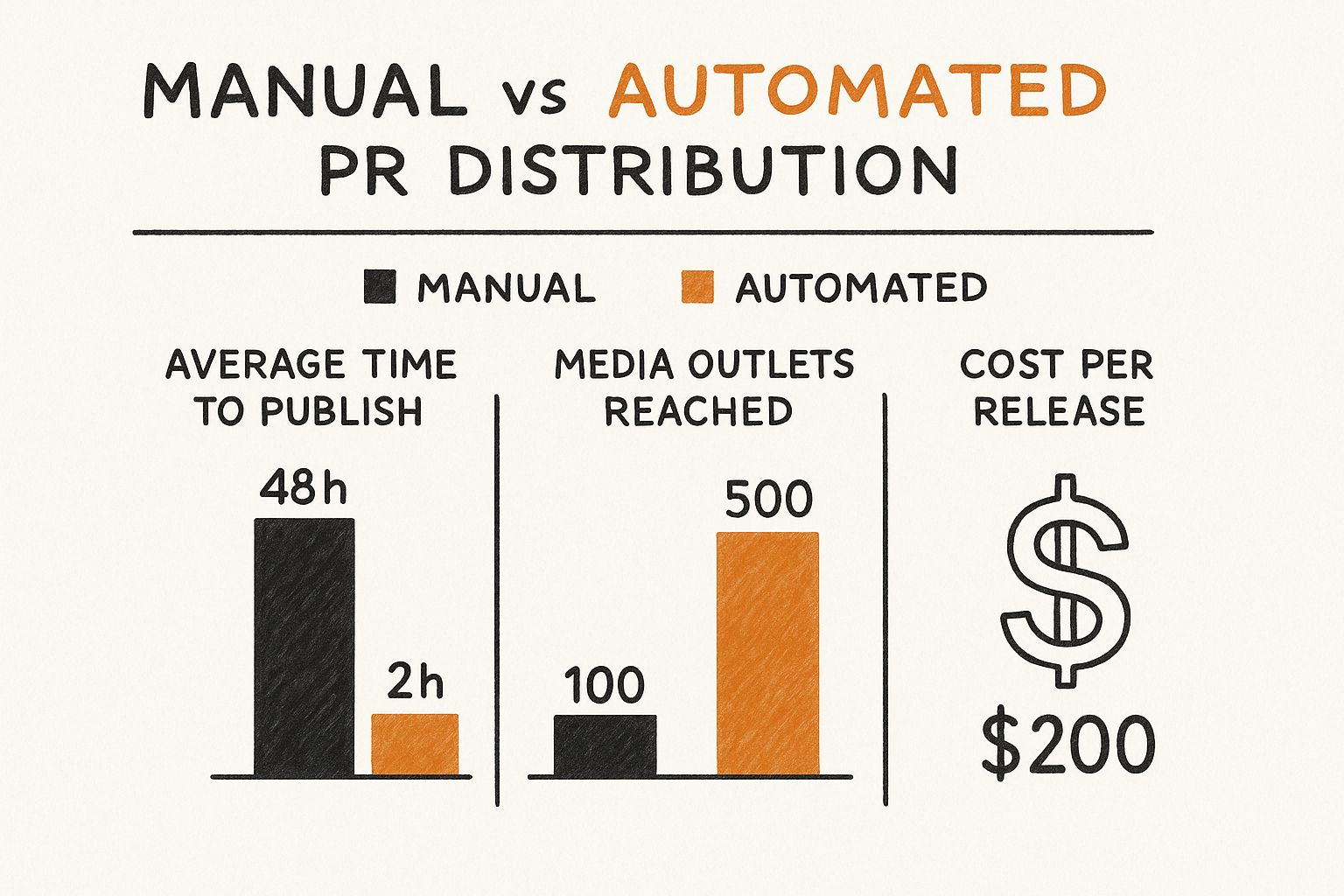
Simply put, using software shrinks the time to publication from days down to a few hours, all while massively expanding your reach and being more cost-effective.
Modern PR platforms are far more than just glorified email blasters. They're complete command centers for your media outreach, designed to give you control over the entire process.
The whole point of this software is to make your life easier and your workflow feel effortless. A well-designed platform gives you a clear, repeatable structure for every campaign you build and manage.
Here’s what you should expect to find under the hood:
These features all work together, giving you a powerful, end-to-end system for running a modern PR strategy. They arm you with the tools not just to send the news, but to understand its impact and prove your value.
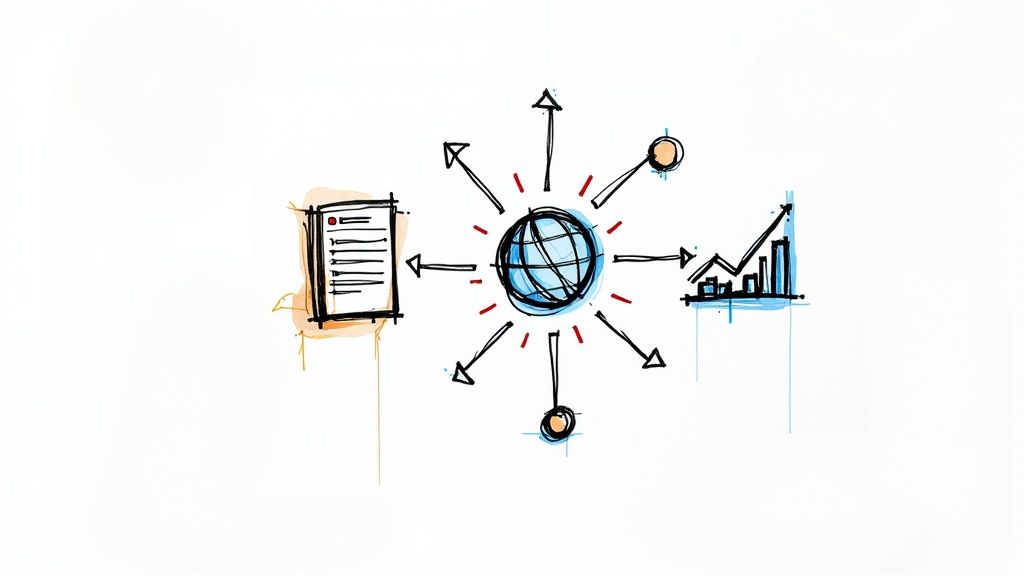
To really get what PR distribution software can do, you have to look under the hood. These platforms are much more than just a fancy way to send emails. They’re powerful tools packed with specific features designed to not only get your story out there but also prove it made an impact.
Understanding these core components is what separates sending a press release into the void from strategically shaping your public image. Each feature is built to solve a real, nagging problem that PR pros have been wrestling with for decades—from the grunt work of finding the right contacts to the pressure of proving a campaign actually worked.
The heart of any good PR software is its media database. Forget your old, dusty spreadsheet of contacts that’s probably out of date. Think of this as a living, breathing encyclopedia of the media world, constantly updated with the journalists, bloggers, influencers, and producers you need to reach.
Instead of sinking hours into manually searching for relevant people, you can filter this database in seconds.
This capability turns what used to be a week of painful research into just a few minutes of focused clicking. You get a direct line to the people who can actually tell your story.
Having a massive database is one thing, but using it effectively is the real game-changer. This is where precision list building comes in. It’s the feature that lets you stop blasting your news to a generic, impersonal list and start creating hyper-targeted groups for every single announcement.
Let’s say you're a B2B SaaS company launching a new AI-powered feature. With smart list building, you can create a specific list of tech journalists who’ve recently written about artificial intelligence, editors at key business publications, and influential B2B software reviewers. This means every single person getting your pitch has a proven interest in your topic, which radically boosts your chances of getting coverage. This targeted approach is a huge advantage that many essential tools for public relations provide.
The goal is to ensure your message is a welcome piece of information, not just another email to be deleted. By curating your lists, you respect the journalist's time and increase your own credibility.
Once your list is perfected, the software handles the heavy lifting of sending everything out. You can schedule your press release to go to hundreds or thousands of contacts with a single click. But the best platforms offer more than a simple "send" button. They give you critical control over timing.
An embargo is a PR pro’s best friend. It lets you send a press release to journalists before the official announcement, with the clear instruction not to publish until a specific date and time. This gives reporters a head start to write their articles, conduct interviews, and be ready to hit "publish" the moment your news is public. It’s how you orchestrate a big, coordinated media splash that gets everyone talking at once.
This might be the most important feature of all: the analytics and reporting dashboard. For far too long, PR success was fuzzy and hard to quantify. Modern software completely changes that by serving up concrete data on your campaign's performance.
You can instantly see the metrics that matter:
This data is your proof of performance. It empowers you to walk into a meeting and show executives the tangible results of your work, justify your budget, and—most importantly—refine your strategy for the next campaign based on what the numbers tell you.
The real magic of pr distribution software isn't just a list of features. It’s about the strategic wins those features unlock. This is where we move past the old-school "spray and pray" email blast and start treating public relations as a serious driver of business growth. When you align what the software can do with your core business goals, PR stops being a cost center and becomes a source of real, measurable value.
At the end of the day, effective PR is about getting tangible results, not just sending out announcements. The right platform acts as the bridge between your press release and genuine brand impact, turning your news into a powerful asset that builds authority, drives traffic, and grows your audience. Let's dig into the kind of real-world wins you can actually achieve.
The first and most obvious benefit is the sheer amount of time you get back. Manually building media lists, sending one-off emails, and chasing down follow-ups can easily eat up hundreds of hours a year. It's not just inefficient—it's a strategic bottleneck. It keeps PR pros bogged down in admin work instead of focusing on what moves the needle.
Automation completely changes the game. By taking over the repetitive, soul-crushing parts of distribution, the software frees up your team to concentrate on what really matters:
This shift from manual grunt work to high-level strategy is huge. It allows even a small team to execute with the precision and power of a much larger agency.
Let's imagine a tech startup launching a slick new app. Without a focused approach, their announcement is just another drop in an ocean of press releases hitting journalists' inboxes every day. But by using PR distribution software, they can curate a hyper-targeted list of tech bloggers, industry analysts, and reporters who have a history of covering similar apps.
This laser-focused targeting means their pitch lands in front of the right people, dramatically boosting the chances of getting picked up. A single, well-placed article in a major tech publication can trigger a wave of downloads, user sign-ups, and even pique investor interest. Those are results a generic email blast could never hope to deliver.
A single piece of earned media in a respected outlet is often more valuable than thousands of dollars in paid advertising. It provides third-party validation that builds trust and credibility in a way ads simply cannot.
This isn't just for tech companies. A local nonprofit can use the same software to target community news outlets to promote a fundraising gala, amplifying their message and driving ticket sales. By getting the story in front of the right journalists, they turn a simple announcement into a story that inspires people to act.
Every press release you send through a quality platform becomes a new digital asset for your brand. When your news is syndicated and published across different online publications, it generates valuable backlinks pointing to your website. For search engines like Google, these backlinks are a huge vote of confidence.
Think of each backlink as an endorsement from another website. The more high-quality "endorsements" you collect, the more authoritative your own site becomes in the eyes of Google. This directly leads to better search rankings for your target keywords, driving a steady stream of organic traffic long after the initial news buzz has died down.
Example: The Nonprofit Amplifier
A small environmental nonprofit wanted to get the word out about a new conservation initiative. They used PR software to send their announcement, specifically targeting journalists who cover environmental issues and local news in their state.
This SEO benefit is a powerful, long-term advantage that transforms your PR spend into a lasting marketing asset. It’s proof that the right pr distribution software is truly an investment in your brand's future visibility.
Let's be honest: picking the right PR distribution software can feel like a massive decision, because it is. The tool you choose directly impacts who sees your news, how much time you get back in your day, and whether you can actually prove your PR efforts are paying off. With so many options on the market, each one promising the moon, it's easy to get lost in the noise.
The key is to cut through the marketing fluff with a clear, structured approach. Instead of being swayed by a slick dashboard, you need to measure each platform against what truly matters: your specific goals, your industry, and your budget. This isn't about finding the one "best" tool—it's about finding the best fit for your team.
A PR platform is only as good as its media database. A huge list of contacts is completely worthless if they aren't the right contacts. Before you even think about signing a contract, you have to dig into the quality and relevance of their network.
Here’s what you should be asking:
A platform’s reach is its core promise. Your first and most important job is to confirm that its network is a genuine asset, not just an inflated number on a sales page.
Pricing for PR distribution software is all over the map, ranging from simple pay-per-release models to complex monthly subscriptions. It’s absolutely critical to understand what you’re paying for so you don't get hit with surprise fees.
Think about these factors when looking at the price tag:
A common mistake is choosing a tool based on price alone. Think of the right platform as an investment. Focus on the value it can generate, not just the upfront cost.
The most feature-packed tool in the world is useless if your team hates using it. A clean, intuitive interface and responsive customer support are non-negotiable. After all, this software should make your life easier, not add another frustrating task to your plate. If you want a more in-depth look, you might be interested in our guide on the top-rated PR software available today.
When you’re in a demo or a free trial, really pay attention to the user experience. Can you build a media list without pulling your hair out? Is the press release editor simple to use? Are the analytics reports actually easy to understand? If a platform feels clunky when someone is giving you a guided tour, imagine how frustrating it will be when you're on a tight deadline.
To help you organize your thoughts, here’s a simple checklist you can use to compare different options head-to-head.
Use this table as a scorecard when you're doing demos or trials. It will help you stay focused on what matters and make a truly informed comparison between platforms.
| Feature/Criteria | Importance (High/Medium/Low) | Questions to Ask |
|---|---|---|
| Media Network Quality | High | Can I see a sample list for my specific industry and region? How often is the database updated? |
| User Interface (UI) | High | Is the platform intuitive? Can I build a campaign and find analytics easily? |
| Pricing Structure | High | Is it a subscription or pay-per-release? Are there hidden fees for multimedia, word count, or extra lists? |
| Analytics & Reporting | High | What metrics are tracked (opens, clicks, placements)? Are reports easy to export and share with stakeholders? |
| Customer Support | Medium | What are the support hours? Is support available via live chat, email, or phone? What's the typical response time? |
| Integration Capabilities | Medium | Can this tool connect with my other marketing software (e.g., CRM, Google Analytics)? |
| Multimedia Support | Low/Medium | Does it support high-resolution images, videos, and embedded links? Are there extra costs for this? |
Ultimately, a good decision comes down to good questions. By taking a methodical approach and testing the software against your real-world needs, you'll find the platform that not only gets your news out but also becomes a valuable part of your PR toolkit.
Alright, enough theory. Let's get our hands dirty and see what this actually looks like in practice. The best way to understand how PR distribution software works is to walk through a real campaign, step-by-step.
We're going to take an idea from a simple draft all the way to a published story that people actually see. This isn't magic; it's a process. We'll cover everything from getting your press release ready for the platform to building that perfect media list, timing your send, and making sense of the results.
First things first: you need a solid press release. Most distribution tools have a built-in editor, which is great because it keeps things simple. Forget about fancy layouts or weird fonts—journalists want clean, easy-to-read content.
Here’s what you need to focus on when you're loading your draft into the system:
Once your release is polished and formatted inside the tool, you’re ready for the most important part of the whole process.
This is where you'll really feel the power of using proper PR software. Instead of just blasting your news out to a generic list, you get to build a custom list of contacts who are genuinely interested in what you have to say. It’s the difference between using a shotgun and a sniper rifle.
Let’s say you’re a sustainable fashion brand launching a new eco-friendly sneaker. You’d jump into the software’s database and use the filters to find people like:
Getting this right means your email lands in their inbox as a helpful tip, not as spam. That single shift dramatically boosts your odds of getting coverage.
The goal is to create a list so relevant that every recipient feels like you hand-picked them personally. This simple act of targeting respects their time and boosts your credibility.
You've got a great press release and a killer media list. Now, when do you hit "send"? Timing is everything. Firing off your announcement at 10 PM on a Friday is a guaranteed way to get it ignored.
This is another area where the software helps. You can schedule your distribution for the perfect moment—usually mid-week, between 9 AM and 11 AM in your recipients' local time zone. That’s prime time when journalists are at their desks, actively looking for stories.
You can also set an embargo. This gives reporters a heads-up and early access to your news, with the strict agreement that they won’t publish anything until the date and time you specify. It’s a pro move for coordinating a big wave of coverage all at once.
After the press release goes out, the work isn't over. The final, critical stage is digging into the analytics dashboard to see what happened. This is how you figure out what worked, what didn't, and how to do even better next time.
Your report will break down all the key metrics, including:
By reviewing this data, you can see which headlines grabbed attention, which reporters are engaging with your brand, and the real-world impact of your campaign. This feedback loop is what turns a one-off announcement into a repeatable strategy for success.
Alright, let's move past the theory and see how this software actually performs in the real world. Features and functions are one thing, but what really matters is the impact on a business. This is where PR distribution software stops being a list of bullet points and starts solving very real, often urgent, problems.
We'll walk through a couple of classic scenarios where these platforms aren't just helpful, but absolutely essential. Each one tackles a different business challenge, showing how smart, targeted distribution can lead to some serious strategic wins.
Picture a small tech startup, running on fumes and excitement, about to launch their very first app. Their product is fantastic, but nobody knows it exists. That's their biggest hurdle: obscurity. With a shoestring budget and zero media contacts, manually emailing hundreds of journalists would be a full-time job they can't afford.
The Strategy:
Instead of a "spray and pray" approach, the startup uses PR distribution software for a surgical, high-impact launch.
The Outcome:
It works. Because they were so targeted, a major tech blog runs a glowing review on launch day. This sets off a domino effect, with smaller blogs and influencers from their embargoed list quickly following suit. That first wave of earned media drives thousands of downloads, giving them the vital traction they need to catch the eye of more users and even potential investors.
Now, let's switch gears to a large, publicly traded company. They have to announce quarterly earnings. This isn't just a marketing push; it's a legal and regulatory minefield. The news has to go out to everyone—fairly and at the exact same time—to meet compliance rules and keep investors informed.
For public companies, financial news is a different ballgame. The speed and reach of your announcement aren't just "nice to have." They're critical for maintaining investor trust and staying on the right side of regulators.
The Strategy:
The corporate communications team uses a PR platform built for this. They draft the earnings release, complete with all the required financial tables and legalese. Then, they schedule the distribution to go live the second the market closes, hitting a list that includes:
The Outcome:
The software does its job perfectly, pushing the announcement out instantly and everywhere it needs to be. The news lands on financial terminals and in journalist inboxes at the same moment. This bulletproof process meets all regulatory requirements, prevents leaks, and ensures every investor gets the information at the same time. It's a powerful way to reinforce a company’s reputation for being transparent and professional. When you're playing in this league, it's crucial to check out guides on the best press release distribution services to ensure your chosen platform has that proven financial reach.
Even after you've weighed the features and benefits, some real-world questions always pop up when you're thinking about adding a new tool to your workflow. Let's dig into some of the most common ones I hear to help you get a clearer picture of PR distribution software.
It absolutely is. In fact, I've seen small businesses get the most bang for their buck with this kind of technology. Most small teams don't have the budget for a traditional PR firm, which can easily run into thousands of dollars a month. This software gives them a professional-grade megaphone for a fraction of the cost.
Think of it as a great equalizer. It puts a startup's news in front of the very same journalists a Fortune 500 company is pitching. By taking the tedious, manual parts of PR off your plate, it lets a small business run a surprisingly effective communications strategy without needing a dedicated person for the job.
This is one of the most powerful—and most frequently misunderstood—perks. When your press release goes out, it doesn’t just land in inboxes; it gets published on dozens, sometimes hundreds, of online news outlets and media sites.
Every one of those publications includes a link back to your website. To search engines like Google, those links are like votes of confidence, signaling that your site is credible and noteworthy. Over time, this process builds your site's authority, which is a major factor in improving your search rankings and driving organic traffic long after your announcement has faded from the headlines.
It's a strategic way to build a foundation of high-quality backlinks that support your long-term digital growth, making every press release an asset that keeps on giving.
Yes, and you absolutely should! The best PR software isn't meant to replace your hard-earned relationships; it’s there to make them more powerful. Almost every good platform has a feature that lets you import your private lists of journalists.
This is the sweet spot. You can send a personalized note and your release to the editors you already know and trust, while simultaneously pushing the news out to a much wider, targeted audience you couldn't reach on your own. It really is the best of both worlds.
Ready to see how Press Ranger can amplify your message and drive real results? Stop wasting time on manual outreach and start landing the media coverage your business deserves. Get started with Press Ranger today and make headlines tomorrow.
Discover the top 12 affordable press release distribution strategies and tips. Complete guide with actionable insights.

If you’ve ever poured your soul into a book only to hear crickets on launch day, you’re not alone. As a book marketing consultant, I’ve seen it happen to the most brilliant of authors—amazing...
Discover the top press release sample for event types with our expert breakdown. Get actionable tips and replicable strategies to master your event PR.