How to Write a Press Release That Gets You Noticed
Learn how to write a press release that attracts attention. Our guide on how to write a press release helps you craft effective, newsworthy announcements.
Learn how to craft effective search engine optimization press releases that boost visibility and engagement. Maximize your reach today!


A search engine optimization press release is so much more than a simple news announcement. It's a carefully crafted piece of content designed to catch the eye of search engines and boost your brand's visibility in search results. Think of it as where traditional PR smarts meet modern SEO strategy to build authority, earn high-quality backlinks, and pull in highly targeted traffic.

Let's clear the air on a common misconception: are press releases just an outdated PR tactic? The old "spray and pray" approach is definitely a thing of the past. But the modern search engine optimization press release has evolved into a surprisingly powerful tool for any serious digital marketer.
When you do it right, it's not just a fleeting announcement. It becomes a strategic asset that fuels real growth. The ultimate goal isn't just a brief moment in the spotlight; it's about earning recognition from search engines like Google as a credible, authoritative voice in your field. That's where the real, lasting value is found.
Search engines are always on the hunt for signals that point to trustworthy sources. When your company's news gets picked up and published on high-authority news sites, it sends a powerful, positive signal straight to Google. This isn’t about trying to trick the algorithm; it's about legitimately associating your brand with established and respected media outlets.
Think of each publication as a digital thumbs-up. Every time your press release appears on a trusted platform, it adds another layer to your brand's authority profile, helping your website rank higher for the keywords that matter most to your business.
Before we dive deeper, let's summarize the key advantages. A well-executed press release strategy offers a powerful mix of benefits that directly support your core SEO efforts.
Core SEO Benefits of a Modern Press Release
| Benefit | Impact on Your SEO |
|---|---|
| Backlink Generation | Earns valuable "dofollow" and "nofollow" links from high-authority news domains. |
| Brand Mentions | Increases your brand's footprint across the web, strengthening its entity recognition. |
| Referral Traffic | Drives highly relevant, interested readers directly from news articles to your site. |
| Authority Building | Associates your brand with established media, signaling trustworthiness to search engines. |
| Keyword Visibility | Helps you rank in Google News and organic search for targeted, newsworthy keywords. |
As you can see, the impact goes far beyond a single announcement, creating a ripple effect that strengthens your entire digital presence.
The real magic of an SEO press release kicks in with syndication. When a single, well-written release is sent out through a reputable distribution service, it can land on dozens, sometimes even hundreds, of news sites, industry blogs, and media portals. This massive exposure achieves several critical goals all at once:
"A well-optimized press release can significantly increase a brand’s presence in search results, making it more recognizable and approachable online. The key benefit comes when journalists and bloggers pick up the story, generating valuable backlinks that enhance domain authority and improve overall search ranking."
You can learn more about how press releases support SEO on Prezly.com.
Ultimately, a modern press release has moved far beyond being a one-off tactic. It’s now a foundational piece of a smart digital marketing strategy, creating long-term value that boosts your authority, earns crucial links, and drives meaningful traffic well after the publication date.
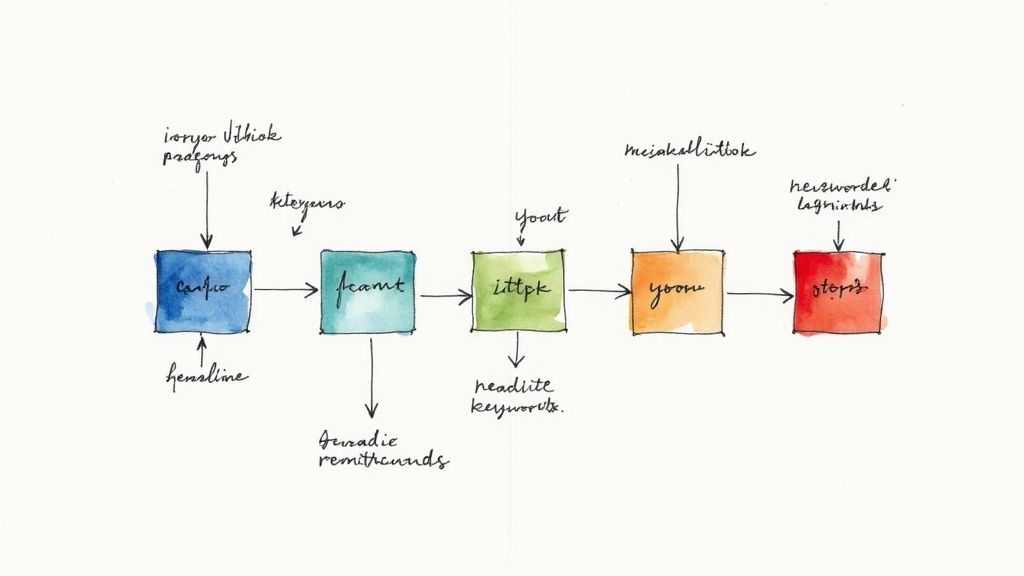
When you write a press release, you're really wearing two hats: the publicist and the SEO strategist. Every single part of that document, from the headline down to your "About Us" section, is a chance to signal relevance to search engines. The real skill is weaving in your keywords so they feel like a natural part of the story, not a clumsy interruption.
This isn't about the old-school, spammy tactic of keyword stuffing. A modern search engine optimization press release is about creating something genuinely valuable for both people and algorithms through smart, strategic placement.
Your headline is everything. It's your one shot to grab a journalist's attention while also telling Google exactly what your news is about. From an SEO perspective, you’ll want to keep it under 70 characters so it doesn't get awkwardly truncated in search results.
Even more crucial is placing your primary keyword as close to the beginning as you can. It’s an immediate signal of what’s most important. For example, instead of a generic headline like, "Our Company Announces New AI-Powered Software," try something that packs a punch: "New AI-Powered Software Launched to Automate Small Business Accounting." See the difference?
A great example I've seen in the wild is from a real estate firm, Cogent Realty Advisors. They used the hyper-specific phrase “affordable office space near Penn Station” right in their headline. This simple move helped them land on Yahoo News and significantly boosted their search rankings for that exact term. It's a perfect illustration of how modern press release SEO works—it’s about natural language and hitting the right search intent.
With a strong headline in place, the body of your release is where you build out the story with supporting details and, just as importantly, secondary keywords. This is the perfect place to sprinkle in what we call Latent Semantic Indexing (LSI) keywords—basically, terms and phrases that are thematically related to your main topic.
If your primary keyword is "sustainable packaging solutions," your body copy should naturally include phrases like:
These related terms give search engines a richer, more complete picture of your news. Honing your skills in effective SEO copywriting is non-negotiable if you want to create content that search engines and humans both appreciate.
Finally, don't overlook your boilerplate. This "About Us" section is prime real estate for cementing your brand's authority. Make it a habit to consistently include your company name, location, and a clear description of what you do. This simple action helps search engines connect the dots between your brand and your news, strengthening your digital presence with every release you publish.
Images do more than just break up walls of text; they are potent SEO tools in their own right. Before you even think about uploading an image, give the file a descriptive name. Something generic like IMG_9876.jpg does you no favors. Change it to something like new-ai-software-dashboard.jpg.
And always, always fill out the alt text. This is the text that tells search engines what an image is about, opening up another avenue for discovery through image search. For that dashboard image, a good alt text would be: "A screenshot showing the dashboard of the new AI accounting software for small businesses." It’s a small step that makes your release more accessible and findable.
For more in-depth guidance on getting the structure and content just right, check out our guide on how to write a good press release.

Links are the lifeblood of the web. They're the pathways that guide both people and search engine crawlers from one place to another. When it comes to a press release, your links are far more than just decoration—they're strategic tools you can use to pass authority and drive real traffic to your most important pages.
This is where I see so many people go wrong. They'll cram a press release with a dozen keyword-stuffed links, which just looks spammy and can even get you penalized. The real secret is to be selective. Focus on value, not volume.
A good rule of thumb I always follow is to include just 2-3 high-value links within the body of a 400-word release. It’s all you need.
Not all links carry the same weight. Before you add a single one, you need to think: what page on my site will benefit most from this new "link juice"? What’s the single most important action I want a reader to take after they finish reading my news?
Your strategy should aim for a healthy mix of destinations.
This balanced approach stops you from funneling all the authority to one page. Instead, you're strategically strengthening the topical relevance of several key pages across your entire website.
Anchor text—the clickable words in a hyperlink—is a powerful signal to search engines about what the destination page is about. But this is another area where you have to be careful. Gone are the days of stuffing your anchor text with exact-match keywords. That’s a huge red flag now.
A natural, safe anchor text profile uses a healthy variety.
An effective linking strategy signals relevance without being aggressive. It's about creating a natural user journey. A link should feel like a helpful signpost, not a blinking advertisement. By guiding readers to relevant content, you enhance their experience and build trust with search engines simultaneously.
Let's imagine you're announcing a new AI accounting tool. A good mix of anchor text might look something like this:
| Anchor Text Type | Example | Purpose |
|---|---|---|
| Branded | "Our company, ExampleTech..." | Strengthens brand association and identity. |
| Naked URL | "...available at www.exampletech.com/ai-tool." | Appears very natural and is a safe choice. |
| Partial-Match | "...more about our new accounting software." | Provides context without exact-match stuffing. |
| Topic-Based | "...explore our complete suite of business tools." | Broadens topical authority for related services. |
This variety looks organic to search engines and helps protect your site from potential penalties.
For those who want to really get this right, our guide on how to build backlinks naturally offers more advanced tactics for building a strong, sustainable link profile. When you're thoughtful with your links, your press release transforms from a simple announcement into a powerful asset for boosting your website’s overall authority.
You’ve crafted the perfect press release, hit all the right SEO notes, and it’s ready to go. But here's the hard truth: a brilliant press release is useless if no one sees it. The distribution service you choose is the critical next step, and it’s what separates a release that builds real authority from one that just gets lost in the noise.
The market for these services is incredibly crowded, with everything from free platforms to high-end premium distributors. I've seen countless businesses get lured in by the promise of "free," but it's almost always a dead end for SEO. These services typically push your release out to a network of low-authority sites that Google and other search engines have learned to ignore. You get what you pay for, and in this case, it’s not much.
If you want your search engine optimization press release to actually move the needle, it has to land on high-authority news outlets. This is where paid services earn their keep. They’ve spent years building relationships with major news aggregators and media giants. When you pay for distribution, you're not just sending an email blast; you're buying access to a powerful network that can get your news onto platforms like Yahoo News, AP News, and other domains that search engines trust.
The real value of a paid distribution service is its ability to secure placements that generate high-quality brand mentions and backlinks. These are the powerful signals that tell Google your brand is credible and newsworthy, which directly boosts your domain authority and search rankings over time.
This is a real-world example of the kind of results you can expect from a properly executed paid distribution campaign. The SEO benefits are tangible.
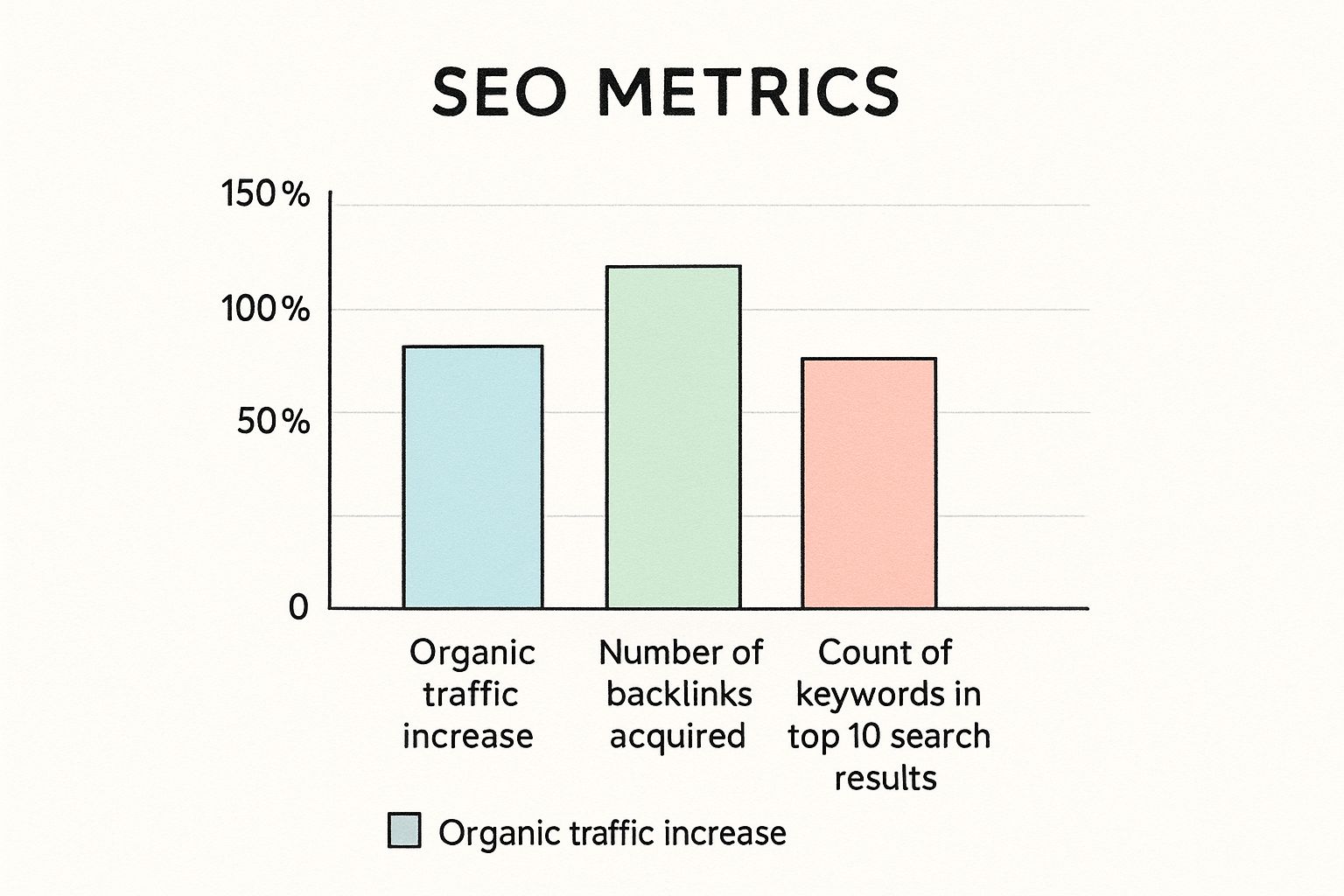
As you can see, a smart investment here can lead to noticeable jumps in organic traffic, new backlinks, and better keyword rankings. It's about turning an announcement into an asset.
When you're comparing different distribution services, it's helpful to think in terms of tiers. Not all paid services are created equal, and understanding what you get at different price points will help you set realistic expectations for your SEO results.
| Service Tier | Typical Reach & Features | Expected SEO Value |
|---|---|---|
| Budget/Basic | ~50-100 sites, mostly smaller blogs and regional news affiliates. No major outlets. | Minimal. Might generate some brand mentions, but the backlinks are often low-quality or no-follow. Limited direct SEO impact. |
| Mid-Range | ~200-300 sites, including guaranteed inclusion in Google News and some recognizable outlets like Yahoo Finance or MarketWatch. | Moderate. You'll get some valuable backlinks and strong brand signals. Good for building foundational authority and visibility. |
| Premium/Top-Tier | ~400+ sites, including top-tier national outlets, AP News, and major industry publications. Often includes editorial proofreading. | Significant. Secures high-authority backlinks and widespread brand exposure. This is the tier that can directly influence rankings for competitive keywords. |
Choosing the right tier really depends on your goals and budget. For a major product launch, a premium service is often worth the investment. For a smaller company update, a mid-range service can provide a solid boost without breaking the bank.
When you’re ready to evaluate services, look past the big promises on their homepage. Focus on the features that actually deliver SEO value. I always use a quick checklist to make sure a service is worth the money.
Here's what I recommend looking for:
I know making the right choice can feel overwhelming. If you need a more in-depth look at the top players, our comparison of the best press release distribution services breaks down the pros and cons of each.
Ultimately, picking a service that aligns with your SEO goals is the final, crucial step in turning your press release from a simple announcement into a powerful authority-building tool.
Just because your press release is live doesn’t mean the job is done. Far from it. Now comes the part where you prove it was all worth it: measuring the impact.
Without tracking the right things, you’re flying blind. You need hard data to show the ROI of your work, justify the budget, and figure out how to make your next release even more successful. Let's move past the fluff metrics like "potential audience reach." A big number looks nice on a report, but it tells you nothing about real SEO value. We need to focus on tangible results that show how your press release actually moved the needle.
So, what should you really be tracking? The only numbers that matter are the ones that directly connect your press release to a boost in your organic search presence and site authority.
Here are the core KPIs I always keep on my radar:
A huge mistake I see people make is giving up on the analysis too early. The SEO benefits of a great press release don't happen overnight. It can take several weeks for Google to crawl new backlinks and for ranking changes to stabilize. Be patient and track these KPIs for at least 30 to 60 days.
You can't measure what you can't see. Using the right tools is non-negotiable for gathering accurate data. The good news is you probably already have what you need in your existing SEO toolkit.
Here’s a quick look at a solid monitoring stack:
| Tool | Primary Use Case for Press Release Tracking |
|---|---|
| Ahrefs or Semrush | Your go-to for finding new referring domains and precisely tracking fluctuations in your keyword rankings. |
| Google Analytics 4 | The definitive source for measuring referral traffic and identifying which news sites sent the most valuable visitors. |
| Google Alerts | A simple, free way to catch mentions of your brand or news online that didn't include a link (a perfect outreach opportunity). |
Beyond direct traffic, you can get even more sophisticated. Using tools for a marketing funnel page score analysis can uncover deeper insights into how your release influenced user behavior further down the line. By piecing together the data from these different sources, you can build a complete picture of your press release's performance and prove its true SEO value.
It’s natural to have questions when you’re diving into the world of SEO and press releases. The rules of the game have definitely changed over the years, so what worked back then might not fly today. Let's clear up some of the most common things people ask so you can move forward with a solid plan.
One of the first things people wonder about is timing. Does it really matter when you send out a press release? You bet it does. If you can tie your announcement to a trending topic, an industry conference, or even a relevant holiday, you give it an immediate boost. It makes your news feel fresh and gives journalists a reason to pay attention right now.
Then there's the question of length. This isn't the place for a long-winded blog post. Think of a press release as a quick, factual heads-up. We've found the sweet spot is usually between 300 and 400 words. That’s enough to get the point across without overwhelming a busy journalist, and it’s a good length for search engines to digest quickly.
Yes, they absolutely do, but how they help has evolved. Forget about the old-school tactic of stuffing keywords into a release and blasting it everywhere. Today, the real SEO power comes from generating high-quality brand mentions, driving actual people (referral traffic) back to your site, and—most importantly—earning legitimate backlinks when credible news sites pick up your story.
These are the signals that tell search engines your website has authority, which is a massive piece of the ranking puzzle.
There's a reason SEO is still a cornerstone of any smart marketing strategy. Organic search results pull in around 94% of all clicks. And with about 75% of people never clicking past the first page, you have to rank well to be seen. You can dig into more numbers like these by exploring detailed SEO statistics on AIOSEO.com.
This is the million-dollar question. Backlinks are never a guarantee, but you can stack the deck in your favor. It all comes down to one thing: having a story that’s genuinely newsworthy. Journalists are hunting for compelling narratives, not just another corporate announcement.
If you want to increase your chances of getting those coveted links, you need to give them something they can’t ignore.
When a news outlet runs with your story and links back to your website as the original source, that’s a huge vote of confidence in the eyes of Google. You're not just distributing a release; you're earning media coverage by providing real value. That’s the core of a press release strategy that works today.
Ready to make headlines? With Press Ranger, our AI-powered platform makes it easy to find journalists, draft compelling pitches, and distribute your press release to top-tier publications. Stop guessing and start getting the press your business deserves. Get started with Press Ranger today!
Learn how to write a press release that attracts attention. Our guide on how to write a press release helps you craft effective, newsworthy announcements.

The future of PR isn't just about being seen by humans—it's about being referenced by AI.

What is media relations? Learn how building authentic media relationships can boost your brand's credibility, improve SEO, and drive sustainable growth.